Hours, daily cost, penalties, exemptions and the ULEZ link, plus what the traffic figures and the wider evidence on congestion pricing show.
The London congestion charge is a daily fee on most vehicles driven in central London, weekdays 7:00 am to 6:00 pm and weekends 12:00 noon to 6:00 pm. It began in 2003, was 15 pounds in 2025 and rose to 18 pounds from 2 January 2026. Traffic volumes fell 10% after launch.
Traffic in central London fell by 10% when the congestion charge arrived. Yet the speed of the traffic that remains has kept sliding ever since, and Transport for London (TfL) has its own explanation for why. That tension is the best way into the story of the London congestion charge, the scheme that became the best-known example of road pricing in a major city.
London congestion charge hours and how the scheme operates
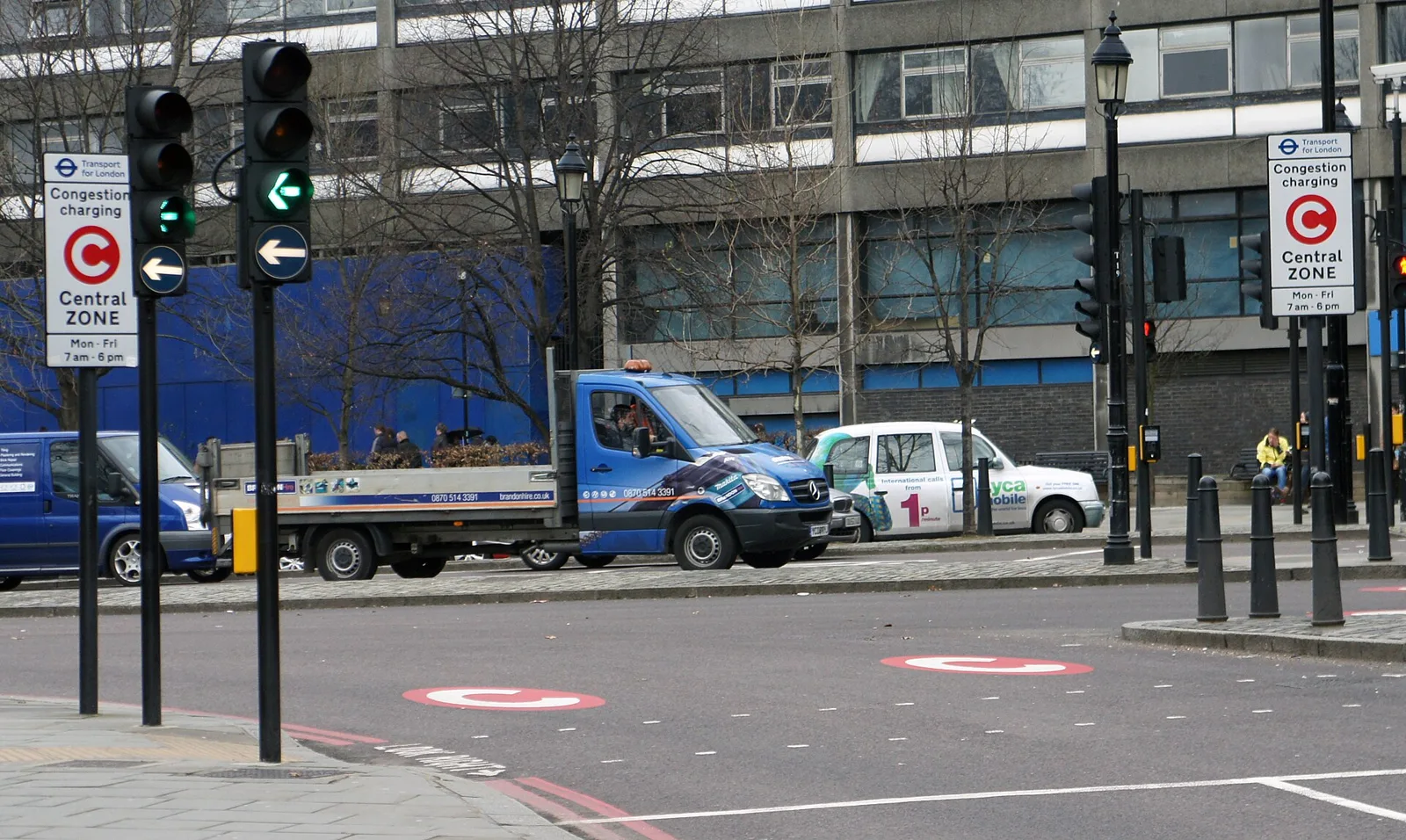
The charge is a daily fee on most cars and other motor vehicles driven inside the Congestion Charge Zone (CCZ) in central London. It applies from 7:00 am to 6:00 pm Monday to Friday, and from 12:00 noon to 6:00 pm on Saturday and Sunday. Bank holidays follow the weekend pattern. The only days when it is switched off run from 25 December to 1 January inclusive.
Nobody stands at a barrier. Cameras read number plates, and automatic number-plate recognition (ANPR) is the main enforcement tool. If your plate is seen inside the zone and no payment is attached to it, the system generates a penalty.
The scheme began on 17 February 2003. London officials had travelled to Singapore, seen its Electronic Road Pricing at work and brought the idea home. The goals were stated plainly: fewer vehicles in the centre, cleaner air, less noise, and money to spend on the capital's transport network. TfL runs the scheme, and IBM has operated it since 2009.
Traffic fell by a tenth, yet the traffic that remains has kept getting slower.
Where the zone sits
The zone covers everything inside the London Inner Ring Road. That takes in the City of London, the main financial district, and the West End, the city's commercial and entertainment heart. It is primarily a commercial area, but 136,000 people live there, out of a Greater London population of almost 9,000,000. There is little heavy industry.
The northern edge runs along Pentonville Road and the Euston Road, while the southern limit passes through Elephant and Castle and along Tower Bridge Road. Park Lane and Edgware Road mark the west, with Old Street, City Road and Commercial Street closing the east. Signs and symbols painted on the road tell drivers they are crossing the line.
For a few years the zone was bigger. A Western Extension opened in February 2007 and was removed on 4 January 2011, with the Westway itself always outside it. Mayor Boris Johnson took it out as part of a package that also lifted the basic charge to 10 pounds and brought in an automated payment system.
Congestion charge cost: the daily rate and the penalties
As of 2025 the standard charge was 15 pounds a day. You can pay in advance, or by midnight on the day of travel, or register for Fleet Auto Pay or CC Autopay. Autopay counts the charging days a vehicle has used each month and bills a debit or credit card at the end of it. Leave payment until the third day after your trip and the price becomes 17.50 pounds.
After that the penalty notices begin. From June 2020 the Penalty Charge Notice was 160 pounds, halved to 80 pounds if paid within 14 days and raised to 240 pounds if still unpaid after 28 days. A penalty of between 65 and 195 pounds is quoted for 2025, so the exact figure depends on the date and is worth checking.
From 2 January 2026 the standard charge rose to 18 pounds, with annual increases in line with public transport fares and the removal of some exemptions.
The price has moved in steps before. In January 2013 TfL opened a consultation on lifting the standard charge by 15%, from 10 pounds a day to 11.50 pounds by mid 2014. It expected the change to bring in 84 million pounds more by the end of 2017/18, and said the aim was to recoup three years of inflation while keeping the charge an effective deterrent to unnecessary journeys. Ken Livingstone had also proposed a structure based on CO2 emissions, but Johnson announced in July 2008 that it would not go ahead.
The scheme has also been interrupted. It was suspended on 7 and 8 July 2005 after the terrorist attacks on London Transport, and again on 2 February 2009 in heavy snow. After a pause during the COVID-19 pandemic, charging was re-implemented on 15 May 2020.
Congestion charge exemptions and discounts
Residents who live in or very close to the zone get a 90% discount, collected through CC Autopay. People who pay monthly or annually in advance can claim refunds if their plans change. Reimbursement is available to NHS patients judged too ill to use public transport, to NHS staff driving on official business and to care home employees. Wheelchair-accessible taxis and private hire vehicles are exempt. Until April 2019 every private hire vehicle was.
Until 2021 the list was longer. Low-emission cars met the Euro 5 standard at 75 g/km of CO2 or less and paid nothing, and so did vehicles with nine or more seats, motorcycles, mopeds and breakdown and recovery vehicles.
The car side of that list is a story of a loophole being closed. The old Greener Vehicle Discount mostly helped small diesel engines that emitted under 100 g/km of CO2. TfL proposed ending it in November 2012, Johnson approved the change in April 2013, and the Ultra Low Emission Discount (ULED) took over on 1 July 2013. Free entry shrank to all-electric cars, some plug-in hybrids, and any car or van at 75 g/km or less that also passed Euro 5. When it started, no vehicle with only an internal combustion engine met those terms. The measure was meant to curb the growing number of diesels on London's roads.
About 20,000 owners had registered for the old discount by June 2013. They were given a three-year sunset period, which ended on 24 June 2016. In December 2018 a further tightening was announced, partly to go beyond the ULEZ. From April 2019 only vehicles that were Euro 6, emitted up to 75 g/km and could cover at least 20 miles (32 km) with zero emissions qualified. A later phase, from October 2021, was to leave only zero-emission vehicles, meaning pure electric and hydrogen fuel cell, with the discount phased out completely from December 2025.
Electric cars are the latest to lose their free pass. They and eligible plug-in hybrids qualified for a 100% discount until 2026, when they began paying the full charge, with 25% off if they are registered for autopay. A plug-in electric car qualified if the DVLA listed its fuel type as electric, or if it was a plug-in hybrid on the government's OLEV grant list. The dates on which each class of plug-in lost its discount have varied, and the exemption is described as applying only to pure electric vehicles from 2021, so check TfL's current list for the date that applies.
From the T-Charge to the ULEZ
London's air quality rules grew out of the same zone. The toxicity charge, or T-Charge, began on 23 October 2017 and ran during the congestion charge hours. Older cars and vans that missed the Euro 4 standard paid an extra 10 pounds on top of the daily fee. These were typically petrol and diesel vehicles registered before 2006, and the levy affected up to 10,000 of them.
Mayor Sadiq Khan announced the scheme on 17 February 2017, after January brought record air pollution and the city's first-ever high pollution alert. Cold, still weather had failed to clear pollutants emitted mainly by diesel vehicles. By December 2017 TfL said the T-Charge had cut the number of non-compliant vehicles by around 1,000 a day. About 2,000 were paying, with a further 3,000 eligible for discounts such as the Blue Badge.
On 8 April 2019 the Ultra Low Emission Zone (ULEZ) replaced it. The ULEZ uses a different logic: it runs 24 hours a day, every day except Christmas Day. It originally covered the same area as the CCZ and charged 12.50 pounds for cars, vans and motorcycles, but 100 pounds for lorries, buses and coaches. Petrol vehicles must reach Euro 4 and diesels Euro 6, or VI for heavy ones.
The ULEZ is credited with a 20% reduction in emissions, and the number of non-compliant vehicles entering the zone each day dropped from 35,578 to 23,054. The zone reached the North and South Circular roads in October 2021, then the whole of Greater London from 29 August 2023.
Where the money goes
Gross revenue reached about 2.6 billion pounds in the first ten years, up to the end of December 2013. Between 2003 and 2013 roughly 1.2 billion pounds went into public transport, road and bridge improvements and walking and cycling schemes, including 960 million pounds on the bus network.
Critics read the gap differently. Because only 1.2 billion pounds was invested, they argue, 54% of gross revenue went on running and administering the system. Enforcement is a big part of that: penalty charges made up between 42% and 48% of total revenues, even after prices rose.
Compliance has improved, though. Income from penalties fell by about a quarter between 2005 and 2007. The 2008 annual report found that around 26% of penalties went unpaid, because the notice was cancelled on appeal or the money could not be recovered, for example when the registered keeper could not be traced, had died or was bankrupt.
Evasion has become more inventive. Newspapers have reported copied number plates being used to dodge the charge, which leaves the real owners with penalty notices for journeys their cars never made. Plates known to be copied are held in a database that triggers alerts, including to police ANPR vehicles.
Diplomats have been another sore point. After pressure from the Mayor, 99 of 128 embassies had agreed to pay by 2008. Germany, Japan, Russia and the United States declined, and by 2015 they collectively owed 95 million pounds.
Does congestion pricing work? What happened to London's traffic
The headline numbers are good. Traffic volumes dropped 10% from baseline conditions after the charge was introduced, and vehicle kilometres in London fell by 11% overall between 2000 and 2012. The careful reading is that this does not prove the charge was the cause.
The speed picture is less flattering. Traffic has been getting progressively slower, particularly in central London. TfL says the likeliest reason is a deliberate shrinking of road capacity to improve the urban environment, increase road safety and give priority to buses, pedestrians and cyclists, plus a rise in roadworks by utilities and developers since 2006.
In 2006 TfL concluded that congestion in central London was close to its level before the charge. Its argument was that the scheme's success in cutting traffic meant conditions would have been worse without it. Later studies stress that causality has not been established.
How other cities charge
| City | Start | How it charges |
|---|---|---|
| Singapore | 1975, upgraded 1998 | Fee each time a vehicle crosses the cordon; rates set by traffic conditions at each pricing point and reviewed quarterly |
| Rome | 2001 | Similar pricing scheme |
| London | 2003 | One daily fee however many times the vehicle crosses the boundary |
| Stockholm | 2006 seven-month trial, then permanent | Fee per crossing, with a cap on the maximum daily tax |
| Milan | Ecopass from January 2008; Area C from 16 January 2012 | Area C is 5 euros whatever the vehicle emits; residents get 40 free entries a year, then 2 euros |
| Gothenburg | January 2013 | Modelled on Stockholm |
The economics behind road pricing
Congestion pricing is older than any of these schemes and wider than roads. It means charging more for a public good at the times or places when demand outstrips supply, and it is already routine for telephones, electricity, metros and railways, and for airport slots and canal passage. On roads it is one of several demand-side answers to traffic, as opposed to building more capacity.
The reasoning rests on externalities. A driver entering a packed street imposes delay on everyone else but pays nothing for it. At a price of zero, economists say, demand exceeds supply, so the shortage should be corrected by setting a price rather than by adding lanes. A charge makes drivers weigh the costs they impose on each other, and it nudges some to travel at another time, by another route or on public transport.
Some regard the Nobel laureate William Vickrey as the idea's father, since he proposed distance- or time-based fares for the New York City Subway in 1952. Maurice Allais extended the theory to roads, and Gabriel Roth was instrumental in the first designs and in the World Bank recommendation that led to Singapore's system. Britain considered it in the Smeed Report of 1964, but successive governments rejected its recommendations.
Road schemes come in two main types. Cordon or area pricing draws a boundary around a dense area and charges vehicles that cross it. Lane or facility pricing charges for one stretch of road or one bridge. The charge itself can be fixed, variable, with higher rates set in advance for busy periods, or dynamic, changing with actual conditions.
Singapore shows how far dynamic pricing can go. Its Land Transport Authority reports that electronic road pricing has been effective in holding expressways to 45 to 65 km/h and arterial roads to 20 to 30 km/h. A pilot with IBM between December 2006 and April 2007 tested a tool called TrEPS that predicts congestion up to an hour ahead. In 2021 the authority required motorists to swap their old readers for satellite navigation (GNSS) units, which allows smaller gantries. The pricing stays cordon-based, even though distance-based charging is now technically possible.
The reported benefits of such schemes include less traffic congestion, less pollution, less asthma and higher home values. They have also sparked criticism and political discontent. Economists broadly agree that charging for crowded roads and using the proceeds to lower other taxes leaves citizens better off on average. They disagree about setting the tolls, covering shared costs, spending surplus revenue, compensating the losers on roads that used to be free, and whether highways should be privatised.
What this means for drivers in central London
For a weekday trip the practical rules are short. Know the hours, remember that the charge is per day and not per entry, and pay on the day or sign up for autopay. Pay late and the 17.50 pounds rate applies; leave it longer and the penalty ladder begins. A car that fails Euro 4 for petrol or Euro 6 for diesel also faces the ULEZ charge, which now covers Greater London and runs around the clock. Electric cars pay the full rate less 25% on autopay.
Where this goes next
The standard charge is set to keep rising each year in line with public transport fares, with some exemptions removed along the way. Elsewhere the model keeps spreading. Singapore, Stockholm, Gothenburg, Milan and New York City all charge drivers, and Durham in England does too. Before the pandemic the idea was also on the table in Washington, D.C., San Francisco and Boston, and Bangkok, Cambridge, Edinburgh, Switzerland and Hong Kong have all piloted or proposed schemes. Growing awareness of pollution and greenhouse gas emissions has recently added to the interest.