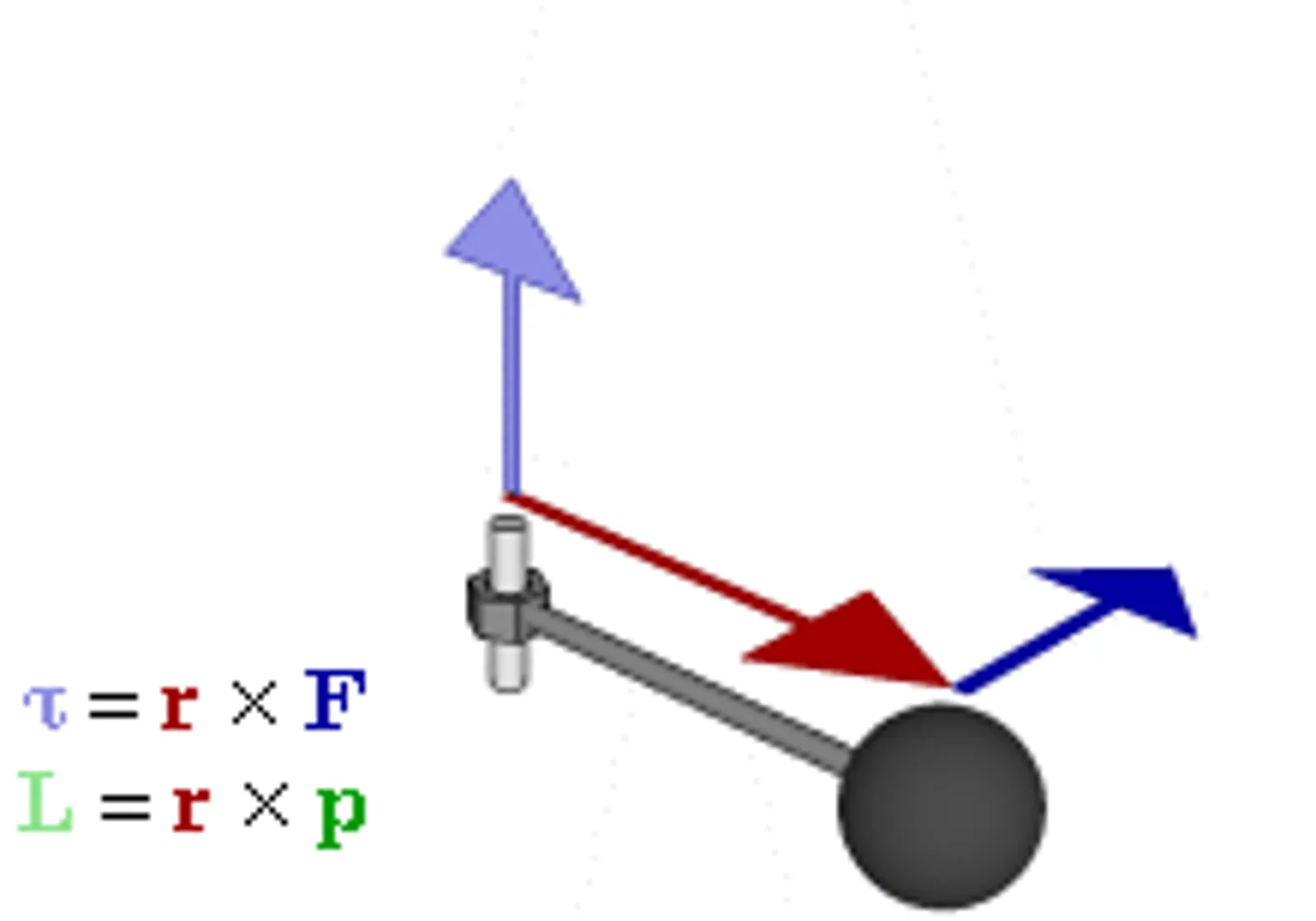
Torque is a twist, horsepower is the rate at which that twist does work, and a dynamometer measures one to calculate the other.
Torque is a twisting force and horsepower is the rate at which work is done. They are linked by rotational speed: power equals torque multiplied by engine speed, with a constant that depends on the units. A dynamometer measures torque and rpm, then calculates power from them.
When engineers modified a dynamometer in 2023 to test a real horse, it measured 5.7 hp, a reminder that the unit is still anchored to the animal. Torque and horsepower sound alike but measure different things.
What is the difference between horsepower and torque?
Torque is a twist: the rotational counterpart of a push or pull. Horsepower is power: the rate at which work gets done. A spec sheet quotes both because an engine can twist hard without doing work quickly, and the link between them is rotational speed. Power is torque multiplied by how fast the shaft turns.
That one relationship answers most spec-sheet puzzles. Two engines can twist equally hard and still differ in power if one spins faster. And an engine that makes its twist at low revs may feel strong even with a modest power figure.
Torque is the twist; horsepower is how quickly the twist keeps coming.
What is torque?
Torque is the rotational equivalent of force. Where a linear force pushes or pulls a body, a torque twists it about an axis. Another name is moment of force, often shortened to moment. A screwdriver turning a screw is the textbook picture: the handle applies torque, and the screw tends to rotate around its own axis.
You can work it out by multiplying a force applied at right angles to a lever by the length of that lever. A longer spanner turns the same bolt with less push, which is why the lever arm sits inside the definition. The SI unit is the newton-metre.
The word is not ancient. Torque comes from the Latin torquere, meaning to twist, and James Thomson is credited with proposing it. It appeared in print in April 1884, and Silvanus P. Thompson used it the same year in Dynamo-Electric Machinery. Engineers in the UK and US often say moment of force, shortened to moment, a usage traceable to at least 1811.
What is horsepower, and where did it come from?
Horsepower is a unit of power, the rate at which work is done, and is usually applied to engines and motors. James Watt, the Scottish engineer, adopted it in the late eighteenth century as a way of setting steam engines against the draft horses they could replace. It was later extended to piston engines, turbines and electric motors.
The idea had a commercial purpose. In 1702 Thomas Savery had already written of an engine that could raise as much water as two horses. Watt used the comparison to sell his steam engine, partly because his royalty scheme, a third of the coal saved against older Newcomen engines, did not work for customers who had no engine and kept horses instead.
Watt worked from a horse walking a mill wheel round 144 times an hour, the wheel having a radius of 3.7 m (12 feet), and put the horse's pull at 800 N (180 pounds-force). That worked out at 32,572 ft lb per minute. Other estimates ran from 22,916 (John Smeaton) to 44,000 (John Desaguliers). Watt then found by experiment in 1782 that a brewery horse could produce 32,400, and he and Matthew Boulton fixed the unit at 33,000 ft lb per minute the following year.
A popular legend says a brewer demanded an engine to match his strongest horse, driven to its limit, and that Watt built a machine stronger still. Real horses vary. In 1993 Nature carried a report by R. D. Stevenson and R. J. Wassersug that put the peak at as much as 14.88 hp (11.10 kW) over a few seconds, while about 1 hp (0.75 kW) fits sustained work. In 2023, the dynamometer test gave 5.7 hp (4.3 kW).
People make a useful yardstick too. A healthy person can briefly reach about 1.2 hp (0.89 kW) and hold about 0.1 hp (0.07 kW) indefinitely, while trained athletes can briefly manage as much as 2.5 hp (2 kW). Usain Bolt reached 3.5 hp (2.6 kW) 0.89 seconds into his 9.58-second 100 m world record in 2009.
How are torque and horsepower connected?
Power is torque multiplied by rotational speed, scaled by a constant that changes with the units. In imperial units, horsepower is torque in pound-feet times engine speed in rpm, divided by 5252. The constant is the rounded result of 33,000 ft lbf per minute divided by 2 pi radians per revolution, which is Watt's figure translated into rotation.
Two things follow from the arithmetic. First, at 5252 rpm, torque in pound-feet and power in horsepower come out as the same number, which is why the two curves cross there on a chart drawn in those units. Second, for any given power, an engine turning more slowly must be producing more torque. That is the arithmetic behind engines that deliver their effort low in the rev range.
If torque is measured in inch-pounds, the constant becomes 63,025, but the logic is identical.
What is the difference between hp, bhp and PS?
| Unit | Also written | Value |
|---|---|---|
| Imperial horsepower | hp, bhp | About 745.7 W |
| Metric horsepower | PS, cv, ch, KM | About 735.5 W |
| Electric horsepower | hpE | Exactly 746 W |
| Boiler horsepower | - | 9809.5 or 9811 W, depending on the year |
| Kilowatt | kW | The SI unit that replaced PS in EEC directives in 1972 |
The metric horsepower is defined by the German standard DIN 66036 as the power needed to raise a mass of 75 kilograms against gravity over one metre in one second. That equals 735.49875 W, or 98.6% of an imperial horsepower, so a figure quoted in PS is slightly smaller than the same number in hp. Abbreviations such as PS, KM, cv, hk, pk and ch all stand for metric horsepower, from the German Pferdestaerke to the French cheval-vapeur.
British manufacturers often intermix metric and mechanical horsepower depending on where an engine comes from, which is worth remembering when comparing brochures. Most countries now use the watt, and since 1 January 2010 the EU Directive 80/181/EEC has allowed horsepower only as a supplementary unit. France once had its own revolutionary-era unit, the poncelet, based on 100 kgf m/s.
Two other uses of the word are not engine power at all. Tax horsepower is a non-linear rating used for taxation, originally tied closely to engine displacement, and since 2000 many countries have moved to systems based on CO2 emissions. The Citroen 2CV is named for its French fiscal rating of deux chevaux. Electric motor nameplates, meanwhile, show shaft output rather than electrical input.
How is horsepower measured on a dyno?
A dynamometer, or dyno, measures torque and rotational speed at the same time, so power can be calculated and displayed as kW or bhp. Power is not measured directly. The dyno multiplies the two readings and applies the unit constant, then plots the result against engine speed.
Most dynos use an absorbing unit, which acts as a load driven by the engine under test and turns the power it absorbs into heat. Some are regenerative: the engine drives a DC motor as a generator, and the excess power can even be fed back into the grid. A motoring dynamometer works the other way round, driving the equipment under test.
There are two main test methods. In a constant-force test, the absorber applies a set braking torque, set slightly below the engine's output so the engine can accelerate through the rev range while power is calculated from speed times torque. In a constant-speed test, a speed regulator varies the braking torque to hold the engine at one chosen speed. Inertia dynamometers are different again: they calculate power solely from the energy needed to accelerate a roller of known mass and provide no variable load.
How is torque measured on a dyno?
The usual method mounts the dyno housing so it is free to turn except for a torque arm. A weighing scale reads the force the housing exerts, and torque is that force multiplied by the length of the arm from the dyno's centre. A load cell can replace the scale to give an electrical signal proportional to torque.
Another method joins the engine to the dyno through a coupling that senses torque, a transducer, which also produces an electrical signal proportional to torque. With electrical absorbers, torque can be inferred from the current drawn or generated, but that is generally less accurate and not much practised now.
What is the difference between an engine dyno and a chassis dyno?
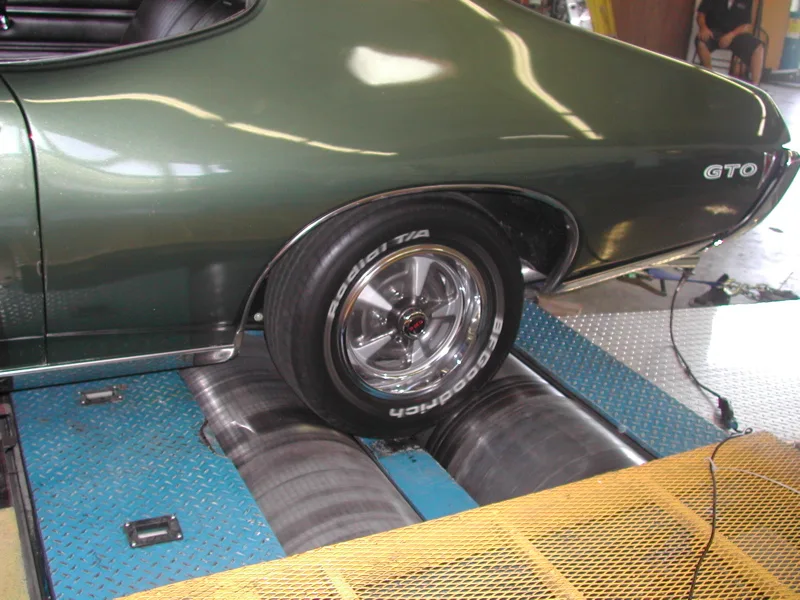
An engine dyno is coupled directly to the engine. A chassis dyno measures the torque and power delivered by the whole drivetrain at the drive wheels, without removing the engine from the car. Chassis dynos also serve in emissions test cycles, such as those the US Environmental Protection Agency defines, to simulate road loading.
The absorber type varies. Eddy current units are currently the most common on modern chassis dynos because they change load quickly; most are air cooled and use cast iron discs similar to brake rotors. Powder dynos create great torque but are typically limited to lower rpm because of heat. Hysteresis brakes give largely constant torque over the whole speed range, and hysteresis and eddy current designs are the most useful in small dynos of 200 hp (150 kW) and less.
Others have limits of their own. A fan brake is inherently limited in the torque it can absorb because air has such low viscosity. Electric motor and generator dynos can both absorb and drive an engine, so they can measure friction and pumping losses, though they are generally more costly and complex. An oil shear brake stays smooth right down to zero rpm.