Full synthetic is a marketing term. What actually separates the oils, what the grade measures and what decides when an oil has done its job.
Mineral oil comes from refined crude oil, while synthetic base stocks are man-made with predictable properties. Full synthetic is a marketing term, not a measurable quality. Synthetics cost substantially more per volume and are credited with extended drain intervals, but all oil wears out as viscosity and reserve alkalinity fall.
The words "full synthetic" on a bottle describe no measurable quality at all. Mobil sued Castrol, Castrol showed that its Group III base oil had been changed enough to qualify, and the American Petroleum Institute then dropped every reference to synthetic from its standards documentation. The label tells you less than the argument over it suggests.
What does engine oil actually do?
Motor oil is a base oil plus additives. The additives include antiwear agents, detergents, dispersants and, in multi-grade oils, viscosity index improvers; a non-detergent oil is nothing more than the base stock. Its main job is to reduce friction and wear between moving parts. Where metal slides on metal, friction wastes power by turning movement into heat and wears the surfaces away. Proper lubrication cuts fuel consumption and wasted power and adds to an engine's life.
It does a good deal more. Detergents lift varnish and dispersants hold sludge in suspension. The oil neutralises acids that come from the fuel and from its own oxidation, improves the seal between piston rings and cylinder walls, and carries heat away from moving parts. It also coats the metal so oxygen cannot reach it, which keeps rust and corrosion at bay. Soot from combustion is trapped in the oil instead of being left on internal surfaces, and that is partly why used oil turns black.
Where engine oil came from
John Ellis founded the Continuous Oil Refining Company on 6 September 1866. He had been studying crude oil for possible healing powers, found no real medicinal value, and turned instead to its lubricating potential. Steam engines of the day ran on clumsy mixtures of petroleum with animal and vegetable fats, and Ellis set out to build an all-petroleum, high-viscosity lubricant. His breakthrough was an oil that worked at high temperatures, which meant fewer stuck valves and corroded cylinders.
Where the oil goes
An engine-driven pump, either a vane or a gear type, draws oil from the sump and pushes it through the filter into galleries that feed the main bearings, the camshaft bearings and, through passages in the crankshaft, the connecting rod bearings. In modern designs more passages carry it up the connecting rods to the contact between the piston rings and the cylinder wall. From there it falls back into the pan. Some engines also spray oil from a nozzle onto the pistons to cool parts under high strain.
Think of it as a thin, constantly moving cushion between surfaces that would otherwise grind. Small engines such as lawn mower units manage with dippers on the connecting rods that splash oil around the crankcase, and total-loss oiling remains popular in small and miniature engines, but passenger cars use a recirculating pump. The filter exists because wear produces microscopic metal particles that could circulate and grind against the very parts they came from.
Heat is a constant test. In a petrol engine the top piston ring can expose the oil to 160 degrees Celsius (320 Fahrenheit), and in a diesel to more than 315 degrees Celsius (600 Fahrenheit). Oils with a higher viscosity index thin less at these temperatures. The pool of oil also takes longer to reach its designed temperature range than the engine's water-based coolant, and until it does it cannot protect the engine fully under high load. That is why some older engines, and most high-performance or racing engines, carry an oil thermometer.
Run an engine without adequate oil and wear comes first. In extreme cases the engine seizes, stopping suddenly with extensive damage to its mechanisms.
Unless the maker specifies it, a thicker oil is not necessarily a better one.
Synthetic vs conventional oil: what is in the bottle
Most motor oils start from a heavier, thicker petroleum base stock derived from crude oil, in which the bulk of the molecules have between 18 and 34 carbon atoms. Base oils may be petroleum hydrocarbons, polyalphaolefins (PAOs) or a mixture, sometimes with up to 20 percent by weight of esters to help the additives dissolve.
Mineral base oils are untidy mixtures of hydrocarbons and paraffins found in nature. Synthetic base stocks are man-made, tailored to a controlled molecular structure so that their behaviour is predictable. Even so, the raw material for most synthetics is overwhelmingly crude oil, which is distilled and then reworked by physical and chemical means. The exact process and the additive formula are generally commercial trade secrets and vary among producers.
| Type | What it is | Notes |
|---|---|---|
| Mineral | Refined petroleum base stock, a complex mixture of naturally occurring hydrocarbons | Substantially cheaper per volume than synthetics |
| Semi-synthetic (synthetic blend) | A mixture of mineral and synthetic oil | Aims for many of the benefits of full synthetic without the cost; Motul introduced the first in 1966 |
| Full synthetic, Group III or IV | Group III or Group IV base stock, or a mix of the two | "Full synthetic" is a marketing term; Group III is sometimes called fully synthetic but is classed as a top-level mineral stock |
| Group IV (PAO) | Polyalphaolefin, a 100 percent synthetic compound | The base stock behind most synthetic lubricants |
| Group V | Anything that is neither mineral nor PAO | Esters are the best-known example |
Semi-synthetics sit in the middle. A lubricant with a synthetic base stock content even lower than 30 percent but high-performance ester additives can also be considered synthetic, and customs authorities use the ratio of synthetic base stock to set commodity codes for tax.
Is synthetic oil worth the extra?
The listed advantages of synthetic motor oils are better viscosity performance at both low and high temperatures, a higher viscosity index, and chemical and shear stability. Less of it is lost to evaporation. It resists oxidation, thermal breakdown and sludge, and it allows extended drain intervals, which means less used oil waste. It provides better lubrication in extreme cold.
Synthetic oils are also credited with longer engine life and better protection against ash and deposits in hot spots, particularly in turbochargers and superchargers, along with less oil burn-off and a lower chance of clogged oil passageways. Less internal drag is said to produce a net increase in horsepower and torque, and fleet tests have documented fuel efficiency improvements of 1.8 percent to 5 percent.
The disadvantages are cost and chemistry. Synthetics cost substantially more per volume than mineral oils, and in certain chemical environments they can decompose, a problem seen mainly in industry. Synthetic lubricants make up about 4 percent of the lubricants market overall.
Some uses leave no choice: aircraft jet engines require synthetic oils, while aircraft piston engines get by without them. Synthetics also appear in metal stamping, where they are called non-oil or oil free, and in pendulum clocks.
What do oil viscosity grades mean?
Viscosity is a measure of a liquid's thickness, its resistance to flow. Syrup has a higher viscosity than water. For an engine the viscosity must be high enough to keep a film between moving parts and low enough for the oil to flow around the engine under all conditions. The viscosity index measures how much that thickness changes as temperature changes, and a higher index means less change.
Cold matters at start-up, because the oil must flow well enough at the lowest expected temperature to limit metal-to-metal contact. The pour point was the original yardstick. Today the cold-cranking simulator and the mini-rotary viscometer are the properties required in oil specifications, and they define the Society of Automotive Engineers classifications.
Viscosity is not fixed. In general it depends on a fluid's temperature, pressure and rate of deformation, which is why a single oil has to behave well on a cold start and again at the top ring. Refiners also shape the oil before it reaches the bottle: fractional distillation separates a motor oil fraction from the rest of the crude and strips out the more volatile components, which raises the flash point and lowers the oil's tendency to burn.
Why thicker is not better
Unless the manufacturer says otherwise, a thick oil is not automatically the better one. Heavy oils cling for longer between two moving surfaces and wear out sooner than a lighter oil that flows freely and lets fresh oil take its place. Makers have varying requirements and their own designations. The EPA requires the viscosity grade used in the fuel economy test to be the one recommended to customers, an exclusive recommendation that ended the old charts matching climate temperature to oil grade, even though a different grade can perform better in some environments.
Other numbers on the data sheet
The flash point is the lowest temperature at which oil gives off vapours that can ignite, and a high one is desirable. Total base number measures reserve alkalinity, the oil's ability to neutralise acids, while total acid number measures acidity. The Noack test checks how much oil evaporates away in hot running: up to 14 percent loss is allowed to meet the API SL and ILSAC GF-3 specifications, and some manufacturers' specifications require less than 10 percent.
How long does engine oil last?
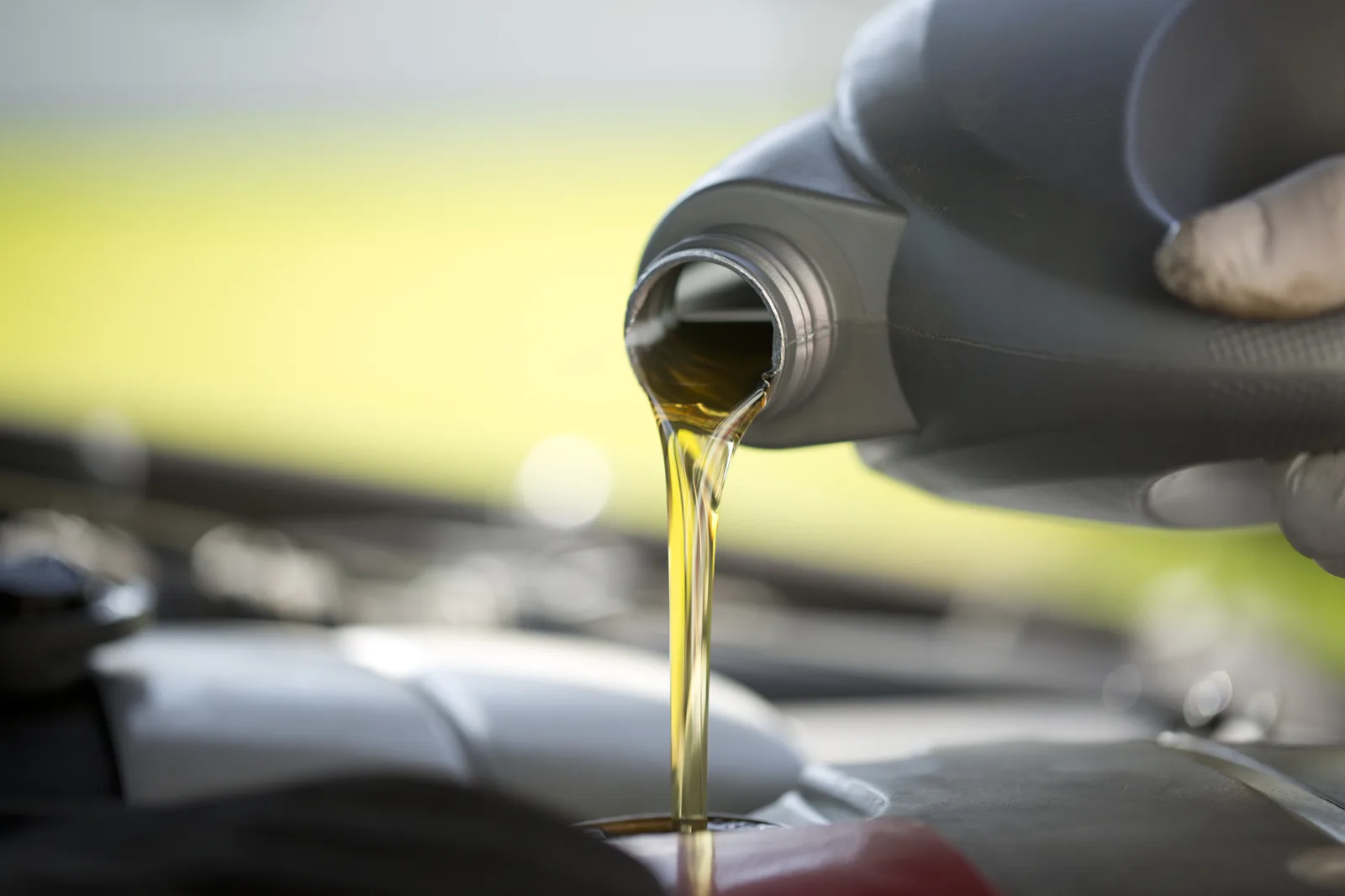
The oil and its filter need periodic replacement. An oil change means draining the old oil into a pan, fitting a new filter and adding fresh oil, a job many owners do themselves. The used oil has to be recycled in most localities.
Three things wear the oil out. Microscopic soot and metal particles build up, and the filter removes many of them but can clog if used for extremely long periods. The oil and especially its additives suffer thermal and mechanical degradation. And that degradation lowers both viscosity and reserve alkalinity.
Lower viscosity means the oil lubricates less capably, so wear rises and so does the chance of overheating. Reserve alkalinity is what lets the oil resist acid formation. Let it fall to zero and acids appear and eat into the engine. Synthetic oils, with their resistance to oxidation and thermal breakdown, are the ones credited with extended drain intervals.
Beyond the car
Two-stroke engines in chainsaws, blowers and similar gear have the oil mixed into the fuel, in fuel-to-oil ratios such as 25:1, 40:1 or 50:1, and the oil burns, adding to emissions. Non-smoking two-stroke oils, often esters or polyglycols, cut visible emissions, and European environmental rules in particular have pushed leisure marine users toward ester-based types. Generators and walk-behind lawn mowers use four-stroke engines and standard motor oils.
Where this goes next
Newer two-stroke outboards and some personal watercraft use direct injection, which removes the need to blend oil into the fuel, at the cost of separate oil maintenance. Synthetic oils continue to be promoted for longer drain intervals and less used oil waste, and European environmental rules keep pushing two-stroke oils toward esters.