Where a car's fuel energy goes, which driving habits shave it, and where efficient driving becomes unlawful or dangerous.
Eco-driving cuts fuel use through correct tyre pressure, less weight, steady cruising speeds usually reported at 35-50 mph (56-80 km/h), smooth acceleration, anticipation and avoiding idling. Combining many techniques is called hypermiling, whose more radical forms can be unlawful and dangerous.
With one person aboard, only about 0.5% of the energy a car uses goes into moving that person. The other 99.5%, roughly 200 times more, moves the car itself. Everything in efficient driving follows from that lopsided sum.
The techniques for cutting fuel use run from the plain, such as correct tyre pressure and less idling, to the extreme. Using several together has a name, hypermiling, and a few of its more radical forms are unlawful and dangerous. Each habit comes with figures, and each has limits on what a driver can change.
Where does the fuel energy in a car actually go?
Most of the loss happens inside the engine, as heat. Take a car averaging 60 km/h (37 mph): roughly a third of the fuel's energy leaves in the exhaust, nearly another third is carried away by the cooling system, and engine friction takes about 11%. Rolling friction in the tyres accounts for 11%, and air drag and braking for 5% each.
A car that is idling goes nowhere, which is why switching the engine off at a stop raises efficiency. And because as much as 95% of the efficiency ceiling at city speeds is fixed by how the vehicle is built, the driver is working with the remainder. That remainder is still worth having: changes to driving practice and to the vehicle can lift energy efficiency by about 15%, and many drivers have scope to improve a good deal.
With one person aboard, about 99.5% of the energy goes into moving the car itself.
What is eco-driving, and what is hypermiling?
Eco-driving is the everyday name for energy-efficient driving: keeping tyres properly inflated, keeping the vehicle well maintained, avoiding idling, using acceleration and deceleration with care, and above all limiting high speeds. Stack several of these together and you are hypermiling.
Anyone can do it, and fleet managers have turned it into a discipline. As part of fleet digitalisation, companies use telematics to monitor and manage fuel economy automatically. The systems collect data on fuel-wasting behaviour such as harsh acceleration, speeding and idling, and feed it into driver scoring apps that identify drivers and coach them. They are often paired with fuel-management systems built on high-precision fuel level sensors, which give exact consumption figures and help prevent fuel theft.
The ordinary techniques deliver savings without resorting to radical measures, which can be unlawful and dangerous. Tailgating larger vehicles is one such measure.
Which fuel efficient driving habits begin before you set off?
Maintenance comes first. Underinflated tyres wear out faster and waste energy as they deform, at a cost of about 1.0 percent for every 2 psi (0.1 bar; 10 kPa) of lost pressure across all four tyres. Poor wheel alignment and engine oil of high viscosity also take a toll.
Then there is weight and shape. Cutting the load of passengers, cargo, tools and equipment helps. On a typical vehicle, every extra 25 kg (55 lb) adds about 1 percent to fuel consumption. Stripping off roof racks, brush guards, wind deflectors, running boards and push bars lowers weight and drag together, and removing a roof rack and its accessories can lift efficiency by up to 20 percent. Narrower, lower-profile tyres reduce rolling resistance. Running with a tank only 50% to 75% full can help in town traffic, and some cars carry a half-size spare to save weight, cost and space.
| Habit | Figure attached to it |
|---|---|
| Keeping tyres inflated | About 1.0 percent lost for every 2 psi drop in all four tyres |
| Carrying less weight | About 1 percent more fuel for each extra 25 kg (55 lb) |
| Removing a roof rack | Efficiency up by as much as 20 percent |
| Cruising at a steady 35-50 mph (56-80 km/h) | Usually reported as the optimum range, varying by vehicle |
| Cutting air conditioning | Up to 5 hp (3.7 kW) of extra power avoided |
| Regenerative braking in hybrids and electric cars | About 50% of energy recovered per braking event |
| Lower speed limits | Efficiency changes of 2 to 18 percent, depending on compliance |
What is the best speed for fuel economy?
A steady cruise in the highest gear is where a car does best. The ideal speed depends on the vehicle but is usually reported to sit between 35 and 50 mph (56 and 80 km/h). One 2004 Chevrolet Impala had its optimum at 42 mph (68 km/h) and stayed within 15 percent of that figure anywhere from 29 to 57 mph (47 to 92 km/h).
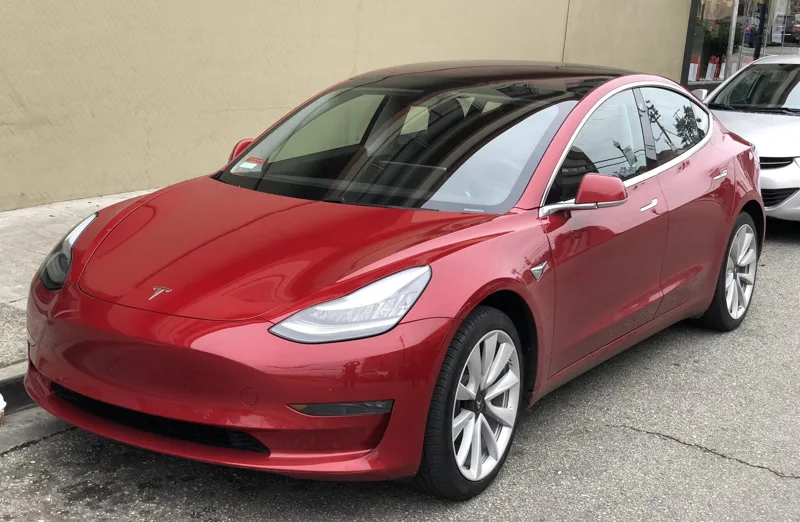
The drag on a car grows quickly with speed. At 60 km/h, air drag is only about 5% of the total energy loss, but above that wind resistance rises roughly with the square of speed and becomes the dominant factor at high speed. Hybrids generally do best below a model-dependent threshold speed, since the car switches by itself between battery power and engine power with recharging. Electric cars also reward low speeds: a Tesla Model S can go as far as 1,080 kilometres (670 mi) at 39 km/h (24 mph).
Traffic adds a second speed question. Studies show that roads in congestion move the most vehicles when speeds sit just above 45 mph (72 km/h). Drivers help their own economy, and everyone else's, by staying off roads and away from hours when traffic slows beneath that. Communities can adopt limits or policies to keep traffic from drifting under it, and congestion pricing rests on the same principle: road access costs more at busy times, which keeps cars out of traffic that would drag speeds below efficient levels. Research has found that mandated speed limits can be adjusted to improve efficiency by anywhere from 2 to 18 percent, depending on how well drivers comply.
How does gear choice affect fuel use?
An engine's efficiency changes with speed and load. At a steady speed there is a fixed amount of power to find, and a manual gearbox lets the driver choose where along the engine's range to find it. In a turbo diesel, too low a gear pushes the engine into high revs and low torque, where efficiency drops off sharply. Petrol engines lose efficiency faster than diesels because of throttling losses.
Cruising needs far less than full power, so the sweet spot is surprisingly low: around 1500 rpm for a petrol engine and 1200 rpm for a diesel, or even slightly below. That is why very tall overdrive gears suit motorway cruising. Holding 60 mph (97 km/h) may take a small car just 10-15 horsepower (7.5-11.2 kW). Its gearing probably has the engine turning about 2500 rpm at that speed, yet for peak efficiency the engine should turn at roughly 1500 rpm (petrol) or 1200 rpm (diesel), though actual figures vary by engine and vehicle.
How should you accelerate and brake to save fuel?
Efficiency during acceleration generally improves as revs rise toward a point near peak torque. Going faster than necessary without watching the road ahead can force braking, followed by yet more acceleration. A 2001 study recommended accelerating briskly but smoothly before changing up in a manual car.
The broader rule is simple: the less a driver accelerates and brakes, the better the economy. The efficient strategy is to read what lies ahead and maximise coasting. At high speeds there is less time to let a car slow naturally, and more kinetic energy is thrown away in braking. At medium speeds there is time to choose between accelerating, coasting and slowing. When approaching a red light, a driver can ease off early and let the car drift, giving the light time to turn green before arrival and sparing the energy of a full stop. Rush hour is inefficient and produces more toxic fumes because of stop-and-go traffic.
Ordinary brakes turn kinetic energy into heat that cannot be recovered. Hybrid and electric cars with regenerative braking win back about 50% of the car's energy every time they brake, which can mean perhaps a 20% cut in the energy cost of city driving.
Anticipation extends beyond lights. A driver who stops abruptly or turns without signalling limits what other drivers can do to save fuel, while giving other road users as much information as possible helps them cut consumption, and improves safety too.
Is coasting or pulse and glide worth trying?
Coasting means gliding without propulsion. The car spends stored energy, kinetic and gravitational, against air drag and rolling resistance, which it must overcome on any journey anyway, and that is more efficient than burning it off in the brakes. Coasting uphill also spends energy on the gradient, but that energy is not lost, because it becomes gravitational potential energy usable later.
There are catches. With the engine running and a manual car in neutral or with the clutch down, the engine still burns fuel to keep itself idling. Coasting out of gear is also prohibited by law in most US states, mostly on downhill stretches. Maine's statute bars an operator on a downgrade from coasting with the vehicle's gears in neutral. Not using the engine on a long, steep descent, or leaning on the brakes too much, might lead to failure from overheated brakes.
Pulse and glide is the more deliberate version. The driver accelerates to a chosen speed, the pulse or burn, then coasts down to a lower speed before repeating the sequence. Drivers have long found it saves fuel, and some experiments have confirmed that it does.
Does idling or stop-start save fuel?
Shutting the engine off beats leaving it to idle. Signals follow a pattern, so a driver can often tell when one will turn green, and some lights carry timers to help. Some cars handle this automatically with a start-stop system that switches the engine off and on during a halt.
Certain hybrids cannot shut the engine down while the car is in motion with the transmission engaged, yet they have an auto-stop feature that acts when the vehicle halts. Using it fully matters, because idling sends momentary fuel economy to zero miles per gallon, which drags down the running average.
What about air conditioning and fuel type?
Holding a given speed with the air conditioning on can call for as much as 5 hp (3.7 kW) of extra power, though the system cycles on and off or varies its output, so it rarely runs flat out all the time. Switching it off and opening the windows may avoid that loss but adds drag, so the saving can be smaller than people expect. Using the cabin heater slows the engine's climb to operating temperature, and until it gets there, a choke in a carburettor car from the 1970s or earlier, or the injection computer in a modern one, adds extra fuel to the mixture.
On octane, paying for high-octane petrol in a car that does not need it is usually seen as wasted money, although Toyota has recorded small efficiency differences between octane numbers even where knock is no concern. Every vehicle built in the United States since 1996 has OBD-II on-board diagnostics, and most models carry knock sensors that retard the timing when pinging is detected. A lower-octane fuel can therefore go into an engine designed for higher octane, at some cost in efficiency and performance. For an engine that is designed for high octane, the better fuel gives gains in both under certain load and mixture conditions.
Electric cars change the arithmetic. A battery-electric vehicle uses around 20 kWh per 100 km (equivalent to 3 miles per kWh), about four times less than a fossil fuel car. Another comparison puts electric cars at about 38 megajoules per 100 km against 142 megajoules for combustion cars, although the true primary energy use may be higher, depending on how the electricity is generated.
Where this goes next
The direction is toward measurement. Fleet telematics and fuel-management systems already monitor harsh acceleration, speeding, idling and exact consumption, and eco-driving is described as a major focus of modern fleet management. Beyond fleets, congestion pricing and speed policies target the same goal of keeping traffic at efficient speeds.