The first child seats were built to help parents see their kids, and today the rules, groups and anchors vary by country.
Rear-facing seats support a young child's head best and suit babies and toddlers, forward-facing seats follow, and boosters lift older children so the adult belt fits. Isofix anchors fit compatible seats to the car without the belt. Rules vary: most US states require rear-facing to at least 1 year.
The first child car seats, built in the early 1930s, were not meant to protect anyone: they lifted the child so the driving parent could keep an eye on them. Seats designed for safety arrived only in 1962.
How do rear-facing, forward-facing and booster seats differ?
A rear-facing seat holds the child with their back to the front of the car. A forward-facing seat points the same way as the driver. A booster seat is for older children and lifts them so that an ordinary adult seat belt sits where it should. Each suits a different size and age.
The European standard ECE R44/04 sorts seats into four groups, numbered 0 to 3, and many seats combine groups 1, 2 and 3. Groups 0 and 0+ cover babies, group 1 toddlers, group 2 small children and group 3 the booster stage.
Group 0 and 0+: the newborn stage
Group 0 seats come in two forms. Infant carriers lock the baby in a rear-facing, semi-recumbent position, secured by a standard adult seat belt, an Isofix fitting or both. Carrycots lay the baby flat and are held by both rear seat belts. Carrycots, also called infant car beds, are used for babies who cannot sit in a regular seat, such as premature infants or those with apnea.
Infant carriers resemble a bucket with a handle, and they are often called bucket seats. In a crash they press into the backrest of the car seat, so the outer shell takes the force of the impact. Typical ratings start at 4 pounds (1.8 kg) and top out at 35 pounds (16 kg). American infant seats today generally carry a baby to at least 30 pounds (14 kg) and 30 inches (76 cm); older ones ran out at 20 pounds (9.1 kg) and 26 inches (66 cm).
Group 0+ seats are normally held in place by an adult seat belt through a fixed chassis, and some models can be lifted out and used in a baby transport via an integral handle. They cover babies from birth, at 2 to 3 kg, up to 13 kg (29 lb).
Group 1: toddlers
A Group 1 seat is a permanent fixture, held by an adult seat belt, with a five-point harness holding the child. It suits children from 9 kg to 18 kg (20 lb to 40 lb), roughly 9 months to 4 years. Rear-facing is recommended and forward-facing is legal. Versions that face the rear are spreading, though they remain hard to find in many countries.
Group 2 and 3: the move to boosters
Group 2 seats are larger and use the car's adult belt to hold the child, for children of 15 kg to 25 kg (33 lb to 55 lb), roughly 4 to 6 years old. Group 3 seats are boosters, for 22 kg to 36 kg (48 lb to 76 lb), roughly 4 to 10 years and above if the child has not yet reached 36 kg.
Rear-facing seats are inherently safer than forward-facing ones for exactly that reason.
Child seat groups at a glance
| Group | Weight | Approximate age | Position |
|---|---|---|---|
| 0 | Birth to 10 kg (22 lb) | Birth to 15 months | Lying in a carrycot, or rear-facing in an infant carrier |
| 0+ | Birth (2 to 3 kg) to 13 kg (29 lb) | Birth to 15 months | Rear-facing |
| 1 | 9 to 18 kg (20 to 40 lb) | 9 months to 4 years | Rear-facing recommended; forward-facing legal |
| 2 | 15 to 25 kg (33 to 55 lb) | 4 to 6 years | Forward-facing or rear-facing |
| 3 | 22 to 36 kg (48 to 76 lb) | 4 to 10 years, and older if under 36 kg | Forward-facing, as a booster |
Why is a rear-facing child seat safer?
A rear-facing seat gives a child's head more support during a sudden deceleration, which is why these seats are deemed the safest. The advantage is largest in frontal crashes, which are the likeliest to cause severe injury or death. Rear-facing seats are inherently safer than forward-facing ones for exactly that reason.
Various countries and seat makers recommend that children stay rear-facing for as long as is physically possible, even though parents are sometimes eager to switch to a forward-facing seat because it seems more grown up.
Scandinavia shows what that looks like in practice. Children there sit rear-facing until around the age of four, and most Scandinavian countries require it up to at least that age. That habit is credited with helping Sweden post the lowest rate of child road deaths in international comparisons.
Convertible and three-in-one seats
Convertible seats cover several stages. Most change from rear-facing to forward-facing, and some become boosters. Many take 2.3 to 18 kg (5.1 to 39.7 lb) rear-facing. Rear-facing ceilings range from 9 to 23 kg (20 to 51 lb) and forward-facing ones from 9 to 40 kg (20 to 88 lb), which varies with the seat model, its maker and where it was made.
A five-point harness is considered safer than an overhead shield. Newborns are not well served by a convertible, because its lowest harness slots usually sit above their shoulders, though a seat with low slots can be used from birth. Three-in-one seats go from rear-facing baby seat to forward-facing seat to booster, and may use the LATCH system for fixing.
What do child car seat rules require?
Lawmakers in many places set an age, weight or height at which a child must ride in an approved seat. The detail varies widely. In the United States, laws differ by state, while in Europe the main framework is the ECE R44/04 grouping plus the newer i-Size rule. Canadian law is firm about restraint until age four.
American rear-facing laws vary. The legal floor is age 1 in most states and age 2 in many, and a growing number of states are adopting a 2-year minimum. Recommendations go further: rear-facing to at least age 2, or until the child exceeds the seat's rear-facing height and weight limits, whichever comes later. The American Academy of Pediatrics says age is beside the point and advises staying rear-facing until the convertible seat is outgrown. That point arrives when the child hits the seat's weight ceiling or the head comes within 25 mm (1 in) of the shell's upper edge.
A more permissive general rule lets children ride forward-facing once they pass their first birthday and 20 pounds (9 kg). Canada and some US states set a higher bar: a child must stay in a restraint until reaching age 4 and 40 pounds (18 kg), and only then may a booster take over. In the United States, a five-point harness is suggested over a booster for children under 4 or under 40 pounds (18 kg).
In Europe, the i-Size regulation took effect in July 2013. It applies to children under 15 months and provides for rear-facing travel up to 15 months, where the earlier EU rule advised 9 to 12 months.
When does a child need a booster seat?
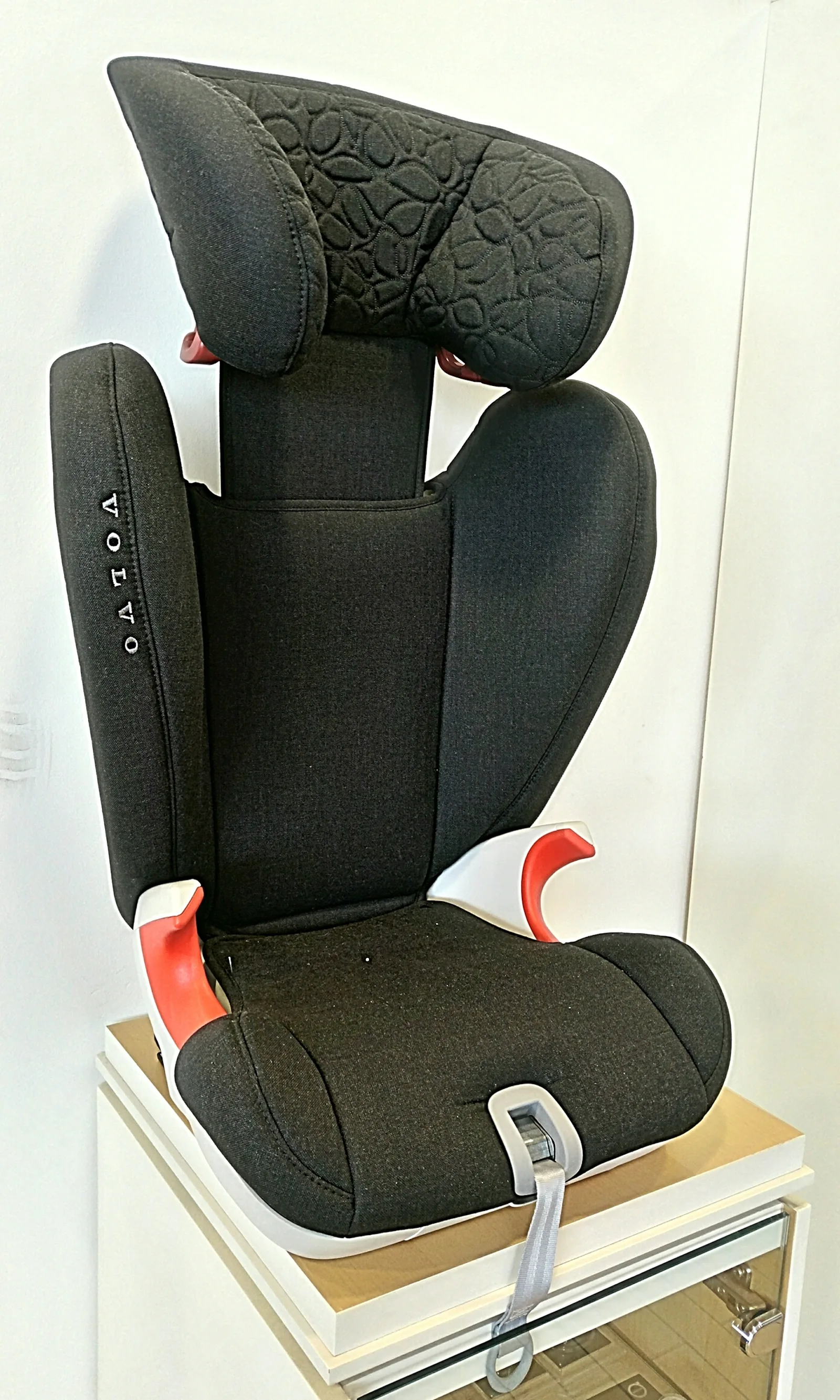
Boosters are recommended until a child is big enough to use the seat belt properly. Belts are engineered for adults and are too big for small children. A booster lifts the child so the sash crosses the collar bone and chest while the lap section sits on the hips.
Getting that position wrong has consequences. A belt sitting in the wrong place climbs onto the neck and stomach, and can cause internal injuries in a collision. The stakes make sense when you recall what the belt does: the US Centers for Disease Control and Prevention summarises the evidence as roughly a halving of serious crash injuries and deaths among belted occupants.
There are two main types of booster, high back and no back, and some high backs have energy absorbing foam. Newer boosters add rigid Isofix (Latch) connectors that lock onto the car's anchors, steadying the seat in a crash. Certain consumer groups want makers and retailers to drop backless boosters, saying side-impact protection is thin. Backless cushions are better than no child seat at all, but they do not give adequate protection in all circumstances.
What is Isofix and how does it work?
Isofix is the worldwide standard for where child seats attach inside a car. Instead of relying on the seat belt, a compliant seat clips to anchors built into the vehicle: a top tether plus a pair of fixings low down on either side of the seat. It was launched as an ISO standard in 1990 and is defined by ISO 13216.
The system goes by several names. In the United States it is LATCH, short for Lower Anchors and Tethers for CHildren. In Canada it is LUAS or Canfix, and another label is the Universal Child Safety Seat System. The centre-to-centre spacing of the anchors is 280 mm (11 in) in both Isofix and LATCH, and the design carries a maximum combined weight of seat and child of 33 kg (73 lb).
Europe versus America
The anchor points are the same idea, but the hardware differs. European seats clamp onto the lower anchors with a pair of alligator-style clips, while American seats typically use open-clip connectors. Isofix in the EU covers both Group 0/0+ and Group 1 seats. The European standard has three installation categories:
- Universal: the Isofix anchorage plus a top tether strap.
- Vehicle-specific: the Isofix anchorage alone, no tether, and only in listed vehicles.
- Semi-universal: the anchorage plus a foot-prop.
Which cars must have it
ISO 13216 part 1, covering the lower anchorage points, was published in 1999, and part 2, covering top tether anchorages, followed in December 2004. In the United States, the full set of anchor points was required in new cars from September 2002. Amendments to include Isofix in UN vehicle regulations 14 and 44 came into force in February 2004, and under the current UN/ECE R14, every new vehicle built from February 2013 onwards must carry Isofix lower anchors and top tether points.
Australia took its own path. The government legalised Isofix child seats on 19 September 2014; before that date their sale and use there was illegal.
Is a crashed or second-hand child seat still safe?
Like crash helmets, child restraints are certified for a single crash. If a seat is compromised in any way, owners are strongly advised to replace it, because nobody knows how a damaged restraint will perform in the next crash.
The US National Highway Traffic Safety Administration recommends replacement after a moderate or severe crash. Recent studies, it notes, show that restraints can withstand minor impacts with no documented loss of performance. It defines a minor crash as one in which all five of these hold:
- A visual inspection, including under any easily movable padding, shows no cracking over 2 inches.
- The vehicle could be driven from the scene.
- The door nearest the seat was undamaged.
- No vehicle occupant was injured.
- The airbags, if fitted, did not deploy.
Recalls happen too; the remedy may be a replacement part or a whole new seat. Buying a second-hand seat is not recommended.
Where this goes next
The weak point, according to research, is use rather than design: a lot of seats are fitted or used incorrectly. Health officials and child safety experts have responded with videos that teach correct installation to parents and caregivers.