A pickup that debuted in Mexico, an SUV benchmarked on the Model Y, a small SUV with two powertrains and a warship-named hybrid sedan.
The BYD Atto 2, Sealion 7, Shark 6 and Destroyer 05 are four newer BYD models: a subcompact SUV sold as an electric car and a plug-in hybrid, an electric mid-size SUV, a plug-in hybrid pickup that debuted in Mexico in 2024, and a compact DM-i hybrid sedan sold under several names.
BYD's first pickup, the Shark 6, did not debut in China. It made its world debut in Mexico in May 2024, the first time BYD had given a vehicle its global debut outside China, and it was not marketed in China at launch. That detail says a good deal about how the four models here fit together. The Atto 2, Sealion 7, Shark 6 and Destroyer 05 are all BYD models, but each one grew out of a different part of the company's range, and each travels under a different set of names depending on where you buy it.
What is the BYD Shark 6?
The Shark 6 is a mid-size plug-in hybrid pickup, and in some markets it is just the BYD Shark. It is the maker's first light utility vehicle. Underneath is a ladder-style body-on-frame chassis and a hybrid drivetrain BYD calls Dual Mode Off-Road, much like the one on the Denza B5. BYD builds it in China at its Super Intelligent Factory in Zhengzhou, Henan. A China launch is planned for 2026, with the truck wearing a Fangchengbao badge and the name Fangchengbao Shark.
BYD announced the name in April 2024, and the truck was shown in Mexico on 14 May 2024. It reached Brazil in October 2024 as part of the brand's wider Latin American plan, and Australians, who know it as the Shark 6, could order one from 29 October 2024.
How does the Shark's drivetrain work?
Originally every Shark had the same set-up. A 1.5-litre turbocharged petrol engine of 135 kW (181 hp; 184 PS) sits lengthways in the nose, and an electric motor drives each axle: 170 kW (228 hp; 231 PS) at the front and 150 kW (201 hp; 204 PS) at the rear. Together they give four-wheel drive and a combined 321 kW (430 hp; 436 PS), with 650 N-m (479 lb-ft) of torque. BYD says the arrangement is a world first for a range-extender hybrid with the engine mounted longitudinally.
The battery is a 29.58 kWh LFP Blade pack, fixed under the floor in a cell-to-chassis arrangement. BYD claims an electric-only range of 85 km on the WLTP cycle and 670 km combined, and the pack accepts DC fast charging at up to 55 kW.
BYD claims 5.7 seconds from 0-100 km/h and fuel use of 7.5 L/100 km (13.3 km/l; 31.4 mpg-US). The braked towing limit is 2,500 kg (5,510 lb), with a payload of 790 kg (1,740 lb) or 835 kg (1,840 lb) and 1,450 L (51 cu ft) of cargo volume. A Performance version, first released in Australia in April 2026, uses a 2.0-litre turbocharged petrol engine plus two motors for a combined 350 kW (469 hp; 476 PS) and 700 N-m (516 lb-ft). BYD claims 5.5 seconds to 100 km/h, and towing rises to 3,500 kg (7,716 lb).
Off-road hardware
Where most rivals in the mid-size class use leaf springs at the back, the Shark has coil-spring double-wishbone independent rear suspension. BYD claims 230 mm (9.1 in) of unladen ground clearance, a 31-degree approach angle, a 17-degree ramp-over angle and a 19-degree departure angle. The April 2026 Performance version also added a Crawl Mode that limits speed to 20 km/h (12 mph), and BYD plans to add it later to the Dynamic and Premium versions. The Dynamic is a cab chassis designed specifically for Australia, with an alloy tray that BYD developed together with the accessories specialist Ironman 4x4.
Inside, there is full synthetic leather trim, a 12.8-inch or 15.6-inch rotating touchscreen, a 10.25-inch digital instrument cluster and a 12-speaker audio system, although Latin American cars have a basic eight-speaker system.
Where the Shark 6 sells
South Africa's sales began on 4 April 2025 with a single Premium variant, and at the time it was the most powerful pickup sold there. A Performance version followed in July 2026. Other launches include Laos in late November 2024, the Philippines on 7 March 2025 in Advanced and Premium trims, Brunei on 21 June 2025, Pakistan on 25 July 2025 and Argentina on 17 April 2026. New Zealand has had the Premium AWD since October 2024, with the Dynamic cab-chassis and Performance added in April 2026. In Mexico it comes in GL and GS trims. In 2024 BYD exported 11,038 Sharks from China, and in March 2025 a Shark 6 took victory in the Frontera Aventura 2025 Rally in the Dominican Republic. BYD's 100,000th Australian sale, in April 2026, was a Shark 6 Premium.
BYD's first pickup made its world debut in Mexico, not China.
What is the BYD Sealion 7?
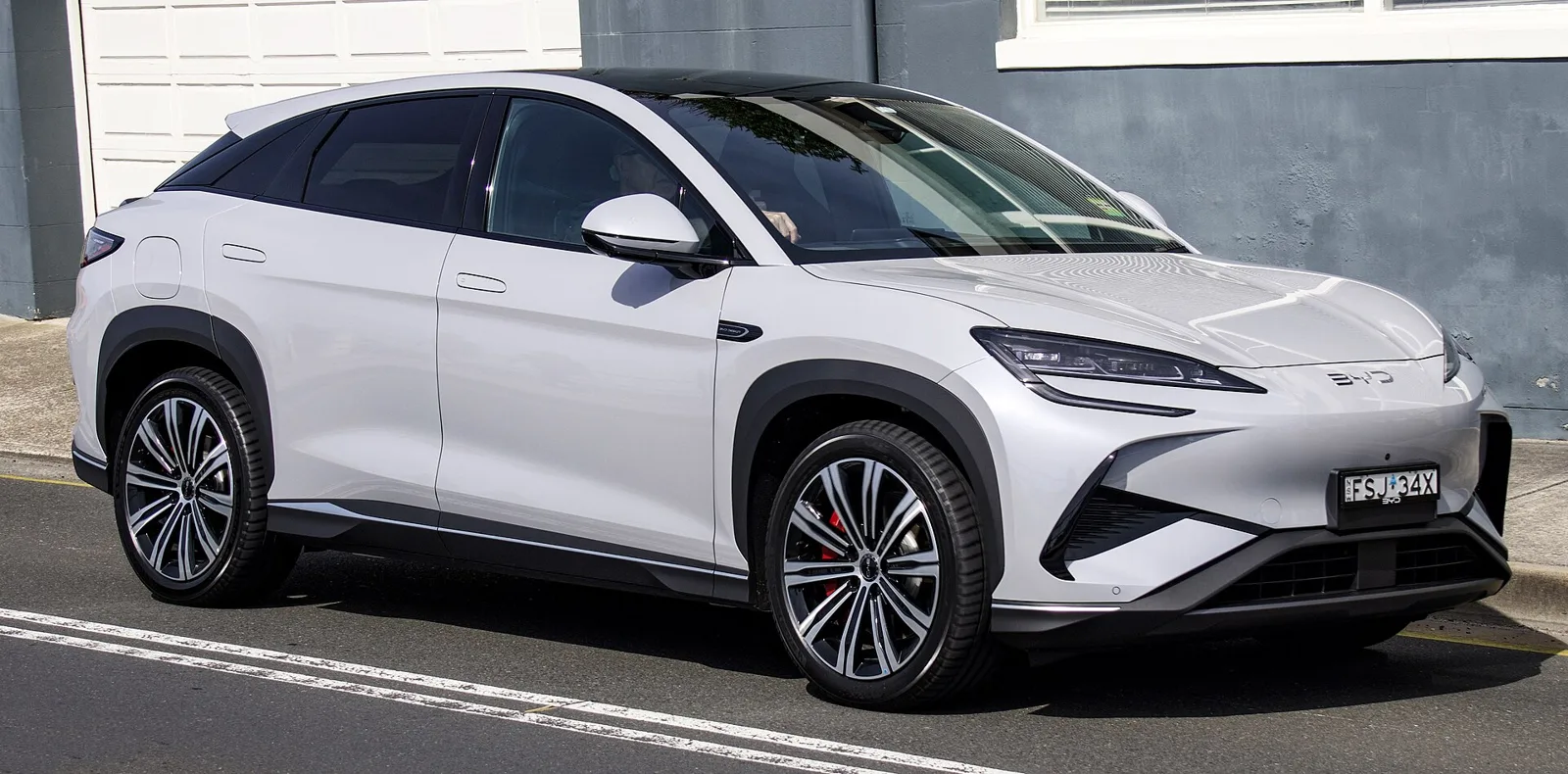
BYD Auto has built the Sealion 7 since 2024, a battery-electric mid-size SUV that carries the name Sealion 07 EV in China. It opens the Sealion family within the Ocean Series. BYD first showed it on 17 November 2023 at the Guangzhou Auto Show, launched it at the April 2024 Beijing Auto Show and began sales the next month. The engineers used the Tesla Model Y as the main benchmark. The Chinese market dropped the model from BYD's domestic line-up in 2026.
Design and technology
The styling follows BYD's Ocean Aesthetics. The nose has the Ocean Series X-face look, with U-shaped LED lamps and sculpted curves meant to suggest waves, the doors have flush handles and the roofline is rounded. At the back is a fastback with a subtle ducktail spoiler and a full-width water-drop LED light bar. The cabin has a 10.25-inch digital instrument panel, a 15.6-inch rotating touchscreen, twin wireless charging pads and a number of physical buttons. Boot space is 520 L (18 cu ft), rising to 1,789 L (63.2 cu ft) with the rear seats folded, and there is a 58 L (2.0 cu ft) frunk.
The Chinese-market car rides on the e-Platform 3.0 Evo. Its 12-in-1 electric drive system integrates more parts than the 8-in-1 unit on the earlier platform, and it allows motors to reach 23,000 rpm, a speed no earlier BYD motor has matched. Like the Seal, it uses BYD's cell-to-body construction. A new adaptive damping system, DiSus-C, senses the road and adjusts damper stiffness. The Sealion 07 EV was also the first BYD with the DiPilot 100 driver-assistance system, nicknamed God's Eye, fitted only in China and reportedly built around 12 ultrasonic sensors, five millimetre-wave radars and 11 all-round cameras. Extras include Nappa leather, a 50W wireless charger and a 50-inch augmented-reality head-up display.
Export versions and charging
Outside China the car is the Sealion 7. It rides on the older e-Platform 3.0 with 400V electrics, apart from the top European version with a 91.3 kWh battery, which uses the Evo platform and 800V architecture. Peak DC charging is 150 kW for the standard export car, 230 kW for that top European car and 240 kW for the Chinese car. In China the buyer chose between LFP Blade batteries of 71.8 kWh, charging at up to 180 kW, and 80.64 kWh, at up to 240 kW. Both take 25 minutes to go from 10 to 80%, and the car can also feed power back to the grid.
Hong Kong was the first major export market, with sales from 30 September 2024. Buyers there can pick a rear-drive model with 230 kW (308 hp; 313 PS) or an all-wheel-drive one with 390 kW (523 hp; 530 PS). Europe saw it at the Paris Motor Show on 14 October 2024. Malaysia followed on 14 November 2024, Thailand on 28 November 2024 and Singapore and Mexico on 13 January 2025, Mexico with a single 82.5 kWh variant. Australia launched it on 12 February 2025, Indonesia on 13 February, India on 17 February with deliveries from 7 March, and New Zealand on 19 February. South Africa got it on 4 April 2025 alongside the Shark 6 and Sealion 6, Brunei on 21 May 2025 and the Philippines on 28 May 2026.
Cheaper versions have since arrived. Singapore added an entry-level Dynamic with a 71.8 kWh battery and 100 kW (134 hp; 136 PS) in September 2025, a power level that fits Category A of the local Certificate of Entitlement system. Malaysia got a Dynamic RWD with the 91.3 kWh pack in July 2026 and India in August 2026. Thailand received an Ultimate AWD on 21 August 2026 carrying an upgraded 800V LFP Blade battery of 91.39 kWh, charging at up to 230 kW DC and offering as much as 600 km (373 mi) of range.
What is the BYD Atto 2?
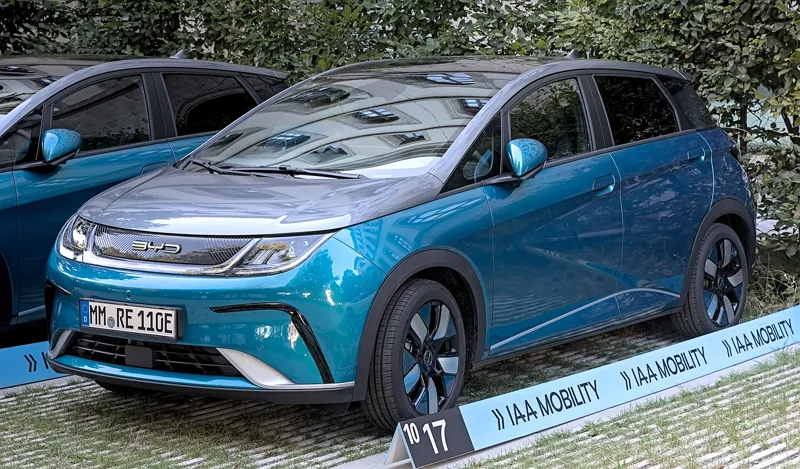
The Atto 2 is a subcompact B-segment SUV built by BYD Auto since 2024. In China it began as the battery-electric Yuan Up, part of the Yuan series named for the Yuan dynasty, introduced in February 2024, in production from March and launched on 26 March 2024 in three variants with 32 or 45.1 kWh batteries. It is based on the e-Platform 3.0 and uses the Blade LFP battery.
Export sales began in September 2024, in South America as the Yuan Pro, except Colombia, where it kept the Yuan Up name, and as the BYD S1 Pro in Costa Rica. Europe, Southeast Asia, Australia and New Zealand know it as the Atto 2. In October 2025 BYD added a plug-in hybrid called the Atto 2 DM-i. It is not sold in China, and it debuted in Europe before spreading to Latin America and South Africa.
Design
The Atto 2 uses the Dragon Face design concept from the Song L EV, with a dragon-face front, flap-type door handles, a floating roof and a full-width rear light bar, and the rear bumper echoes the front. Inside are a D-shaped steering wheel carrying the Yuan logo, an 8.8-inch instrument cluster, a 12.8-inch rotating touchscreen, perforated leatherette seats, a wireless charging pad and, on the centre console, a crystal gear selector above a row of physical buttons.
Europe and the United Kingdom
The Atto 2 was shown to Europeans in Brussels in January 2025, and it went on sale across the continent that February in Active and Boost trims, both with the 45.1 kWh battery and a WLTP range of 312 km (194 mi). The DM-i made its European debut in October 2025 at a Luxembourg fleet event, then was formally launched on 20 November 2025. The Active has a 7.8 kWh battery and a claimed 40 km (25 mi) of electric range, and the Boost has an 18 kWh pack and a claimed 90 km (56 mi). The DM-i is 20 mm (0.8 in) longer than the electric car at 4,330 mm (170.5 in), with a larger grille, a revised lower bumper, no vents in the front wings and a Midnight Blue paint option.
In Britain the price and specification were confirmed on 20 August 2025, with Boost deliveries from September. Boost has a 51.1 kWh battery and Comfort a 64.8 kWh pack, and Comfort charges at up to 155 kW compared with 82 kW for Boost. The DM-i could be ordered from June 2026, with first deliveries in August 2026.
Elsewhere
In Australia the Atto 2 went on sale on 13 November 2025 in Dynamic and Premium forms with a 51.3 kWh battery, and at launch no other battery-electric crossover SUV there cost less. The DM-i followed on 24 September 2026. South Africa received the DM-i first, on 11 June 2026, in Comfort and Dynamic trims with a 7.8 kWh battery, again the cheapest plug-in hybrid available there; an electric model with a 51.1 kWh battery came in September 2026. Brazil, selling the Yuan Pro EV since 5 September 2024, introduced the Atto 2 DM-i Flex on 9 June 2026, BYD's first ethanol flex-fuel plug-in hybrid, with 7.85 kWh and 18.03 kWh batteries in the GL and GS. Argentina, Colombia, Mexico, Malaysia, Singapore, Vietnam, Thailand, the Philippines and Brunei each have their own launch dates, running from Colombia's 30 July 2024 to Brunei's 29 July 2026.
What is the BYD Destroyer 05?
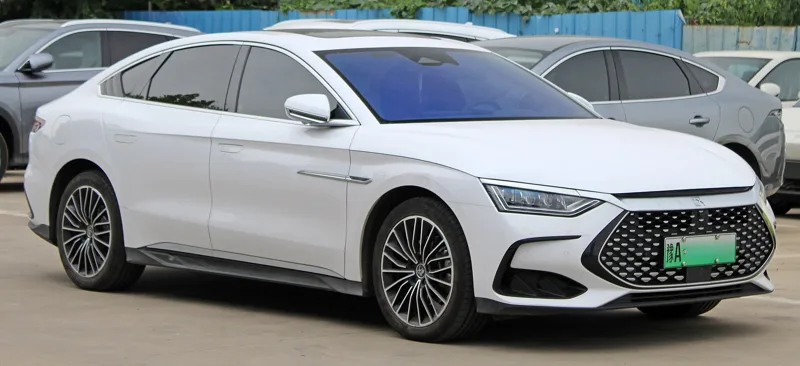
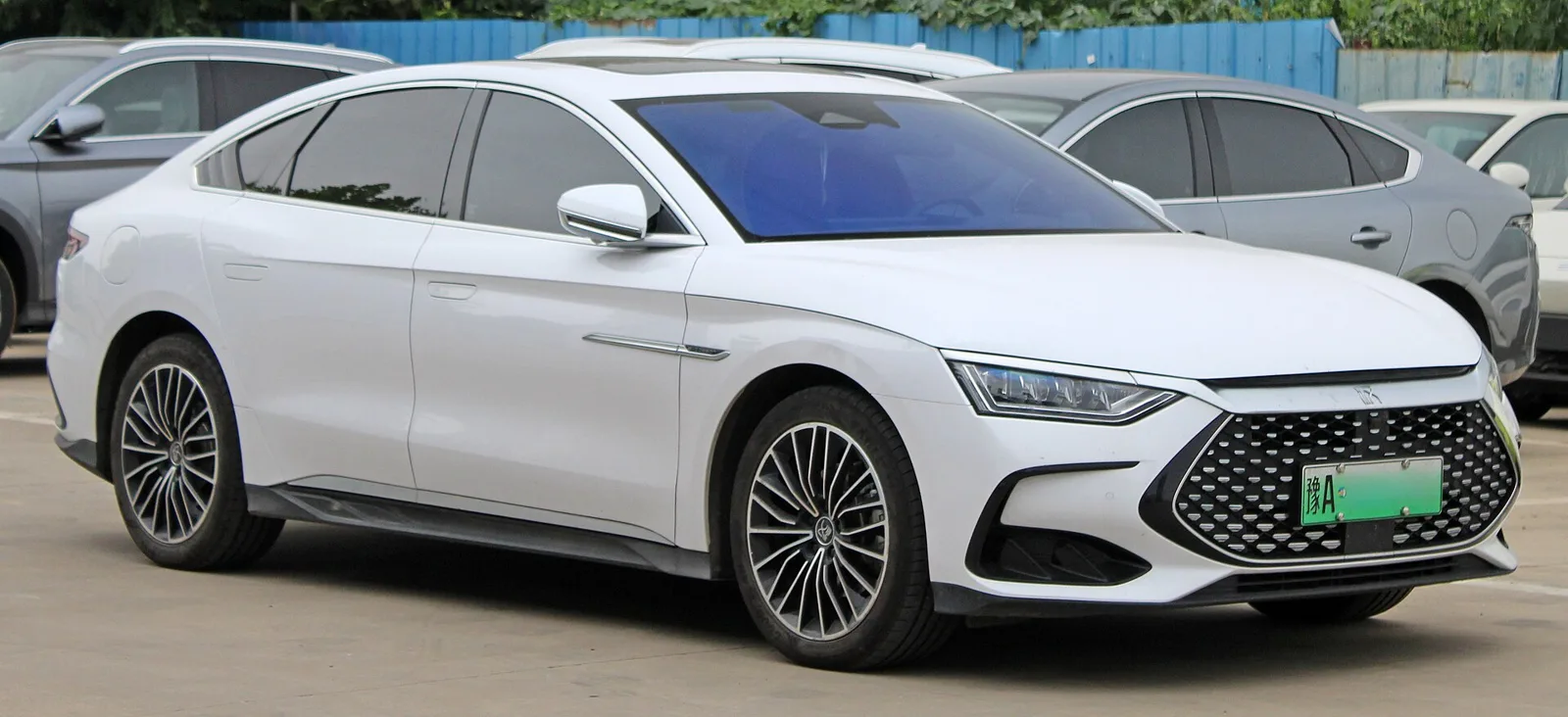
The Destroyer 05 is a compact sedan named after the destroyer class of warship. It was the first plug-in hybrid in the Ocean Series, using the DM-i 4.0 hybrid system. In Uzbekistan it is the BYD Chazor, in Latin America the BYD King, and in Southeast Asia the BYD Seal 5 DM-i. BYD unveiled it at the Guangzhou Auto Show in November 2021 and began China sales in March 2022 as the first model of the Warship Series, sold through Ocean Network dealers.
It is heavily based on the Qin Plus and Qin Pro of the Dynasty Series, sharing their body, wheelbase and height, with fully restyled front and rear ends. The cabin has an 8.8-inch instrument panel and a rotating touchscreen of 12.3 or 15.6 inches, plus the DiPilot driver-assistance system with active braking, lane keeping, adaptive cruise control and pedestrian recognition.
The DM-i system
A 1.5-litre petrol engine, rated at 81 kW (109 hp; 110 PS), combines with one or two electric motors, depending on trim, to give 132 kW (177 hp; 179 PS) or 145 kW (194 hp; 197 PS). The smaller of the two batteries gives 55 km (34 mi) of pure-electric range, and the larger up to 120 km (75 mi). BYD claims 3.8 litres per 100 kilometres (74 mpg-imp; 62 mpg-US), and a combined range beyond 1,200 km (750 mi). The 120 km version accepts 25 kW fast charging and goes from 30 to 80 percent in 25 minutes.
Markets
Mexico got it on 17 April 2024 with an 8.3 kWh pack, and it received a facelift on 17 July 2026 with 7.4 kWh and 24.5 kWh options. Brazil followed on 18 June 2024 as the King DM-i in GL (8.3 kWh) and GS (18.3 kWh) trims. The Philippines launched the Seal 5 DM-i on 21 November 2024. Thailand started on 8 August 2025 with 13 kWh and 18.3 kWh versions, Vietnam and Brunei in October 2025, and Argentina on 3 September 2026 with a 7.7 kWh battery. Uzbekistan had the Chazor DM-i from March 2023 as part of BYD's arrival there, in 55 km Comfort, 120 km Comfort and 120 km Flagship forms.
How do the four BYD models compare?
| Model | Body | Powertrain | Headline figure |
|---|---|---|---|
| Atto 2 | Subcompact SUV | Battery electric; DM-i plug-in hybrid from October 2025 | 312 km WLTP range in Europe (45.1 kWh) |
| Sealion 7 | Mid-size SUV | Battery electric | Up to 230 kW DC charging on the top European car |
| Shark 6 | Mid-size pickup | Plug-in hybrid | 321 kW combined; 2,500 kg braked towing |
| Destroyer 05 | Compact sedan | DM-i plug-in hybrid | Up to 120 km electric range; over 1,200 km combined |