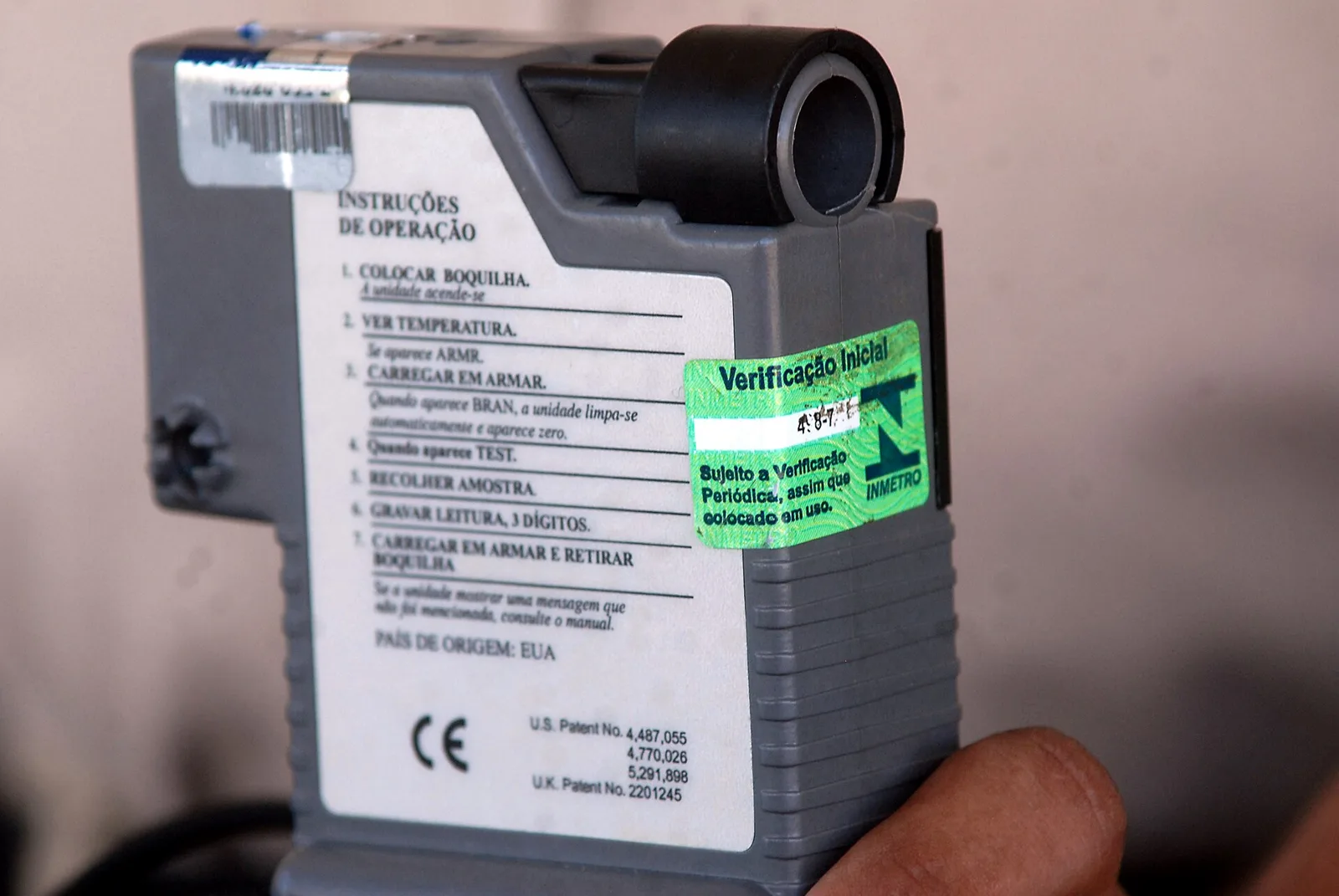
From a football bladder in a 1927 English court case to the fuel cell in a modern patrol kit, the devices and balance checks that decide whether a driver is over the limit.
A breathalyser measures alcohol in exhaled breath, most often with a fuel cell that turns ethanol into acetic acid and produces a current, and displays an estimate of blood alcohol. Field sobriety tests add three checks of eyes, balance and attention, which give officers grounds for a chemical test.
The device an officer holds to your mouth at the roadside does not measure the thing the law is written around. A breathalyser reads alcohol in breath, and the blood figure that decides a drink-driving charge is worked out from that reading. Between a football bladder filled with breath in an English court case in 1927 and a fuel cell in a modern patrol kit sits a long run of chemistry, a set of eye and balance checks devised by a California psychology researcher, and a surprising amount of argument about what any of it proves.
How does a breathalyzer work?
A breathalyser captures a sample of exhaled air and asks how much ethanol it holds. The result is reported as breath alcohol content, or BrAC, usually in milligrams of alcohol per litre of air breathed out.
Several different tricks can answer the question. The oldest are chemical: pass the breath through a liquid that changes colour when ethanol is present, and judge the shift with a beam of light. Infrared machines work differently. They fire a beam through the captured breath and watch which wavelengths vanish. Alcohols have an O-H bond that soaks up infrared strongly at a short wavelength, so the more light that fails to reach the detector on the far side, the higher the reading.
The type most associated with police work today is the electrochemical fuel cell. Think of it as a tiny, thirsty battery that runs on alcohol. When you blow into it, ethanol in the breath is oxidised to acetic acid at one electrode, and oxygen from the air is reduced to water at the other. Overall, ethanol and oxygen turn into acetic acid and water. That reaction produces an electric current, which a computer measures and displays as an estimate of blood alcohol content.
The word "estimate" matters. A breath analyser does not measure blood alcohol concentration directly, since that needs an actual blood sample. The link between what comes out of the lungs and what sits in the bloodstream is complex and shifts with several factors.
The breath machine does not measure blood alcohol. It estimates it.
From football bladders to fuel cells
The idea is older than the car as a mass product. In 1874 Francis Anstie noticed that small amounts of alcohol leave the body in breath. By 1927 Emil Bogen had gathered breath in a football bladder and found that 2 litres of exhaled air held slightly more alcohol than 1 cc of urine. The same year a Chicago chemist, William Duncan McNally, built a device in which breath passed through chemicals in water and changed their colour. One of the uses he suggested was for wives to check up on their husbands.
In December 1927, at Marlborough in England, a police surgeon named Gorsky asked a suspect to fill a football bladder. The 2 litres of breath contained 1.5 mg of ethanol, and Gorsky told the court the man was "50% drunk". Using drunkenness as the yardstick, rather than blood alcohol, may have undermined the analysis because tolerance varies between people, yet the episode shows the principle that every later device relies on.
The first practical roadside tool came in 1931. Rolla Neil Harger, at the Indiana University School of Medicine, built the drunkometer, which collected a driver's breath in a balloon inside the machine and pumped it through acidified potassium permanganate. The bigger the colour change, the more alcohol. Then in 1954 Robert Frank Borkenstein, an Indiana State Police captain who later became a professor, produced the instrument whose name went generic. His Breathalyzer used chemical oxidation and photometry and gave police a quick, portable way to judge intoxication from breath.
Britain added its own chapter in 1967, the year the Road Safety Act set the first legally enforceable alcohol limit for drivers and put the roadside breathalyser into police hands. Bill Ducie and Tom Parry Jones marketed the first electronic version and founded Lion Laboratories in Cardiff. Their crystal-tube Alcolyser was approved for police use in 1979 and won a Queen's Award for Technological Achievement in 1980. The Lion Intoximeter 3000 replaced it in 1983, and later models swapped crystals for a fuel cell sensor. That made the roadside test more dependable, and police no longer had to take blood or urine at the station.
Breathalyser methods compared
| Method | How it detects alcohol | Point to know |
|---|---|---|
| Drunkometer (1931) | Breath pumped through acidified potassium permanganate; the colour change shows alcohol | First practical roadside device |
| Potassium dichromate | Ethanol oxidised to acetic acid, with a light beam recording the colour shift | A strong oxidiser, so other alcohol groups can react |
| Crystal tubes (Alcolyser, 1979) | Crystals change colour above a certain breath alcohol level | Approved for UK police use in 1979 |
| Infrared | Absorbance of an infrared beam by the alcohol O-H bond | Aromatic rings and carboxylic acids can read similarly |
| Fuel cell | Ethanol oxidised at an electrode, producing a measurable current | Does not respond to acetone; recalibration usually yearly |
| Semiconductor (consumer) | Silicon oxide sensor in handheld units sold to the public | Prone to contamination; recalibrate or replace every six months |
How accurate is a breathalyzer?
Two things decide whether a reading can be trusted: whether the machine has been checked against a known standard, and whether anything other than ethanol is fooling it.
Calibration means comparing the device with a reference and adjusting its internal settings. Sensors drift. The semiconductor units sold to consumers are especially prone to contamination and interference, and need recalibrating or replacing every six months. Platinum fuel cell units, used in higher-end personal testers and professional ones, still need attention but usually only once a year. Precision fuel cell machines can be calibrated two ways. The dry-gas method uses a pressurised canister holding a precise mix of ethanol and inert nitrogen, and the kit is cheap and portable. The wet-bath method uses an ethanol and water standard delivered through a breath simulator. It costs more up front, cannot be carried about, and needs fresh standard solution. Both demand specialised equipment and factory-trained technicians.
The second problem is non-specificity. Older instruments identify not just the ethanol in drinks but other substances of similar structure or reactivity. Potassium dichromate, being a strong oxidiser, can react with several alcohol groups, although very few other substances in exhaled air are oxidisable, so this source of error is considered unlikely. Infrared designs can be confused by compounds with aromatic rings or carboxylic acids.
Some interference is natural. The US National Highway Traffic Safety Administration (NHTSA) has found that dieters and diabetics can carry acetone at hundreds or even thousands of times the level found in other people, and some machines can mistake acetone for ethanol. Fuel cell systems do not respond to it. Methyl tert-butyl ether, a common petrol additive, has been blamed for false positives in people exposed to it, and tests confirmed the effect on older machines, though newer ones detect and compensate. Lacquer, paint remover and cleaning fluids can also upset readings.
Improper testing and equipment calibration are often raised in defence of drink-driving charges, and the maths linking breath to blood to impairment has drawn criticism.
What does a field sobriety test look for?
A breath machine is only one half of roadside enforcement. In the United States and Canada, officers also use field sobriety tests, a battery of physical checks run beside the car when impairment from alcohol or other drugs is suspected. They are sometimes called standardised field sobriety tests, or SFSTs.
The logic is "divided attention". Driving demands mental and physical multitasking, steering, judging gaps, watching mirrors, and alcohol is especially good at wrecking the knack of switching attention between tasks. So the tests ask a person to listen, remember and move at the same time. Under NHTSA guidance, no one technically passes or fails. The officer looks for "clues", and the count of clues is what matters.
Three tests have been validated by NHTSA, and most agencies use all three on every drink-driving stop. NHTSA manuals up to 2009 stressed that the validation holds only when the tests are given in the prescribed way, with standard clues and standard scoring. Change any element and the validity is compromised.
Horizontal gaze nystagmus
Usually first. The officer asks the person to keep their head still and follow an object, such as a pen, with the eyes alone, while watching for involuntary jerking as the eyes move to the side. There are three clues in each eye, six in all: the eye fails to follow smoothly, the jerking is distinct and sustained at the far edge of its travel, and the jerking begins before the eye reaches 45 degrees. Four of the six is the decision point.
The original research linked six clues to a blood alcohol level above 0.08%. Later NHTSA work looked at how many clues appeared at different levels. Above 0.06% typically brought 4 to 6 clues, 0.05 to 0.059% brought 2 to 4, 0.03 to 0.049% brought 0 to 4, and below 0.03% brought 0 to 2. Officers may also check vertical gaze nystagmus, a check aimed at high alcohol levels or certain drugs. US courts differ on whether the eye test can be used at trial without an expert to establish its reliability.
Walk and turn
Next comes a test of balance and of following instructions. The person stands with one foot in front of the other, heel against toe, listens to the instructions, and must not start until told. Then they walk nine heel-to-toe steps down a line, arms at their sides, counting aloud while looking at their feet, turn with several small steps, and walk nine more steps back. The officer is watching for eight clues: losing balance during the instructions, starting too soon, stopping, missing heel-to-toe contact, stepping off the line, using the arms for balance, turning improperly, and taking the wrong number of steps. Two clues out of eight is the decision point. If the person misunderstands part of the instructions, only that part is repeated.
One-leg stand
The third validated test is the one-leg stand, completing the battery that most agencies use on every drink-driving stop.
Where did the roadside tests come from?
For a long time, nobody checked whether roadside tests worked. American drink-driving laws date back as far as 1906, yet until the early 1980s the offence was treated as a "folk crime", committed by good and bad citizens alike and rarely prosecuted with success.
NHTSA was created in 1970, and soon asked researchers for standardised pre-arrest tools that officers could use to judge impairment. Marcelline Burns, then writing a psychology doctorate in California, answered the call, guided by her thesis reviewer Herb Moskowitz, and the work began in 1975. She started with a literature search and found almost nothing in American research. A Finnish team had looked back at the 15 tests then used by Finnish police. Burns also rode along with special enforcement teams in several departments and saw tests invented and altered by individual officers with no record of where they came from, and some departments using none at all.
She compiled between 15 and 20 candidates and, through pilot studies and statistical analysis, cut them to three: the one-leg stand, the walk-and-turn and the gaze nystagmus test. By 1981 American officers were using the battery to help decide whom to arrest. Los Angeles police were among the earliest users, so the set was sometimes called the "California tests". At first the tests were reported to identify intoxication above the then-current limit of .10 grams per decilitre. After some states dropped their limits to .08, further studies reported the battery could pick out drivers at or above .08, and on either side of .04.
What happens after a failed roadside test?
Field sobriety tests are widely regarded as having one main job: to establish tangible evidence of probable cause for arrest, or "reasonable grounds" in Canada. Their second job is to corroborate impairment at trial where a jurisdiction allows it. Probable cause is needed under the Fourth Amendment to sustain an arrest and to invoke the implied consent law, and a similar standard applies in Canada before an officer can make a demand for an approved instrument test.
That chemical test is where the law's number comes in. In many places a measurement above a set threshold, such as a BAC of 0.08%, is itself the offence, and nobody has to prove the driver was visibly impaired. Some jurisdictions add an aggravated tier at higher readings such as 0.12%, 0.15% or 0.20%. Breath is the favoured method for police because the result is available almost instantly, though blood and urine can be used too, and Canadian officers have taken blood from suspects found unconscious after a crash.
The wording of the offence varies by country. In the United States, most states use DUI statutes that cover any drug, not only alcohol. The United Kingdom splits it in two: driving or attempting to drive over the limit (code DR10) and being in charge of a vehicle while over it (code DR40), the latter often called "drunk in charge". The limits were created by the Road Safety Act 1967 and carried into the Road Traffic Act 1988.
The consequences are heavy in most countries: licence suspension, fines, prison. Penalties rise where an impaired driver injures or kills someone, and in some places a bar that served the driver can face civil liability. Towing, storage, attorney, bail, court, ignition interlock and traffic school costs mean a first-time charge in the United States can run from thousands to tens of thousands of dollars.
Why the numbers on a breathalyser matter
The thresholds are not arbitrary. In 1964 Robert Borkenstein, the man behind the original Breathalyzer, published a study of drivers in Grand Rapids, Michigan. Its central finding was that collision risk climbs steeply with blood alcohol: at 0.15% the risk was 25 times higher than at zero. Germany and many other countries set their limits using that study. Later analysis showed that all the extra collisions linked to alcohol occurred at 0.06% or above, 96% of them above 0.08% and 79% above 0.12%.
One odd result became famous. Drivers at 0.01 to 0.04% appeared to crash less often than those at zero, a quirk called the Grand Rapids Dip. Researchers have mostly treated it as a statistical illusion: when the data was split by how often people drank, collision rates rose from 0% onward, and a later study of 1997-1999 data saw the dip vanish once other variables were adjusted for. Tests of driving ability show impairment beginning as soon as alcohol can be detected.
Drivers are poor judges of their own state. In a study with college students tackling a hidden maze over an eight-hour period as their blood alcohol rose and fell, the volunteers felt sober far faster than their mistakes allowed. Their cognitive impairment faded more slowly, and in line with actual blood alcohol, than their sense of being drunk. That gap, between feeling fine and being fine, helps explain why so many people get behind the wheel too soon.
The scale of the harm is the reason for the machinery. NHTSA found that from 2014 to 2023 about 11,000 Americans died each year in alcohol-related crashes, nearly 30% of traffic deaths, and the CDC put the money cost of those deaths above $120 billion in 2020. In Europe, drink-driving is among the main causes of death for people aged 15 to 29.