Playground Games' 2016 open-world racer put the player in charge of a festival that spreads across a fictional Australia, with sky footage shot in New South Wales and a Drivatar AI that learns from real players.
Forza Horizon 3 is a 2016 Playground Games racer for Xbox One and Windows, released on 27 September 2016. It casts the player as the director of a festival spreading across a fictional Australia, with 350 vehicles at launch. It sold more than 2.5 million copies by February 2017.
Forza Horizon 3 is a 2016 racing game from Playground Games, published by Microsoft Studios for Xbox One and Windows. It is the ninth Forza game and the third in the Horizon sub-series, set in a fictionalised Australia. The player runs the festival itself rather than racing in it, expanding the event by earning fans.
What is Forza Horizon 3?
Forza Horizon 3 is an open-world racing game released on 27 September 2016. It follows Forza Horizon 2 from 2014 and takes place in a fictional Australia, where the player has to build the Horizon festival into a national event. The world is about twice the size of its predecessor's, and players can roam it freely.
The development began in 2014, shortly after Forza Horizon 2 came out. Playground Games built it on the ForzaTech engine, the same technology used by most Forza titles, and Turn 10 Studios helped with the work, as it had on earlier Horizon games.
The festival is yours to build: one director, a fictional Australia and AI rivals that learn from real players.
How does the festival grow?
Previous Horizon games cast the player as one of the racers at the festival. In this game the player is the director, and the job is to expand the festival across the country by completing races, challenges and stunts. Each time enough fans are earned, the player can set up a new festival location and unlock more events.
Three racing modes are available: Exhibition, which is a single race at one location, Championship, which spreads several races across the map, and Rivals, a time trial against an AI opponent. Bucket List Challenges give a task to complete with a specific vehicle, and the Horizon Blueprint feature lets players customise races and challenges.
Breakable bonus boards are scattered around the map and give experience points or a discount on fast travel when driven through. Rumours of barn finds lead to rare cars that can be restored. Stunts earn skill points, which buy perks that award cars, experience, currency and driving advantages. Forzathon adds weekly challenges with rewards for completing them.
What are Drivatars and how do they work?
Drivatars are computer-controlled drivers modelled on real Forza players, and they learn from the way those players drive. They appear as opponents in races, and their difficulty can be adjusted. Beating a Drivatar head-to-head lets the player recruit it to their racing team, which earns experience, fans and money.
Drivatars can also be recruited into a car convoy, where they follow the player and can be upgraded with skill points to perform tasks. Players often see friends appear on the roads, because Drivatars are frequently built from people on a player's friend list or in a club.
Customisation runs through the game. Cars can be tuned and given body kits, colours and designed liveries. Upgrade Heroes combines tuning with body kits for a limited set of vehicles. Liveries can be sold in the in-game shop, and an auction system lets players bid on cars offered by others. At launch, 350 vehicles were available.
Why was Australia chosen as the setting?
Playground began with a wide list of locations and narrowed it through research. Australia's varied environment was the deciding factor, and the team also saw it as a possible setting for future Horizon games. Mike Brown, a game designer at Playground, said the decision was the right one because the scenery was so varied.
The team travelled to Australia to take reference photos of plants, rocks and road details. A lot of work went into recreating landmarks such as the Twelve Apostles, and small touches were added, including the colours of Australian phone boxes and bins and native wildlife. The world contains six distinct regions, covering every ecologically distinct part of the country, although some real locations are placed in different parts of the map for gameplay reasons.
Ralph Fulton, the creative director, said the team wanted to celebrate Australian car culture and introduce it to players elsewhere. Australian cars were included as a result, along with the rivalry between Ford and Holden, V8s and utes. Locations include the desert town of Coober Pedy, the Great Ocean Road, Byron Bay, Ormiston Gorge and Surfers Paradise.
How were the skies and lighting built?
High dynamic range was central to the visuals. The team had not planned for HDR at first, but after finding the HDR output of the Xbox One S, it decided to add support. Several televisions were bought for testing, and they displayed HDR differently, which made the job harder.
One prototype was an HDR sky system based on a high-resolution camera pointed at the sky for hours. Three teams of two were sent to Braidwood in New South Wales to capture skies, clouds and weather patterns. Over a few months the cameras took thousands of photos across 24-hour periods, and the footage added up to about 30 days of sky video.
The sky footage was imported into the game, which made days longer than in the previous title and linked clouds to weather systems. Lighting is calculated in real time to simulate a realistic sun, and a voxel-based global illumination system calculates how light bounces between surfaces. Shadows and light react to nearby objects, so brightness varies smoothly across the world.
How were cars and the sea modelled?
Most car models were built from CAD data supplied by manufacturers. Rarer and older cars did not have that data, so designers sometimes spent weeks tracking down details. The cover car, a Lamborghini Centenario, had a photographer sent to Italy to measure it, because its hundreds of materials had to be simulated at a sub-pixel level.
Playground wanted the beach to be a major racing area, so the sea had to interact realistically with the sand. The team turned to Rare, which was working on Sea of Thieves, and the two studios shared code and improved it together. Engine sounds combined a looping model from Forza Motorsport 6 with a granular synthesis model built from track recordings.
| Feature | Detail |
|---|---|
| Release | 27 September 2016 on Xbox One and Windows |
| Position | Ninth Forza game; third Forza Horizon game |
| Setting | Fictionalised Australia, six distinct regions |
| World size | About twice the size of Forza Horizon 2 |
| Launch vehicles | 350 |
| Racing modes | Exhibition, Championship, Rivals |
| Sales | More than 2.5 million copies by February 2017 |
| Players | More than 10 million by September 2018 |
How was the opening drive designed?
Playground believed first impressions were critical. In a study of two groups, one group drove a sports car while the other drove a regular car, and the group in the sports car rated the game more highly. As a result, the team spent about eighteen months developing and refining the first few scenes.
The route was finalised in March 2015, and by June 2015 concept art for the scenery was being drawn. The opening car, the Centenario, was too fast for players to see the scenery as intended, so the route and terrain were changed. Because the drive went off-road, a cutscene switched the player to a buggy for the rougher ground.
How did the four-player co-op work?
The goal was to let all players join with as little friction as possible. The team identified four major issues. Players could be hours apart in campaign progress, so a screen showed the fans earned and the festivals that could be upgraded when they left a session. Races could require cars that some players did not own, so a rental feature let them borrow the session leader's car.
Skill gaps were a third problem, so every race became a team race against AI opponents, with points for every opponent beaten. The fourth issue came up during testing: session leaders had to guide others with no communication. The solution was to show the leader's actions, such as starting an event, to everyone else in the session.
How was the game released and supported?
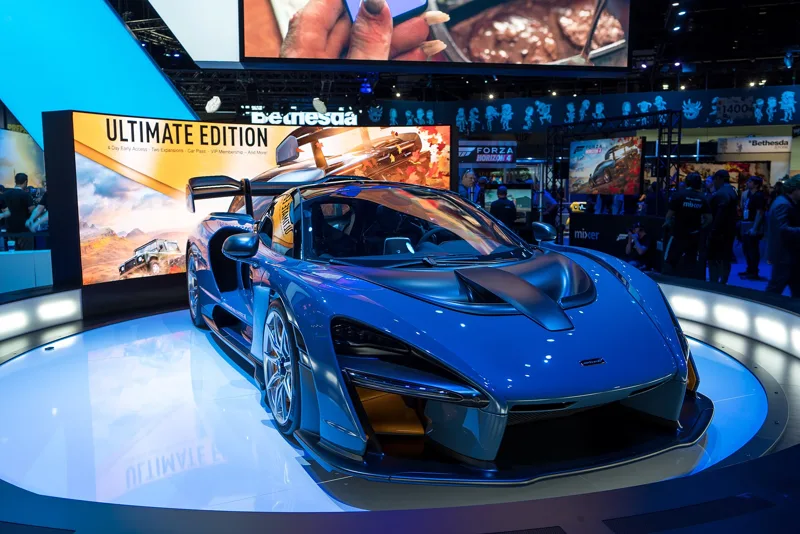
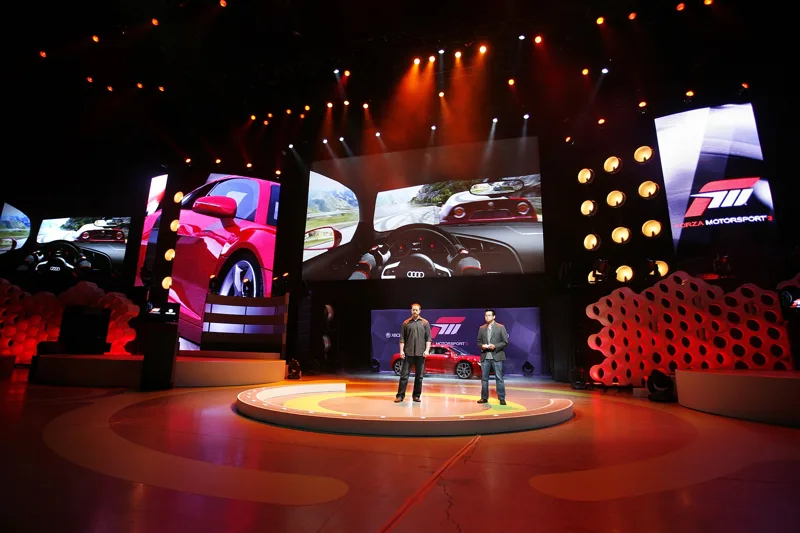
Forza Horizon 3 was announced on 13 June 2016 at Microsoft's E3 press conference, where Ralph Fulton showed a gameplay demo. It was released on 27 September 2016 in Standard, Deluxe and Ultimate editions. Ultimate pre-orders received early access on 23 September, and the game supports the Xbox Play Anywhere programme for digital purchases.
Early Windows performance problems were fixed by Playground, which also addressed a wheelspin glitch that sometimes gave the maximum currency. Some players were falsely banned after bans on hacking clients, and Microsoft asked them to appeal by email. A January 2017 update could corrupt Windows installations, so it was removed.
An Xbox One X enhancement arrived in January 2018, adding 4K resolution and higher polygon models. Groove Music streaming ended on 31 March 2019, which left players with the in-game soundtrack. The game and its downloadable content were removed from the Microsoft Store on 27 September 2020 after reaching end of life.
What downloadable content was released?
Several car packs appeared over time, including the Motorsport All-Stars pack, a Porsche pack and a Hoonigan pack with cars used by that racing division. The first expansion, Blizzard Mountain, arrived on 13 December 2016. It added a snowy mountain region with icy roads and whiteout conditions, and players collected stars rather than fans to unlock events.
The second expansion, Hot Wheels, was released on 9 May 2017 in collaboration with Mattel. It added an archipelago linked by real-scale stunt track pieces, and it also used stars to unlock events. Some of its cars were life-scale Hot Wheels models.
Crossovers included the Halo Warthog for players of Halo 5 or The Master Chief Collection. The Quartz Regalia from Final Fantasy XV arrived on 1 August 2017, and it took about 1,500 hours to program because no real-world data existed for it.
How did critics respond?
The Xbox One version received universal acclaim on Metacritic, and the Windows version was rated generally favourable. Critics praised the map design, the graphics and the amount of content. The main criticism was that progression could feel monotonous.
The Australian setting was widely welcomed, with Polygon's Colin Campbell admiring the realistic portrayal of the country and the Outback in particular. Reviews of the races were more mixed. Head-to-head races against Drivatars were called rarely enjoyable, and some reviewers found the championship structure repetitive, while the Horizon Blueprint feature was praised as a smart addition.
Critics also praised the graphics, including the realistic day and night cycles and rainy weather. One reviewer called it one of the best-looking games on Xbox One.
How well did the game sell?
Forza Horizon 3 was the seventh best-selling game in Australia and the tenth best-selling in the United Kingdom in 2016. It was also the ninth best-selling game on Xbox One in the United States that year. Creative director Ralph Fulton said its success exceeded the expectations of Playground Games.
More than 2.5 million copies had been sold by February 2017, which took the Forza series past $1 billion in total sales. By September 2018 the game had surpassed 10 million players.