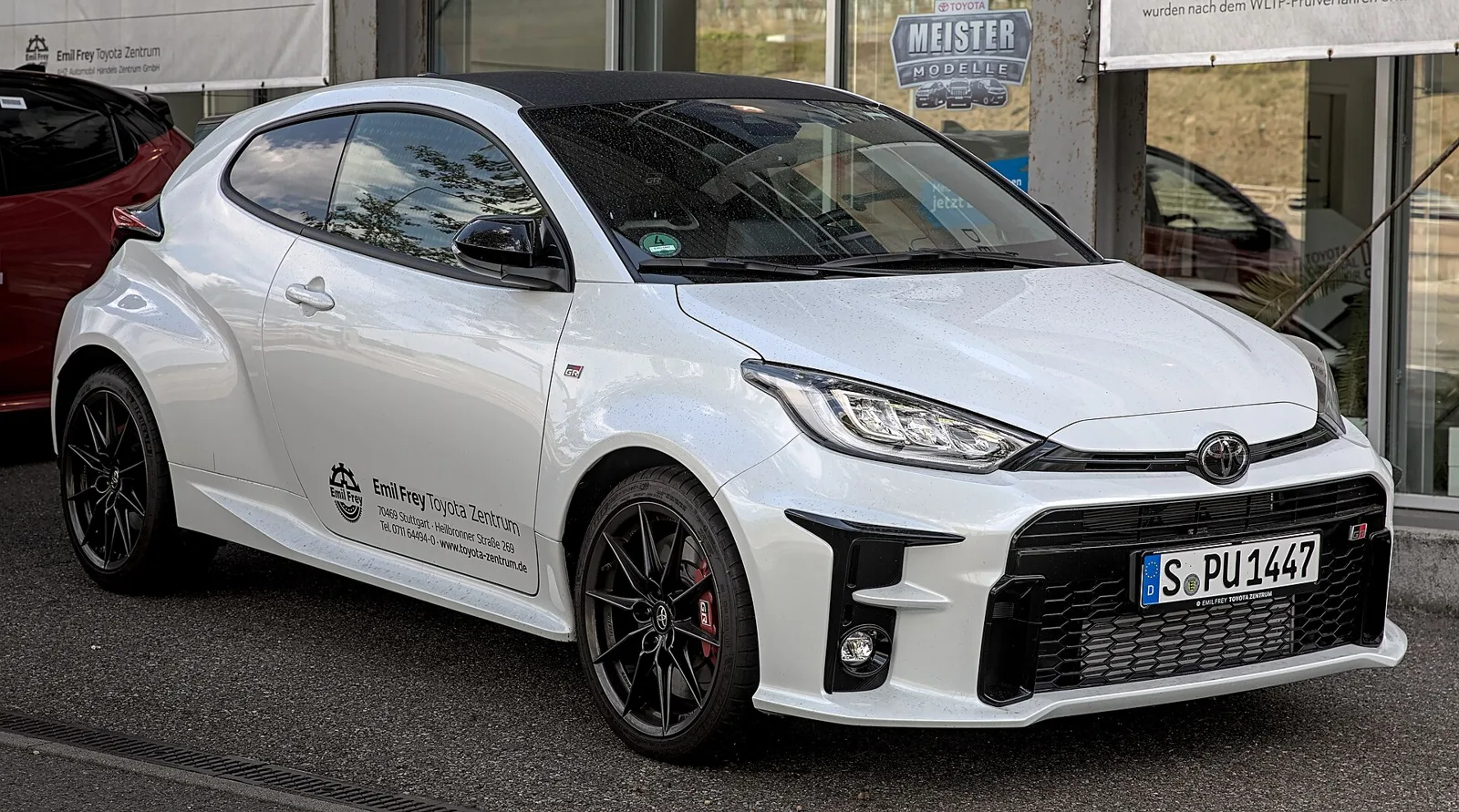
A three-door, four-wheel-drive hatch born from a World Rally Championship homologation brief, with a turbocharged 1.6-litre three-cylinder and a manual gearbox.
Developed around World Rally Championship homologation rules, the GR Yaris arrived in 2020 as a four-wheel-drive, three-door hatch from Toyota's Gazoo Racing division. A turbocharged 1.6-litre three-cylinder sends power through a six-speed manual gearbox.
The Toyota GR Yaris is a three-door, four-wheel-drive hatchback that Toyota began building in 2020 with help from its Gazoo Racing division. It was developed to meet World Rally Championship homologation rules, and it pairs a turbocharged 1.6-litre three-cylinder engine with a six-speed manual. Production continued through 2025, across a 2024 facelift and a run of special editions.
Why did Toyota build the GR Yaris?
Toyota built the GR Yaris because the standard XP210-series Yaris was sold only as a five-door, while the WRC team needed a three-door body for homologation. Akio Toyoda approved the project despite its cost, and it became a sports car of Toyota's own design.
Toyoda described the car as a passion project. He wanted the company to build a sports car on its own terms rather than with a partner, which set the GR Yaris apart from the 86 developed with Subaru and the GR Supra developed with BMW and built by Magna Steyr. Toyota unveiled the finished car at the 2020 Tokyo Auto Salon.
Homologation was the practical hurdle. WRC rules required a production car built in volume, and Toyota would need to make at least 2,500 units in a continuous 12-month period. Rally cars must also share the bodyshell of a production car, and the standard XP210 Yaris was available only with five doors, a body style that the team felt was wrong for competition.
Built to meet rally homologation rules, then sold as a road car with four-wheel drive and a manual gearbox.
How was the GR Yaris engineered?
The engineers built the GR Yaris on the front of the GA-B architecture and the rear of the GA-C platform used by the Corolla. It gained four-wheel drive, a wider rear track and double wishbone suspension, while aluminium panels and a carbon fibre-reinforced roof kept weight down.
Gazoo Racing began with prototypes built by heavily modifying production Yaris cars. Those mules were then reverse-engineered into a car that an ordinary customer could drive every day. Toyoda and team principal Tommi Makinen, a four-time WRC champion, spent time testing the mules and pre-production cars in snow, on gravel and on public roads.
Makinen had a large influence on the result. Chief engineer Naohiko Saito said 90 percent of the requests from Makinen and the rally squad could be met, and the brief was clear: a car that could race at WRC events but still suit daily driving.
What engine and transmission does the GR Yaris have?
The GR Yaris uses a Gazoo Racing-built 1.6-litre turbocharged three-cylinder with direct and port injection. Output is 192-200 kW (257-268 hp; 261-272 PS) depending on market, and the engine drives through a six-speed iMT manual and the GR-Four permanent four-wheel drive system.
Torque ranges from 360 to 370 N m (266 to 273 lb ft), again varying with emissions rules in each market. Toyota claims 0-100 km/h in 5.2-5.5 seconds, and the electronically limited top speed is 230 km/h (143 mph).
The gearbox is a V16-series intelligent manual, and GR-Four is the permanent four-wheel drive system that sits alongside it.
What changed with the 2024 facelift?
The facelift arrived at the Tokyo Auto Salon on 12 January 2024. It added an 8-speed automatic option and paddle shifters for semi-automatic driving, and the Japanese-market engine rose to 224 kW (300 hp; 305 PS) with 400 N m (295 lb ft) of torque.
Engine changes went beyond the power figure. Toyota strengthened the valvetrain, changed the exhaust valve material, raised direct injection pressure, added a new intake air pressure sensor and fitted redesigned lightweight pistons. Body rigidity and suspension were improved to cope with the extra output, and the dashboard took on a more driver-focused layout.
Rollout continued market by market. Australian production began in late 2024 with showroom deliveries in early 2025, and the facelift launched in Indonesia at GIIAS 2024. Thailand followed on 28 November 2024, Brunei on 3 January 2025 and Malaysia on 5 January 2025, with China adding the car in 2025.
Japan added an Aero performance package in October 2025 for the RC and the RZ High Performance. It adds an aluminium bonnet with air ducts, a front lip spoiler, ducts in the wheel arches, a fuel tank undercover, a variable rear wing and a duct in the rear bumper. The facelift had been unveiled in the Middle East on 16 December 2025, and the Aero package was offered there as well.
March 2026 brought smaller changes. Toyota revised the steering wheel, the electric power steering and the shock absorber settings. It also began offering a vertical parking brake near the steering wheel as a factory option on the RC trim.
What are the RS and RC grades?
The RS was a Japan-only, front-wheel-drive entry grade with a 1.5-litre naturally aspirated engine rated at 88 kW (118 hp; 120 PS). It weighed 1,130 kg (2,491 lb), which made it 150 kg (331 lb) lighter than the RZ. The RC replaced it from the 2024 facelift and is intended as a lightweight base for competition cars.
The RC drops air conditioning, navigation and the audio system, and it keeps halogen headlights. Super White II was the only colour offered on that grade. Toyota Safety Sense was not initially available, but it became standard across all models in mid-2025.
Between the RS and the RC sat a Light Package from April 2022 that trimmed the car to 1,110 kg (2,447 lb). The facelift brought that variant to an end.
Which special editions were made?
Toyota built several limited editions of the GR Yaris. The GRMN Yaris of 2022 was limited to 500 units, and the Sebastien Ogier and Kalle Rovanpera Editions of 2024 and the Morizo RR of 2026 were each built in runs of 100 for Japan and 100 for Europe.
The GRMN was based on the RZ and tuned by the Gazoo Racing team. The GRMN gained 20 N m (15 lb ft) of torque, taking the total to 390 N m (288 lb ft), and the bonnet and roof were made from twill weave carbon fibre. Removing the rear seats saved about 20 kg (44.1 lb), and the body gained 545 extra spot welds plus 12 m (39.4 ft) of structural adhesive.
Two packs were offered alongside the GRMN. The Circuit Package brought BBS 18-inch wheels, 18-inch brakes, adjustable Bilstein dampers and a carbon rear spoiler. The Rally Package added GR shock absorbers, a short stabiliser link set, an under guard set and a roll bar. Pre-orders opened on 14 January 2022, and the car was unveiled at the 2022 Tokyo Auto Salon.
The Sebastien Ogier Edition was based on the Type 24 RZ High Performance and was painted matte stealth grey. It had a carbon fibre rally spoiler, BBS wheels with a French flag design and blue calipers, and it was shown at Rallye Monte-Carlo on 25 January 2024. A WRC victory badge was fitted in front of the passenger seat, numbered 001 to 200.
The Kalle Rovanpera Edition was shown at the same event. It carried a three-colour livery and the number 69, which was Rovanpera's rally car number. Its four-wheel drive modes were named DONUT and KALLE in place of the standard GRAVEL and TRACK modes. DONUT maximises the direct coupling of the front and rear wheels for drifting, while KALLE makes use of the constant-speed rear differential.
The Morizo RR was unveiled at the Tokyo Auto Salon in January 2026. It has a revised digital instrument cluster, a smaller steering wheel with modified paddle shifters and switches inspired by the GR Yaris Rally2 car. Carbon parts include a rear wing, a front spoiler, side skirts and a bonnet.
Toyota also built a GR Yaris Hydrogen concept, which uses a modified G16E-GTS engine designed to run on hydrogen fuel. It remains a concept rather than a production model.
Where was the GR Yaris built and sold?
Buyers can find the GR Yaris across much of the world, from Japan and Europe to Australia, New Zealand and South Africa. Southeast Asian markets, Mexico, Argentina, Taiwan and the Middle East also receive it. It has not been offered in the United States or Canada, where Toyota sold the larger GR Corolla from 2022 for the 2023 model year instead.
Production began in September 2020 on a dedicated line at the Motomachi plant, which Toyota calls the GR Factory. The line is staffed by master craftsman team members. Demand was strong enough that production was extended by two years on 30 July 2021, and the car was still in production in 2025.
The United States and Canada missed out for commercial reasons. Analysts pointed to low expected volume, the end of the standard Yaris in those markets and the lack of a matching model in the local range.
How did the GR Yaris perform in motorsport?
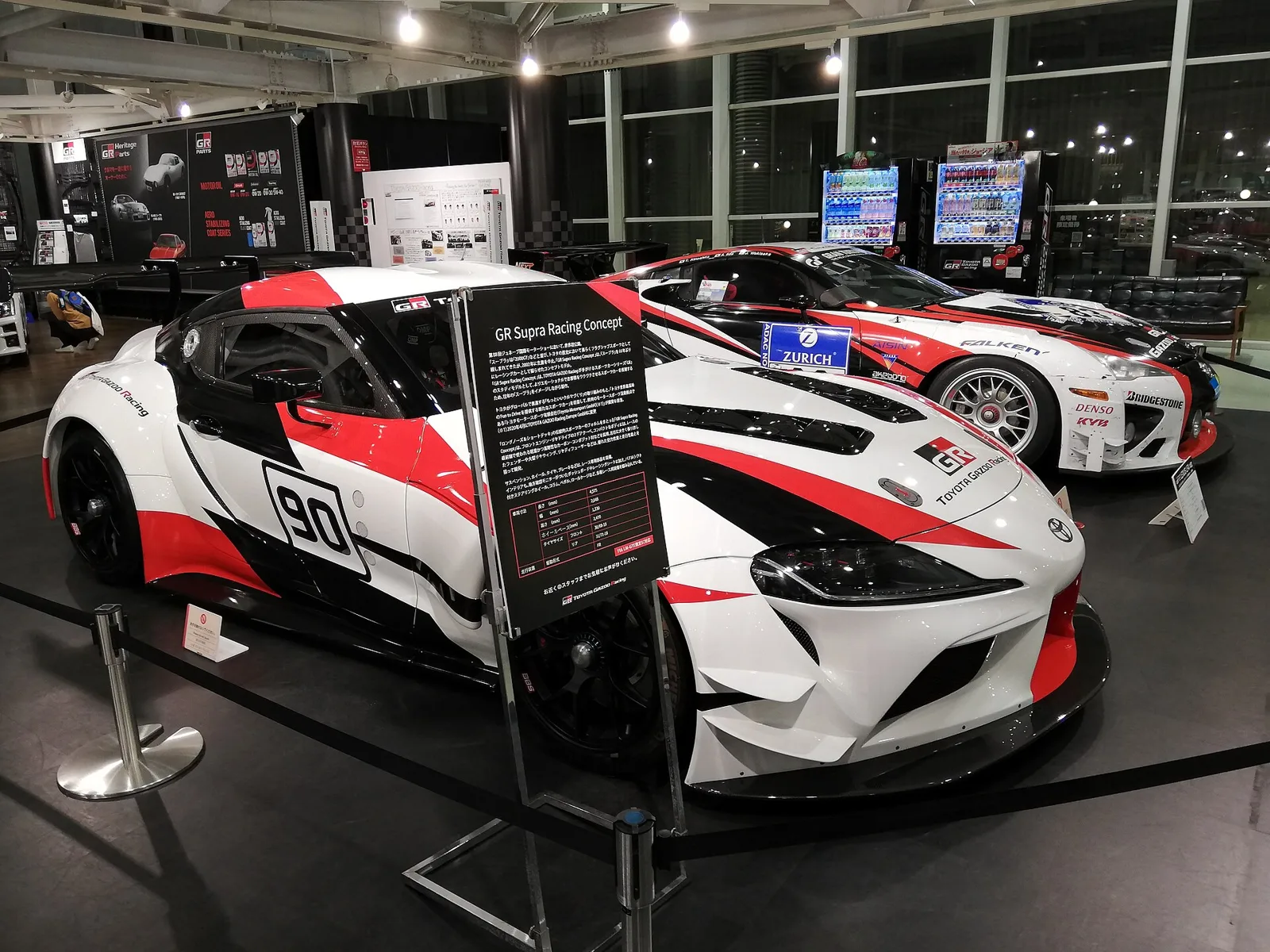
The road car became the foundation for the Rally1 racer, which debuted in the 2022 World Rally Championship season. A Rally2 version followed in 2024. Both racing cars trace back to the same homologation brief that shaped the road car.
What awards did the GR Yaris win?
In January 2021, What Car? named the GR Yaris Hot Hatch of the Year and gave it five stars out of five. The car also took the 2021 UK Car of the Year title and the Best Performance award in the same year.
What are the GR Yaris specifications?
| Specification | Detail |
|---|---|
| Body | Three-door hatchback |
| Engine | 1.6-litre G16E-GTS turbocharged three-cylinder, direct and port injection |
| Output | 192-200 kW (257-268 hp; 261-272 PS), varying by market |
| Torque | 360-370 N m (266-273 lb ft), varying by market |
| Transmission | 6-speed iMT manual with GR-Four permanent four-wheel drive |
| Facelift output (Japan) | 224 kW (300 hp; 305 PS) and 400 N m (295 lb ft), with 8-speed automatic option |
| 0-100 km/h | 5.2-5.5 seconds (claimed) |
| Top speed | 230 km/h (143 mph), electronically limited |
| Weight (RZ and international) | 1,280 kg (2,822 lb) |
| Weight (RS) | 1,130 kg (2,491 lb) |
| Weight (Light Package) | 1,110 kg (2,447 lb), from April 2022 |
| RS engine | 1.5-litre naturally aspirated, 88 kW (118 hp; 120 PS), K120 CVT |