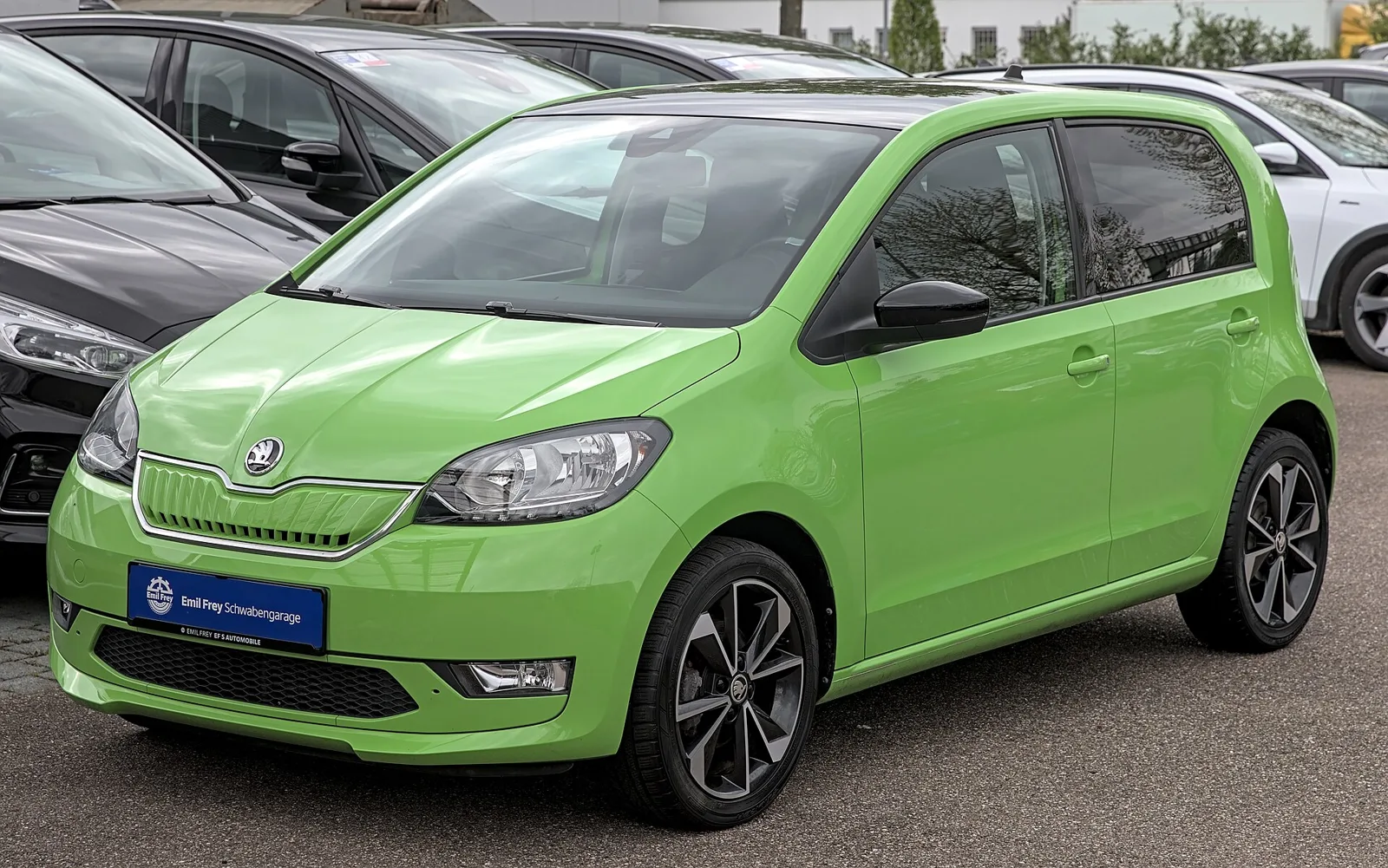
Built in Bratislava beside the Volkswagen Up and SEAT Mii, the Citigo was a city car with Skoda styling, a 2017 facelift and an electric version that ended in 2020.
The Skoda Citigo is a rebadged Volkswagen Up city car, launched in the Czech Republic in October 2011 with slightly different front and rear fascias. It was built in Bratislava and received a 2017 facelift, and its electric Citigo-e iV, with a 36.8 kWh battery, was mass-produced from autumn 2019 before sales ended in 2020.
Skoda's Citigo was never a separate design. It was a Volkswagen Up with Skoda styling at the front and rear, shared the New Small Family platform with the SEAT Mii, and gave Skoda a small car from 2011.
Where did the Up and the Citigo come from?
The production car grew out of a concept series that began at the 2007 Frankfurt Motor Show. Its exterior was designed by the Brazilian designer Marco Pavone, and Walter de'Silva and Klaus Zyciora enhanced it. The production Up was unveiled at the 2011 International Motor Show Germany.
The concepts were at first expected to carry the Lupo name, which Volkswagen had discontinued in 2005. That plan changed, and the 2011 car was called the Up.
The concept used a rear-engine, rear-wheel drive layout, but the production model moved to a front engine and front-wheel drive on the New Small Family platform, with a three-cylinder 1.0-litre petrol engine. The three-door bodywork was inspired by the 2007 concept, and the cabin was configured for four seats.
The Up measures 3.54 metres (139 in) long, with a 2.42 m (95 in) wheelbase. The platform was shared with the SEAT Mii and Skoda Citigo.
A Volkswagen Up with Skoda styling, built in Bratislava and remembered for a short-lived electric variant.
Where was the Citigo built and when did it launch?
The Citigo launched in the Czech Republic in October 2011, and sales in other European countries began in the summer of 2012. It was built at Volkswagen's plant in Bratislava, Slovakia, where the Up itself began production in December 2011.
Skoda's version was a rebadged Up with slightly different front and rear fascias. The SEAT and Skoda versions were also manufactured in the same Bratislava factory, and both were withdrawn from sale as the decade went on, the Citigo in 2020 and the Mii in 2021.
Russia and most other CIS markets were ruled out, since the car was judged too small for them. Israel and New Zealand also took Citigos, though only briefly.
A 2017 facelift refreshed the car, which kept the Up's underpinnings to the end.
What engines did the Up family use?
The core engines were 1.0-litre three-cylinders producing 60 hp (45 kW) and 75 hp (56 kW), mated to a five-speed manual gearbox. BlueMotion technology, marketed as Green Tech on the Skoda, added a start-stop system and regenerative brakes to reduce emissions.
Depending on the market, some 60 PS and 75 PS models were available with an optional five-speed automatic. The Citigo offered the same choice on the same mechanical basis.
Volkswagen added the Up GTI in January 2018, using a turbocharged version of the 1.0-litre three-cylinder that produced 115 PS (113 bhp; 85 kW). It accelerated from 0-100 km/h in 8.8 seconds, reached a top speed of 196.00 km/h (121.79 mph) and weighed 997 kg (2,198 lb). It was the only Up with a six-speed manual gearbox. Volkswagen's economy claims range from 49.6 to 50.4 mpg-imp, with CO2 of 127 to 129 g/km depending on specification.
Brazilian cars received a 1.0-litre direct-injection turbocharged three-cylinder in July 2015.
The Latin American Up was 65 mm (2.6 in) longer than the European car. Its fuel tank held 50 L instead of 35 L, and it used a full-size spare wheel to suit Brazilian roads and cargo.
What safety features did the Up family offer?
The Up was the first car in its class to offer automated City Emergency Braking. The system activates below 30 km/h (19 mph) and applies the brakes when a laser sensor spots a collision risk. On the Citigo it was called City Safe Drive, and on the SEAT Mii it was marketed as City Safety Assist.
The Latin American Up, built in Brazil, scored five stars for adults and four stars for children in Latin NCAP 1.0 tests in 2014. The Brazilian car also used plenty of high-strength steel, and its safety levels matched the European version.
Euro NCAP gave the SEAT Mii five stars overall in 2011, but the standard European Up received only three stars in 2019, and the Mii and Citigo shared those results. Green NCAP also assessed the Up GTI, with its 1.0-litre TSI and six-speed manual, in February 2019.
Where was the Up sold?
The Up was not sold in North America, China, India or South Korea. Japanese sales began in October 2012, and the car reached South Africa in March 2015 with two 55 kW (74 hp) three-door variants, marketed as Take Up and Move Up.
Australian sales of the Up ended in 2015, after slow sales led to its withdrawal. Plans for a Skoda Citigo there were shelved as well.
At the Geneva Motor Show in 2016 the European model received a facelift and a new TSI engine, on sale in the summer of that year.
How did the UK launch of the Up go?
The Up could be ordered in the United Kingdom from October 2011 in five models: Take Up, Move Up, High Up, Up Black and Up White. Top Gear presenters mocked the unusual name by calling the car Up-exclamation-mark.
The Up reached the German market on 3 December 2011, and deliveries to other European markets began in April 2012.
What was the E-up electric version like?
Volkswagen announced the production E-up in July 2010, with sales scheduled from 2013. The car was unveiled at the September 2013 International Motor Show Germany and launched in the autumn of that year.
The 18.7 kWh lithium-ion battery gave 160 km (99 miles) on the NEDC cycle, and the car reached 0-62 mph (100 km/h) in 12.4 seconds with a top speed of 130 km/h (81 mph). It charged at 2.3 kW from a standard socket or 3.6 kW from a home wall box, and it accepted up to 40 kW on DC fast-charging stations, reaching 80 percent in under 30 minutes.
The second E-up, announced on 5 September 2019, had a larger 32.3 kWh usable battery, a range of 260 km (160 mi) and an efficiency of 12.7 kWh per 100 km.
The Citigo-e iV took a 36.8 kWh battery and a 270 km (168 mi) WLTP range, and it was mass-produced from autumn 2019. It was the first all-electric car from Skoda Auto and replaced the combustion version, but Skoda ended sales of electric Citigos in autumn 2020.
How did the SEAT Mii electric and the E-up sell?
The SEAT Mii electric had a 36.8 kWh lithium-ion battery and a range of 205 km (127 mi), and it was mass-produced from 2019 to 2020. SEAT then discontinued its electric models, following the 2021 end of the entire Mii lineup.
Retail E-up deliveries began in Germany in October 2013, followed shortly by Denmark, Sweden, France, Norway and the Netherlands, and by the UK at the end of January 2014. The total reached 21,000 units across all markets by January 2020. The E-up was never sold in the US or Canada.
What concepts came before the Up?
Volkswagen showed several Up concepts between 2007 and 2010. The first two-door concept appeared at the 2007 IAA with a rear-mounted boxer engine and 18-inch wheels, and a 98 hp (73 kW) GT version and a natural gas Eco-up! at 79 g/km CO2 were shown alongside it.
The 2007 Space Up concept debuted at the Tokyo Auto Show as a four-door mini MPV, 3.68 metres (12 ft 1 in) long. Its rear doors were hinged at the rear, eliminating the B-pillar.
The 2009 E-up concept carried 18 kWh lithium-ion batteries and offered a range of 130 km (81 miles), a forerunner of the production E-up. A 2011 Buggy Up dune buggy on the Up platform appeared at the Frankfurt Auto Show that year.
How did the concepts explore electric and hybrid power?
Several concepts tested alternative power well before the production car. The Space Up Blue, shown at the 2007 Los Angeles Auto Show, had a 150 watt solar cell in its roof and twelve lithium-ion batteries giving 45 kW (61 PS; 60 bhp), and its batteries offered a range of 65 miles (105 km) before a hydrogen fuel cell extended it.
The Space Up Blue weighed 1,090 kg (2,403 lb). Volkswagen said that adding its hydrogen high-temperature fuel cell would raise the total range to 220 miles (350 km), a figure that depended on the fuel cell rather than the batteries alone.
The two-door e-up! zero-emissions concept debuted at the 2009 International Motor Show Germany. Its motor produced 60 kW (82 PS; 80 bhp) and 210 N m (155 lb ft) of torque from rest, and a 1.4 square-metre solar roof could power ventilation fans when the car was parked in sunshine.
The 2009 Up Lite concept, revealed at the Los Angeles Auto Show, combined a 0.8-litre two-cylinder TDI with a 10 kW (14 PS; 13 bhp) electric motor. It weighed 695 kg (1,532 lb) and could reach 160 km/h (99 mph), and it was built on Volkswagen L1 technologies.
The Volkswagen IN was a design study created by Brazilian interns of Volkswagen do Brasil. It resembled the Up concepts, and a 1:1 mock-up was presented to the press on 29 January 2010.
The 2011 Up Azzurra Sailing Team concept, shown at the Frankfurt Auto Show, was designed to look and feel like a luxury yacht. It had a waterproof interior, blue and white leather seats, and chrome and wood trim, and its folded rear seats made the boot look like a yacht deck.
What awards did the Up win?
The Up won the 2012 World Car of the Year. It also took the 2012 Scottish Car of the Year compact award and the 2011 Top Gear Small Car of the Year.
What Car? gave the Up its Car of the Year award for 2012 and its City Car of the Year award for 2013.
How did the Up family end?
Production of the Up ended in October 2023. In the UK, ordering for the Up GTI was halted in April 2019 and restarted in January 2020 with a lightly refreshed version, and new orders were closed in January 2023.
What are the Up family specifications?
| Model | Engine or battery | Figure |
|---|---|---|
| Up (2011 production) | 1.0-litre three-cylinder | 60 hp (45 kW) or 75 hp (56 kW) |
| Up GTI | 1.0-litre TSI, turbocharged | 115 PS (113 bhp; 85 kW) |
| E-up (first) | 18.7 kWh lithium-ion battery | 160 km (99 miles) NEDC |
| E-up (second) | 32.3 kWh usable battery | 260 km (160 mi) |
| Citigo-e iV | 36.8 kWh battery | 270 km (168 mi) WLTP |
| SEAT Mii electric | 36.8 kWh lithium-ion battery | 205 km (127 mi) |