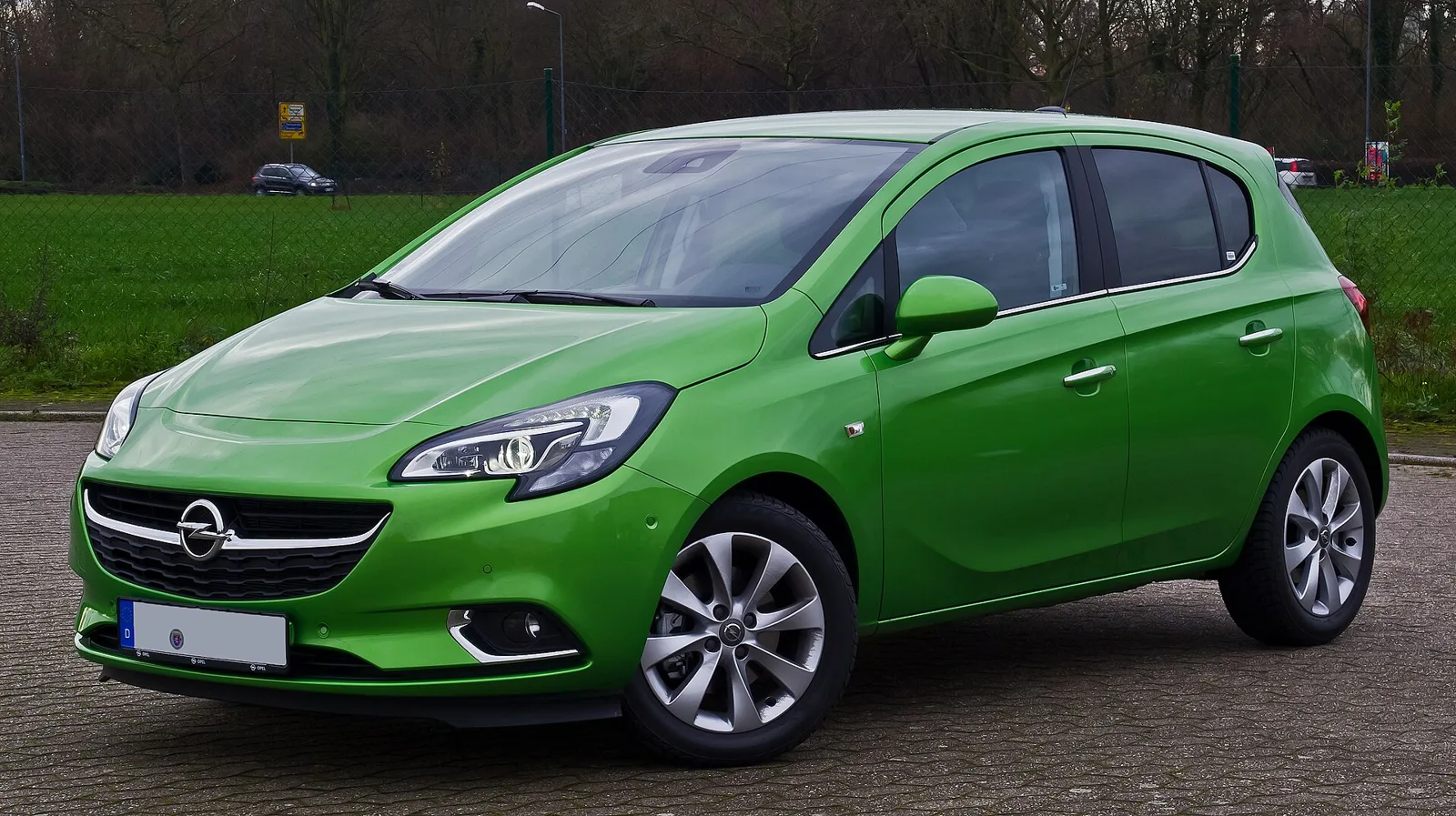
A Corsa D base with a new face, a turbo three-cylinder, the 207 PS OPC and the final Corsas made in Eisenach.
Built from 2014 to 2019 as a B-segment supermini, the fifth-generation Corsa rode on the Corsa D's base with a stiffened front subframe. Seven engines were offered at launch, and the range later topped out with the 207 PS (204 hp) 1.6 Turbo OPC.
The Opel Corsa E was the fifth generation of the Corsa, a B-segment supermini built from 2014 to 2019. It reused the Corsa D's body and mechanical base, gained a stiffened front subframe, and came with seven engines at launch. The 207 PS (204 hp) 1.6 Turbo OPC came later as the top model.
Where did the Corsa E come from?
The Corsa E was built on the body and mechanical base of the Corsa D, the car it replaced. It was first shown to the press in June 2014, and its official public debut came at the Paris Motor Show, held from 4 to 19 October. Project 4,500 was shaped by the recession years, when designers had to economise in development.
Pictures of the car circulated online and in print soon after the preview, so its definitive look soon became public. For Paris, the top model Claudia Schiffer was the ambassador for the new car.
The fifth Corsa, built on a Corsa D base and finished as the last Corsa made under General Motors.
How did the Corsa E look?
The Corsa E kept the bodywork layout of its predecessor, with 3-door and 5-door versions and similar volumes and proportions. Its front, however, took much of its family look from the Adam, launched two years earlier, with a trapezoidal grille striped by two whisker-like bars and a large logo at the centre.
At the rear, new light clusters recalled those of the Astra J, which was already in its declining phase when the Corsa E debuted. Viewed from the side, though, the car followed the outgoing model closely.
Inside, new dashboard materials, a redesigned centre console and a multimedia display moved to a more readable position were the main interior changes. Some styling themes came from the Adam, and the dashboard and instrumentation were redrawn as well.
What changed under the skin?
Much of the Corsa E was carried over. The body and the mechanical base came from the Corsa D, and that base was derived from the FGA Small platform, which had Fiat origins. Even so, the platform, the body, the steering and the suspension all received significant updates.
The front subframe was stiffened and gained new brackets to support the suspension. The suspension geometry was substantially revised, with new dampers and a lowered set-up that sharpened the car's behaviour in corners. The centre of gravity dropped by 5 mm.
Which engines did the Corsa E offer at launch?
At launch the Corsa E came with seven engines, five petrol and two diesel. The most notable newcomer was the 1.0 SGE, a turbocharged three-cylinder that had debuted shortly before under the bonnet of the Adam. The petrol range also included the 1.2, the 1.4 and the 1.4 Turbo, while the 1.3 CDTI covered the diesel side.
- 1.0 SGE: 998 cc (60.9 cu in) turbo three-cylinder, 90 PS (89 hp) or 115 PS (113 hp)
- 1.2: 1,229 cc (75.0 cu in) with 70 PS (69 hp), for the cheapest Corsas
- 1.4: 1,398 cc (85.3 cu in) with 90 PS (89 hp), tested in other Opel models for years
- 1.4 Turbo: supercharged 1.4 with 100 PS (99 hp), not planned for the Italian market
- 1.3 CDTI: 1,248 cc (76.2 cu in) common rail turbodiesel, 75 PS (74 hp) or 95 PS (94 hp)
How much torque did the 1.3 CDTI make?
The 1.3 CDTI delivered 190 Nm (140 lb ft) of torque in both power levels, arriving at 1,500 rpm. The 75 PS (74 hp) version kept that peak up to 2,500 rpm, and the 95 PS (94 hp) version held it up to 3,500 rpm.
The unit was of Fiat origin and had been fitted successfully to other Opel models, as well as to many successful models made by Fiat Group brands. Only the crankcase and the cylinder head stayed common between the two groups. The rest was designed from scratch, including an engine control unit built in-house by GM.
Which gearboxes came with the Corsa E?
The 1.0 SGE Turbo, at both power levels, was matched to a 6-speed manual gearbox. Every other engine came with a 5-speed manual as standard. The OPC also had a six-speed manual.
How was the Corsa E built and launched?
Production began in November 2014. The same two sites had built earlier generations of this popular German supermini, so the Corsa E returned to familiar ground: Eisenach, and the Spanish works at Zaragoza.
A van was revealed at the Brussels Motor Show in 2015. Based on the 3-door body, it had sheet metal in place of the rear glass, as is normal for commercial versions of this kind.
In the summer of 2015 the range grew upward with two sporty versions. The 1.4 Turbo S used a supercharged 1.4 with up to 150 PS (148 hp), the same engine that already powered the top Adam, the Adam S. It stood out through two-tone 17-inch wheels, a sport exhaust, a grey front end and a glossy black roof.
How fast was the Corsa OPC?
The 1.6 Turbo OPC was the true top of the Corsa E range. Its engine was a reworked version of the supercharged 1.6 from the previous Corsa OPC, tuned to produce 207 PS (204 hp). Top speed was 230 km/h (143 mph), and the 0-100 sprint took 6.8 seconds.
Maximum torque was 245 Nm (181 lb ft) between 1,900 and 5,800 rpm, and an overboost could add a further 35 Nm (26 lb ft) for a few seconds. Torque was already good from 2,000 rpm and kept building to almost 6,000 rpm. Average consumption was rated at 13.3 km/l.
The six-speed manual shifted quickly but was not precise when engaging the gears. Road grip was high and body roll limited, thanks to the OPC's firmer suspension. The Performance pack went further, with a stiffer suspension set-up, bigger brake discs, 18-inch wheels in place of the 17s, and a mechanical limited-slip differential.
The OPC could also be specified with safety equipment usually reserved for larger cars, such as sensors that detect vehicles in the blind spot.
Was there a bi-fuel LPG Corsa E?
Yes. A bi-fuel LPG version joined the range in summer 2015 with the 1.4 engine producing 90 PS (89 hp).
How did production of the Corsa E wind down?
In September 2018 the OPC and the S left production together. Both were replaced by the GSi, short for Grand Sport injection, which used a 1.4 engine producing 150 PS (148 hp). That change marked the opening stage of the car's wind-down.
On 5 May 2019 the last Opel Corsa of the German supermini rolled off the Eisenach line after 26 years of service. The Zaragoza plant was left to assemble the final batches before the model's definitive retirement.
What came after the Corsa E?
The Corsa E was the last Corsa built during Opel's long era within General Motors, which the company had been part of since 1929. The sixth generation, the Corsa F, was planned as a project of the PSA group, which later became Stellantis, and Opel has been part of that group since 2017.
Opel Corsa E key specifications
| Specification | Detail |
|---|---|
| Generation | Fifth Corsa, B-segment supermini, built 2014 to 2019 |
| Launch engines | Seven: five petrol and two diesel |
| 1.0 SGE | 998 cc (60.9 cu in), 90 PS (89 hp) or 115 PS (113 hp) |
| 1.3 CDTI | 1,248 cc (76.2 cu in), 75 PS (74 hp) or 95 PS (94 hp) |
| 1.3 CDTI torque | 190 Nm (140 lb ft) at 1,500 rpm |
| 1.6 Turbo OPC | 207 PS (204 hp); 245 Nm (181 lb ft) |
| OPC top speed | 230 km/h (143 mph) |
| OPC 0-100 km/h | 6.8 seconds |
| OPC consumption | 13.3 km/l on average |
| Boot | 285 litres standard; up to 1,120 litres with the rear seat folded (1,090 for the 3-door) |
| Gearbox | 5-speed manual; 6-speed on 1.0 SGE Turbo and OPC |