Twin and four-cylinder cars built from 1909 to 1928, through a world war, a rename from HP to PS and a post-war restart.
The NSU 5PS was a family of 5 tax horsepower cars that Neckarsulmer Fahrradwerke built from 1909 to 1928. Output rose from 12 PS on the early twins to 25 PS on the final 5/25 PS, with engines from 1,105 cc to 1,308 cc.
The NSU 5PS was a family of cars rated at 5 tax horsepower, built by Neckarsulmer Fahrradwerke from 1909 to 1928. It began with a twin-cylinder 5/10 HP and closed with the 5/25 PS, passing through four-cylinder variants, a 5/12 HP and the 5/15 HP, both before and after the First World War.
Why did the name change from HP to PS?
Models built before the First World War carried the English abbreviation HP. When the war broke out the designation became PS, short for Pferdestarken, a change meant to cut every link with the United Kingdom, which was an opponent of the German Empire in that conflict.
The change became permanent in 1915, when the last examples of the 5/15 HP had their designation changed to 5/15 PS.
A family of small NSU cars that changed its name from HP to PS, survived a world war and carried on until the late twenties.
How did the 5/10 HP family begin?
The family began in summer 1909, when Neckarsulmer Fahrradwerke returned to the 5 tax horsepower class with a car that was far more decisive than its earlier attempt. An earlier 5/10 HP, shown in Berlin in November almost three years before, had quickly evolved into a 6/10 HP.
The 1909 return gave rise to a true dynasty of models, whose history would run almost to the end of the twenties.
What was the first 5/10 HP like?
The first 5/10 HP was a twin-cylinder car displacing 1,105 cc (67.4 cu in), its bore and stroke measuring 75 x 125 mm. It was built on the frame of the 6/10 HP, a steel ladder with cross members, and it had a 2.1 metre (6.9 ft) wheelbase and tracks of 1.15 metres (3.8 ft). Rigid axles front and rear, shoe brakes acting on the transmission and side valves kept it close to the standard engineering of its day.
The engine made 12 effective PS at 1,200 rpm, sending power through a three-speed gearbox built in one unit with the engine. Its top speed was 50 km/h. Thermosiphon cooling was used, with forced lubrication by pump. The car sold from July 1909 at 3,000 marks as a two-seat single phaeton, the only body on offer, and it was removed from the price list in 1911.
What did the four-cylinder 5/10 HP change?
The four-cylinder 5/10 HP had 1,131 cc (69.0 cu in) and a 60 x 100 mm bore and stroke. It stayed in the same tax class, because the number of cylinders did not change the rating. Launched in October 1909, it reached 55 km/h, delivered the same 12 PS at 1,200 rpm and came as a two-seat or three-seat single phaeton.
The chassis, suspension and brakes stayed unchanged, so the four-cylinder was mainly a choice of engine layout. The two cars sat side by side on the price list until the four-cylinder left it in the spring of 1911, after about a year and a half of production.
How did the 5/11 HP differ from the 5/10 HP?
Both 5/10 HP models evolved in late spring 1911 into two cars named 5/11 HP. Displacement and maximum power stayed as before, but the three-speed gearbox was borrowed from the larger 6/18 HP, along with its wheels and axles. The wheelbase grew by 25 mm on the four-cylinder and by 200 mm on the twin.
The wheelbases became 2.125 metres (6.97 ft) for the four-cylinder and 2.3 metres (7.5 ft) for the twin. The body range widened to double phaeton, van and pick-up options. The twin was withdrawn in 1912 after only a year in production. The four-cylinder continued until 1913, and its layout was taken up again in later models of the same class.
What was the 5/12 HP?
The 5/12 HP was presented in autumn 1912 and entered sales early in 1913, replacing the four-cylinder 5/11 HP. It came on two wheelbases, 2.21 metres (7.3 ft) and 2.41 metres (7.9 ft). The shorter chassis carried the two-seat single phaeton, while the longer one took the wider range of bodies, including double phaeton, pick-up and van.
Its engine displaced 1,201 cc (73.3 cu in), bored and stroked at 70 x 78 mm, producing 12 PS at 1,600 rpm. The 5/12 HP was not meant for a mass audience. It was the equivalent of today's premium compact, and its assembly and finish set it above the competition. The list price was between 4,200 and 5,000 marks, and its top speed of 60 km/h was a slight improvement on the car it replaced.
Why was the 5/15 HP the longest-lived model?
The 5/15 HP lasted longer than any other model in NSU's 5 tax horsepower range. Its frame was lengthened to a 2.45 metre (8.0 ft) wheelbase, and its 1,231 cc (75.1 cu in) engine, bored and stroked at 66 x 90 mm, produced 15 PS at 1,600 rpm for a top speed of 65 km/h. Buyers could choose wooden-spoke or wire-spoke wheels.
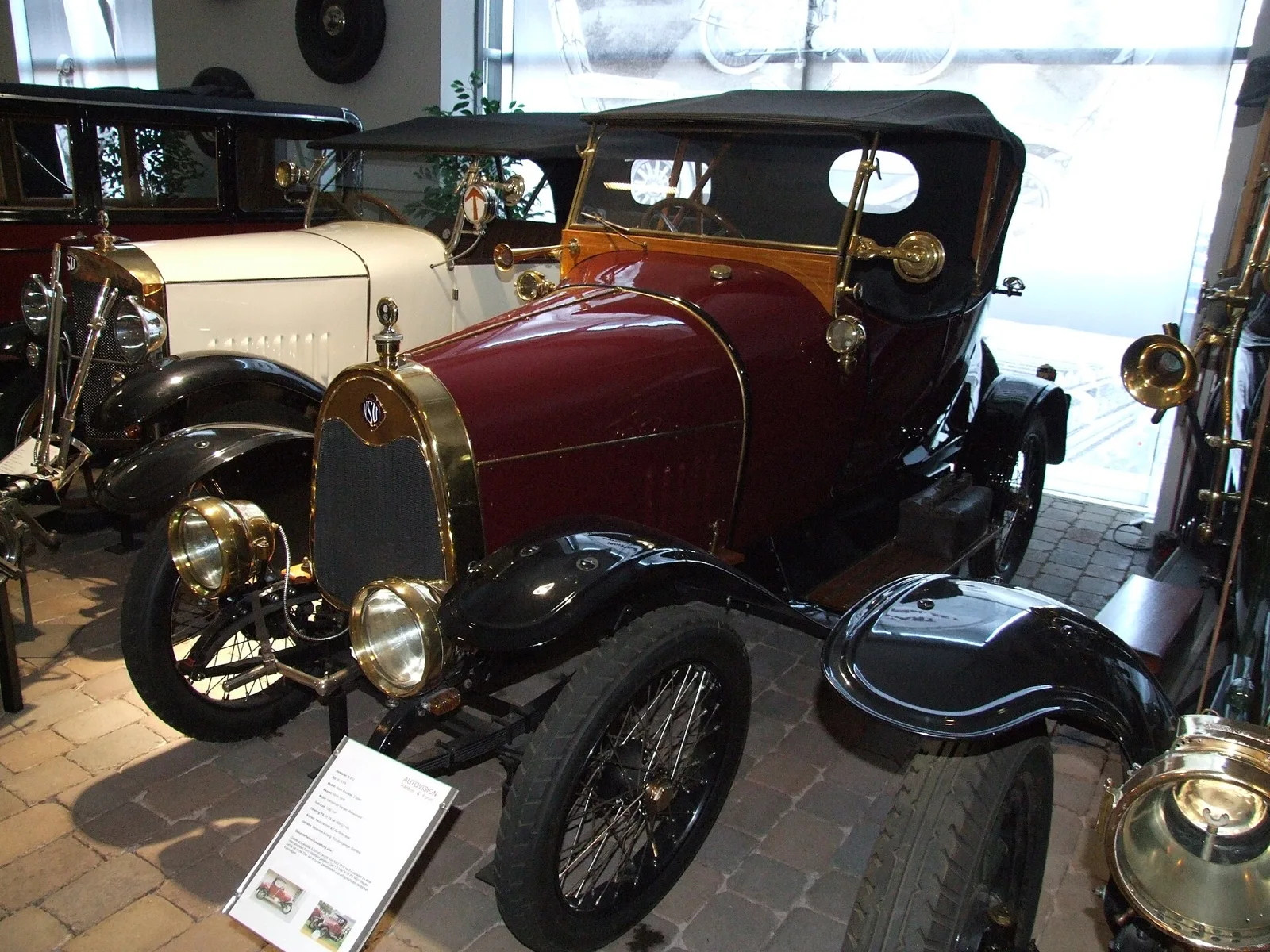
The car was presented in autumn 1914, yet it had debuted in the spring of that year, just months before the war began. Its arrival was needed because Wanderer had launched a 5/12 PS nicknamed Puppchen, and Opel had been selling its own 5/12 PS, also nicknamed Puppchen, for two years. NSU had to move on to stay at the top of its class.
The war did not end the 5/15 HP's commercial career. The two-seat version with a third fold-away seat became one of the favourite vehicles of German officers, at least in the first part of the war. Single phaetons could be ordered with a rear fold-away seat known as the mother-in-law seat. In 1915 production stopped so the factory could meet German orders for trucks, and the last examples had their designation changed to 5/15 PS.
What did NSU build after the First World War?
Production stalled through the first three years after the war, as inflation ran out of control and demand was weak. The 5/15 PS restarted in April 1921 with a limited batch of 200 cars, which sold very slowly. Five limited series were built during the early post-war years, and the 1922 batch received a four-speed gearbox in place of the three-speed unit.
The post-war car had a longer 2,496 mm (98.3 in) wheelbase and an engine that had been revised to produce 21 PS at 2,100 rpm. Its top speed reached 75 km/h, and a new limousine version was added to the body range. Some writers, including the Museum Autovision in Altlussheim, Germany, call it the 5/20 PS. Its commercial career ended in spring 1925.
What was the 5/25 PS?
Production of the 5/25 PS began on 15 May 1925, and it was the last model in NSU's 5 tax horsepower range. The first series was 500 cars. The wheelbase grew to 2.65 metres (8.7 ft) and the overall length reached 3.505 metres (11.5 ft). The engine was re-bored from 66 to 68 mm with a 90 mm stroke, giving a displacement of 1,308 cc (79.8 cu in) and 21 PS at 2,400 rpm.
In 1926 maximum output rose to 25 PS at 2,500 rpm, and the right-hand drive arrangement that had been usual until then moved to the other side. The gearbox went back to three speeds in 1927. In 1928 the 5/25 PS left the price list, and for a few months the 6/30 PS took its place before the end of that year.
Family at a glance
| Model | Displacement | Power | Wheelbase |
|---|---|---|---|
| 5/10 HP twin | 1,105 cc (67.4 cu in) | 12 PS at 1,200 rpm | 2.1 metres (6.9 ft) |
| 5/10 HP four-cylinder | 1,131 cc (69.0 cu in) | 12 PS at 1,200 rpm | 2.1 metres (6.9 ft) |
| 5/11 HP twin | 1,105 cc (67.4 cu in) | 12 PS | 2.3 metres (7.5 ft) |
| 5/11 HP four-cylinder | 1,131 cc (69.0 cu in) | 12 PS | 2.125 metres (6.97 ft) |
| 5/12 HP | 1,201 cc (73.3 cu in) | 12 PS at 1,600 rpm | 2.21 or 2.41 metres (7.3 or 7.9 ft) |
| 5/15 HP | 1,231 cc (75.1 cu in) | 15 PS at 1,600 rpm | 2.45 metres (8.0 ft) |
| 5/15 PS, post-war | 1,231 cc (75.1 cu in), revised | 21 PS at 2,100 rpm | 2,496 mm (98.3 in) |
| 5/25 PS | 1,308 cc (79.8 cu in) | 21 PS at 2,400 rpm; 25 PS at 2,500 rpm from 1926 | 2.65 metres (8.7 ft) |
What did the NSU family leave behind?
The 5/12 HP and 5/15 HP were designed to outdo the competition in refinement and build quality, and the 5/15 HP became the reference model in its class.