The second-generation Primera, its chassis and engines, the estate that arrived a year late, and the touring car titles it won in the late 1990s.
The Nissan Primera P11 was a mid-size car sold from September 1996 to June 2002 as the second generation of the Primera. Its estate arrived at the 1997 facelift, and a racing version went on to compete in touring car series in several countries.
The Nissan Primera P11 was the second generation of the Primera, a mid-size car that went on sale in September 1996. It arrived without an estate, which came only with the first facelift in 1997, and it later raced in touring car championships in several countries.
The P11 grew in every dimension over its predecessor, and it stayed on sale until the P12 replaced it in June 2002. Two facelifts and a changing trim range shaped the car over its six-year run.
Why was there no estate at first?
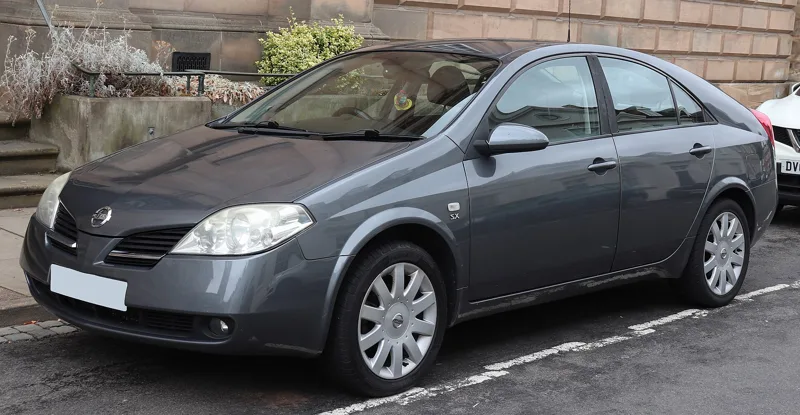
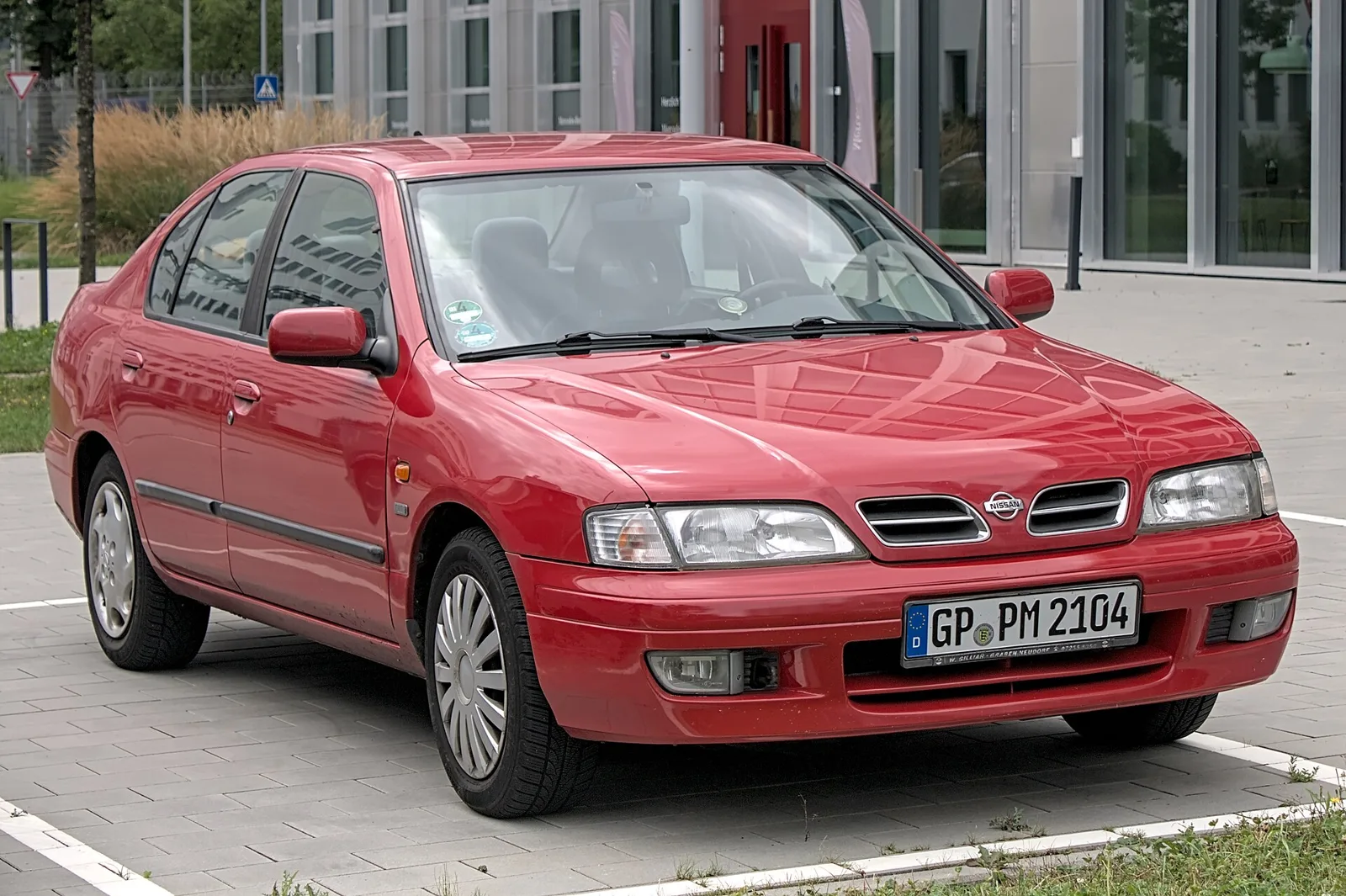
The Primera P11 was launched in September 1996 as a notchback and a hatchback only. No estate was built until the first facelift, so the W10 Traveller of the previous generation stayed on sale to fill the gap until the new estate arrived in September 1997.
The new saloon had grown in all dimensions and offered more room inside than the car it replaced. Its safety kit was much improved, with twin front airbags, belt tensioners and ABS standard in every version.
A mid-size saloon that arrived without an estate and later raced in touring cars in several countries.
How did the chassis change?
Nissan's P11 kept the double-wishbone front axle from the P10 but received a completely new rear suspension: a compact-link axle with a Scott-Russell linkage. The chassis, which received good reviews for its handling, was tuned on the Nuerburgring Nordschleife.
The compact-link rear axle had been used before, in the Almera N15 and Maxima A32. In the Primera P11 it was combined with a double-wishbone front for the first time, and the setup was tuned on the Nuerburgring Nordschleife.
Which equipment levels were offered at launch?
At launch the range ran from GX, the basic version with power steering and central locking, to SE, the luxury version with air conditioning, velour seats, a trip computer and wood trim. GX came only with the 1.6 l (98 cu in) engine, and SE only with the 2.0 l (122 cu in) engine.
Si was the sportier basic variant, with a leather steering wheel, sports seats, a rear spoiler and fog lamps, again only with the 1.6 l. SLX was the normal version with velour seats and electric window lifters, but without air conditioning as standard. SRi added sports suspension and strut braces to a sporty normal specification.
The top model was the GT, with part-leather sports seats, air conditioning, side sill extensions, extended front and rear aprons and a rear spoiler. From April 1997 it was offered only with the 2.0 l SR20DE engine, producing 150 PS (148 hp; 110 kW), and only as a notchback. A SportLine run of 50 red and 50 black cars was based on it, with lowering springs, 17-inch alloy wheels and sports pedals.
What engines did the Primera P11 use?
At launch the P11 offered three petrol engines with intake-manifold injection and one diesel. The new 2.0 l (122 cu in) engine produced 131 PS (129 hp; 96 kW), while the 2.0 l turbo diesel with swirl-chamber injection made 90 PS (89 hp; 66 kW).
The petrol engines were largely carried over from the predecessor P10, with slight modifications. The turbo diesel was the well-known CD20 from the P10 and the Sunny, now fitted with a permanently working turbocharger and given the designation CD20T.
Nissan offered only inline four-cylinder engines. The petrol units had 16 valves driven by a timing chain through two overhead camshafts (DOHC), while the diesel had 8 valves on one overhead camshaft, with valve timing by a toothed belt.
What changed in the 1997 facelift?
The P11-120 facelift arrived in September 1997, and the car was then internally called P11-120. It brought larger front brakes on all 2.0 models, electronic brake-force distribution and standard side airbags, along with yellow rear indicators in place of white.
The 1.6 and 2.0 engines both gained power. The 1.6 rose to 100 PS (99 hp; 74 kW), while the 115 PS (113 hp; 85 kW) 2.0 left the line-up.
The trim names were revised. GX became the base version, Si and SRi came together under Motion, SLX became Competence, SE became Ambiente and GT became TopSport. A rear centre armrest was now available across the trim levels.
The STWline edition, based on the TopSport, was limited to 200 vehicles. It had Cromaflair flip-flop paint, 17-inch light-alloy wheels, leather sports seats, lowered suspension, aluminium interior trim and stainless steel sill plates.
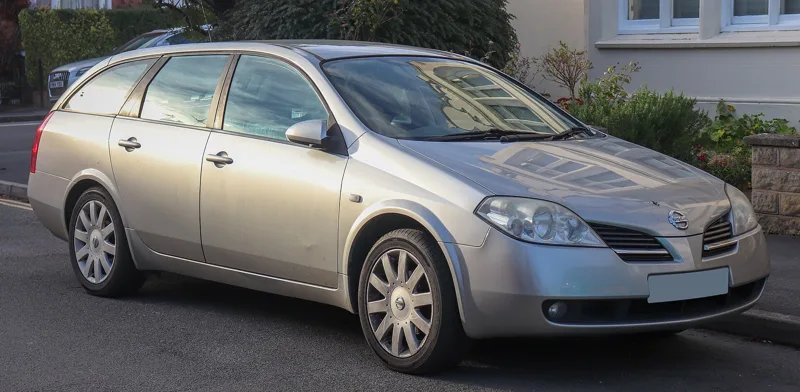
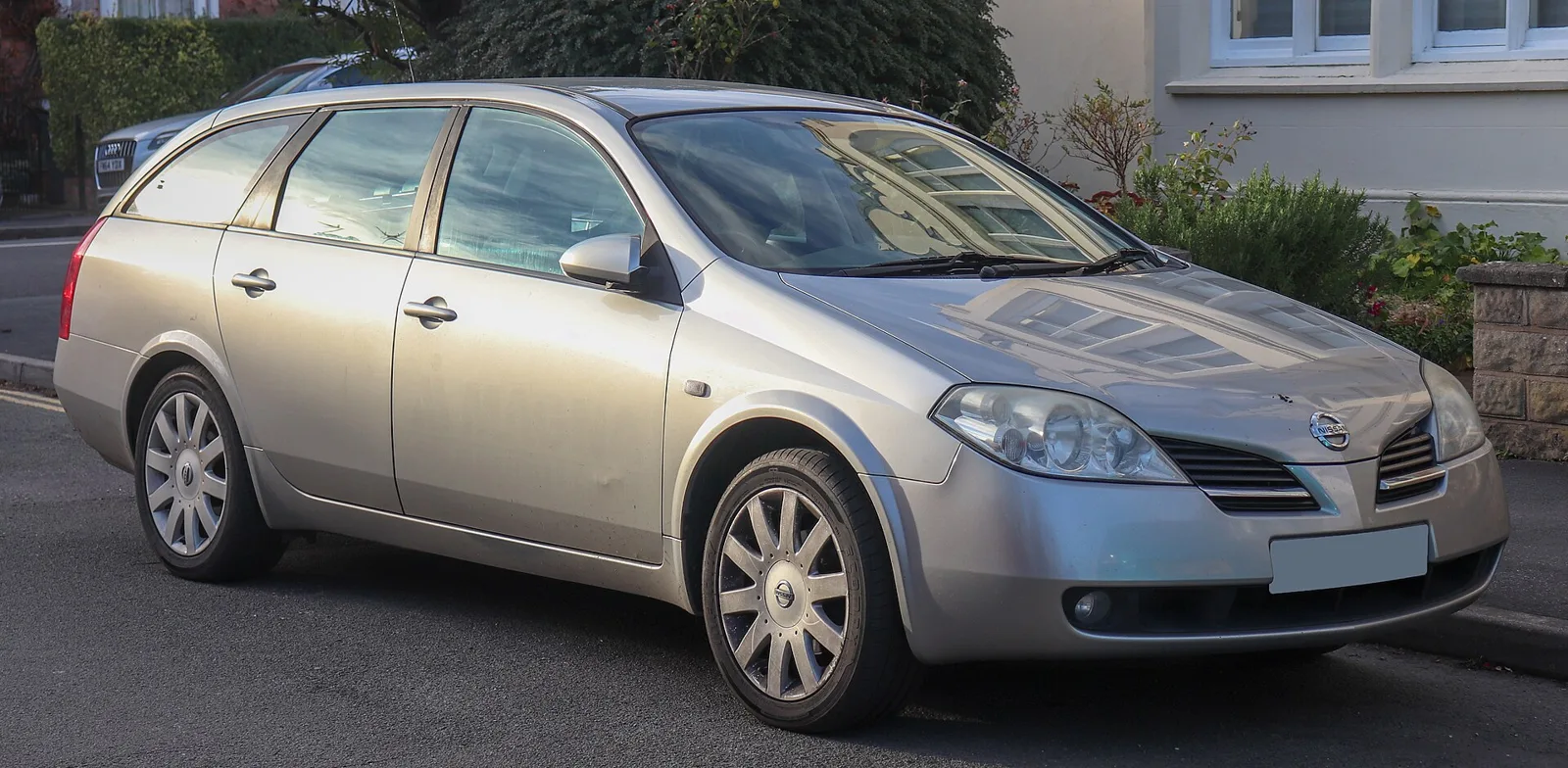
The estate WP11-120 replaced the previous generation Primera estate, which had still been on sale. Like the saloon, it was built by Nissan Motor Manufacturing (UK) in Sunderland.
What did the 1999 facelift bring?
The P11-144 facelift arrived in September 1999 and was sold only in Europe. The front, rear and side profile were all changed, which made it immediately recognisable. The wheelbase and chassis stayed unchanged, but the outer length grew by 26 mm (1.0 in).
Inside, new seats and instruments were fitted, and the dashboard was changed as well. The headlights and rear lamps had clear-glass styling, and the tailgate gained an electric release.
The estate, called WP11-144, changed less. Its basic body shape stayed almost the same, and the front and side profile were refreshed. The rear was carried over from the previous model apart from the bumper, so the tailgate release stayed mechanical.
Safety gained standard head airbags, and the brake system changed to one with a mechanical brake booster, which still had EBD. Automatic climate control and xenon lights were standard on the 2.0 models and on the 1.8 Elegance.
How did the engine range change after 1999?
The P11-144 brought in a 1.8 l four-cylinder rated at 113 PS (111 hp; 83 kW), a first for the Primera in Europe. Its valve gear, like that of the other petrol engines, used two overhead camshafts and a timing chain. Nissan dropped the 131 PS 2.0 and reduced the 150 PS version to 140 PS (138 hp; 103 kW).
Meanwhile the 1.6 l petrol unit (until early 2001) and the diesel remained unchanged.
Late changes and the end of the line
At the end of 2000 a set of changes was made, some of them cost-saving measures required by the sister brand Renault. Seals were removed from the bonnet, tailgate and headlights, and duplicate door seals were dropped.
The brake booster and rear discs were changed, and the sport equipment was removed. The final P11 can be recognised by its aerial, which now sits in the front roof area, and by a revised steering wheel. The model was replaced by the Primera P12 in June 2002.
How did the Primera P11 race?
From 1997 the Primera P11 raced in touring car championships around the world. It was developed from the production Primera GT and competed in Sweden, South Africa, Japan and Turkey, as well as in the German STW series and the British Touring Car Championship (BTCC).
The race cars were front-wheel drive and were built by a specialist race preparation firm. They produced 320 PS (316 hp; 235 kW) from the SR20DE engine, which was optimised for racing.
In South Africa the car took driver and manufacturer titles between 1997 and 1999. In the BTCC the racing Primeras won the manufacturers' title in 1998, and Anthony Reid finished second in the drivers' standings.
The following year Nissan won the BTCC constructors' title again, and Laurent Aiello and David Leslie took first and second in the drivers' championship. Having achieved its goals, the manufacturer then left the series.
In the German STW series the racing P11 replaced the outdated P10 from 1997. The 1998 season was its most successful there, with Roland Asch and Michael Krumm finishing eighth and ninth in the overall standings, before Nissan left the series.
Key specifications
| Specification | Detail |
|---|---|
| Launch | September 1996, notchback and hatchback |
| Estate | WP11-120 from the September 1997 facelift |
| 1.6 l engine (GX, Si) | 1.6 l (98 cu in); 100 PS (99 hp; 74 kW) after the 1997 facelift |
| 2.0 l engine (SE, GT) | 2.0 l (122 cu in); 131 PS (129 hp; 96 kW) at launch |
| GT engine from April 1997 | 2.0 l SR20DE; 150 PS (148 hp; 110 kW) |
| Turbo diesel | 2.0 l CD20T; 90 PS (89 hp; 66 kW) |
| 1.8 l engine (1999 onwards) | 113 PS (111 hp; 83 kW) |
| Length change, P11-144 | 26 mm (1.0 in) longer |
| Front brake disc, 2.0 models | 280 mm diameter |
| Successor | Primera P12, June 2002 |