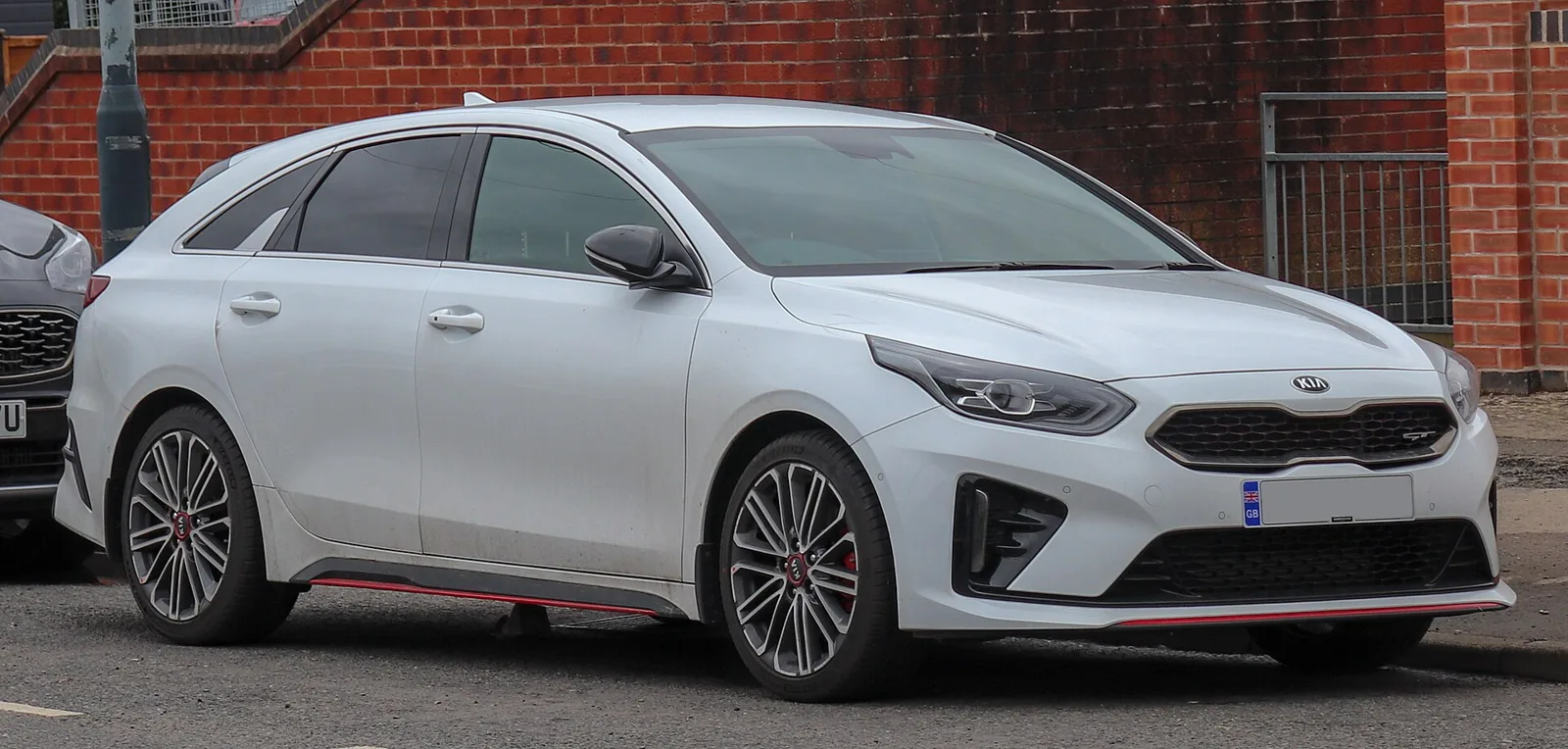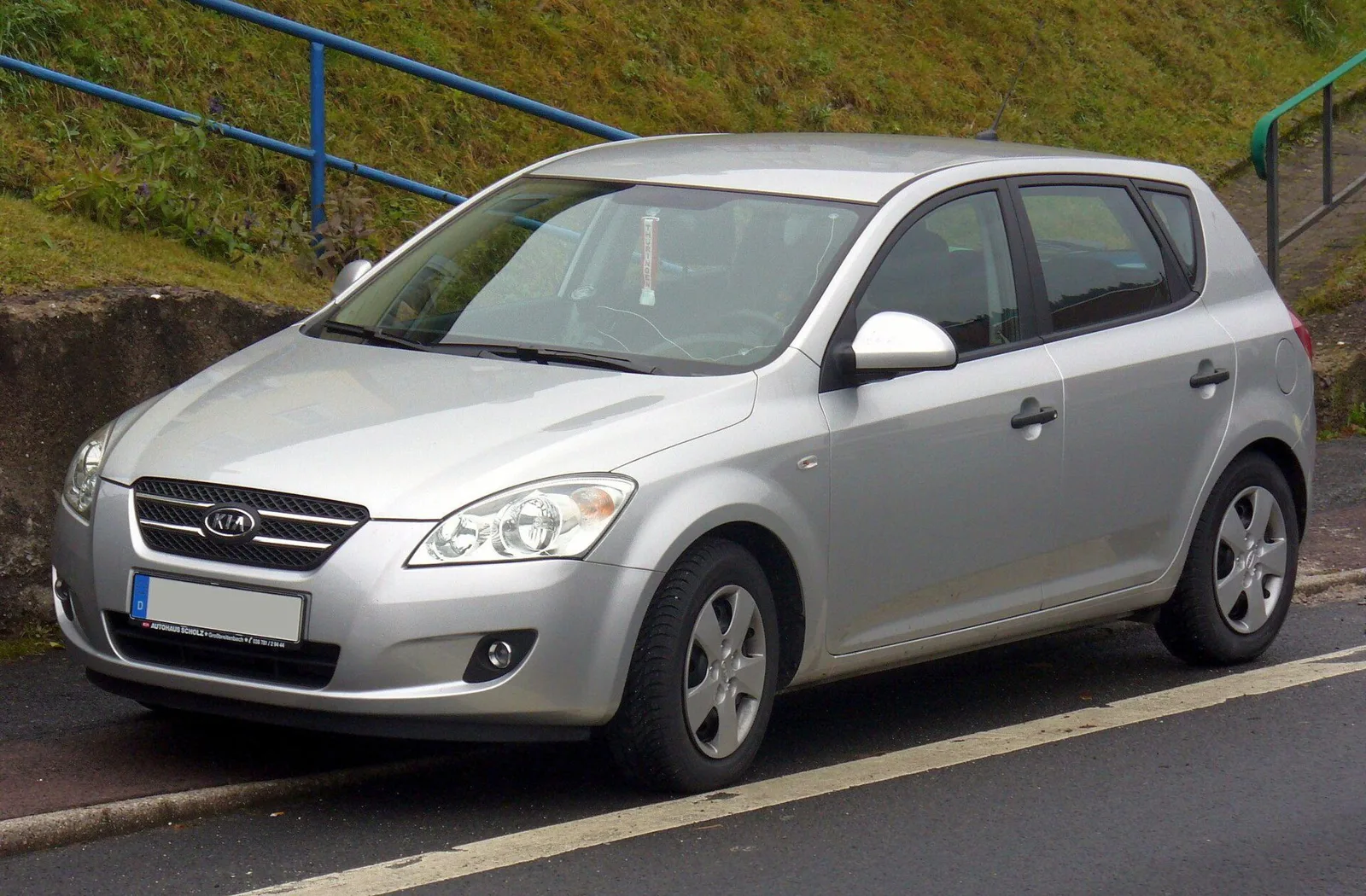
Built at Zilina in Slovakia from 2006, the first cee'd combined five-door, estate and three-door bodies with petrol and diesel engines, autogas conversion and a record-breaking output.
The Kia cee'd (ED) was Kia's first car developed and produced in Europe, shown at the 2006 Paris Motor Show as the successor to the Cerato. Built at Zilina in Slovakia until February 2013, it came as a five-door, estate and three-door with petrol and diesel engines.
The Kia cee'd (ED) was the first Kia developed and produced in Europe, and it became the brand's biggest success on the continent so far. Kia Motors unveiled it at the Paris Motor Show on 28 September 2006, replacing the Cerato in the range. Built at a new plant in Zilina, Slovakia, it went on to win ten national Car of the Year titles.
Where did the Kia cee'd (ED) come from?
The cee'd began as a concept study shown at the Geneva Motor Show in spring 2006. Kia presented the production car in Paris that September, alongside two further studies, the pro_cee'd and the cee'd_sw. Test production began in Zilina in May 2006 and series production started on 7 December 2006.
The name has several layers. Cee'd is pronounced like the English word seed, and it combines the French abbreviation for European Community (CE) with ED for European Design. ED was also the internal development code, and the design was drawn up in Russelsheim.
Jean-Charles Lievens, Senior Vice President of Kia Motors Europe, described the cee'd as the seed for the sales growth Kia wanted from the model. He tied the name to the brand's core claims of quality, trustworthiness and dynamism.
The first Kia developed and produced in Europe, and the brand's biggest success there so far.
Why did building the cee'd in Europe matter?
The Zilina plant cost one billion euros and began test production in May 2006 with 2,400 workers in two shifts. Those workers also made the engines. Series production started on 7 December 2006, and 75 percent of the components came from European suppliers.
Lievens presented the start of production as a broad quality push for the brand, with European-oriented design and a high-quality look shaping every aspect of the car. He called the cee'd the strongest challenger the brand had ever fielded in the European C-segment.
Russian production followed. The company Avtotor started building the car under licence on 15 March 2007, exactly ten years after the first Kia model had been made in Russia. At first it only assembled parts supplied from Zilina; complete production in Kaliningrad came later.
Which engines did the cee'd offer?
The cee'd had three petrol engines of 1.4, 1.6 and 2.0 litres, and diesels of 1.6 and 2.0 litres. Across the petrol range, output ran from 66 kW (90 PS; 89 hp) to 105 kW (143 PS; 141 hp). Every petrol engine could also be converted to run on autogas.
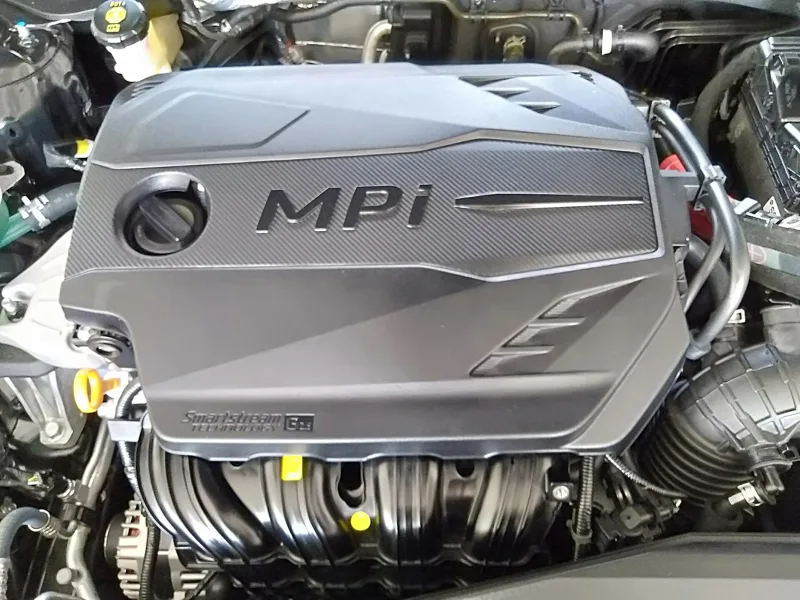
The petrol engines were developed further for the range. All but the 2.0 had aluminium blocks, and two overhead camshafts, driven by a timing chain on the 1.4 and 1.6 and by a toothed belt on the 2.0. The CVVT name stands for continuous variable valve timing, and these engines used multi-point injection with a regulated three-way catalytic converter.
The diesels are Kia's CRDi common-rail engines, with variable-vane turbochargers (VTG) and grey cast iron blocks. The two 1.6-litre units were new designs built in Zilina. The largest diesel was already used in the Kia Carens and joined the cee'd range in July 2007, with a single overhead camshaft driven by a toothed belt.
Emissions rules shaped the line-up. Euro 5 became mandatory on 1 January 2011, and the 2.0 diesel could not meet it, so during 2010 it was replaced by a 1.6-litre diesel of 94 kW (128 PS; 126 hp). The 2.0 petrol was also dropped in August 2010 because it did not meet Euro 5.
Engine range at a glance
| Power | Engine | Displacement | Production |
|---|---|---|---|
| 66 kW (90 PS; 89 hp) | 1.4 l Gamma CVVT petrol | 1,396 cc (85.2 cu in) | Sep 2009 to 2011 |
| 77 kW (105 PS; 103 hp) | 1.4 l Gamma CVVT petrol | 1,396 cc (85.2 cu in) | 2011 to April 2012 |
| 80 kW (109 PS; 107 hp) | 1.4 l Gamma CVVT petrol | 1,396 cc (85.2 cu in) | Dec 2006 to Sep 2009 |
| 90 kW (122 PS; 120 hp) | 1.6 l Gamma CVVT petrol | 1,591 cc (97.1 cu in) | Dec 2006 to Dec 2007 |
| 92 kW (125 PS; 123 hp) | 1.6 l Gamma CVVT petrol | 1,591 cc (97.1 cu in) | Sep 2009 to Feb 2013 |
| 93 kW (126 PS; 124 hp) | 1.6 l Gamma CVVT petrol | 1,591 cc (97.1 cu in) | Dec 2007 to Sep 2009 |
| 105 kW (143 PS; 141 hp) | 2.0 l Beta II CVVT petrol | 1,975 cc (120.5 cu in) | Dec 2006 to Aug 2010 |
| 66 kW (90 PS; 89 hp) | 1.6 l CRDi diesel | 1,582 cc (96.5 cu in) | Jan 2007 to April 2012 |
| 85 kW (115 PS; 113 hp) | 1.6 l CRDi diesel | 1,582 cc (96.5 cu in) | Jan 2007 to Feb 2013 |
| 94 kW (128 PS; 126 hp) | 1.6 l CRDi diesel | 1,582 cc (96.5 cu in) | Aug 2010 to Feb 2013 |
| 103 kW (140 PS; 138 hp) | 2.0 l CRDi diesel | 1,991 cc (121.5 cu in) | Aug 2007 to Sep 2010 |
Could the cee'd run on autogas?
Autogas conversion was available for all three petrol engines from April 2007. A converted car switched between gas and petrol at the push of a button, and its power and boot space were kept, though a tyre repair kit replaced the spare wheel.
Each conversion added a second steel tank in the spare wheel well, fitted with a pressure relief valve, a fusible plug and an 80 percent stop, so the tank was filled only to 80 percent. Gas injectors, a pressure regulator with an evaporator, a separate LPG control unit and a changeover switch completed the kit. The LPG control unit calculated the injection quantities from the engine control unit's data, which kept watching combustion.
Kia said emissions of CO2 and soot particles fell by up to 80 percent in total, while gas mode used 10 to 15 percent more fuel because gas holds less energy. Kia gave three years of warranty on the converted parts, their fitting and any consequential damage, and the regular warranty was left untouched.
According to Kia, the extra cost of 2,699 to 2,899 euros would pay back after about 68,000 km. Pressure in the gas tank runs between six and twelve bar, and the injection pressure is two bar.
Which gearboxes did the cee'd use?
The cee'd came with a five-speed manual or a six-speed manual, both with a single-plate dry clutch, or a four-speed automatic with a torque converter lock-up clutch. The six-speed manual arrived with the facelift, for the 1.6-litre diesels.
Both manual boxes had cone synchronisers for first and second gear, which were meant to make gear changes faster and more precise. To stop reverse gear being engaged by accident, the driver had to lift a safety ring on the gear lever before engaging it.
The four-speed automatic had an electronic control unit that monitored acceleration, deceleration, engine speed and road speed among other parameters. Kia expected only a small share of buyers to choose the automatic, and motoring journalists did not find that surprising.
How did the cee'd drive and brake?
The cee'd used a speed-dependent electro-hydraulic rack-and-pinion steering system, MacPherson struts at the front and a multi-link rear axle. Ventilated front discs measured 280 mm, and the braking system came with ABS, EBD, BAS and a brake booster as standard.
Steering needs 2.69 to 2.86 turns of the wheel, depending on tyre size, and the turning circle is 10.3 to 10.8 metres. The front suspension uses wishbones with MacPherson struts, gas-pressure dampers and anti-roll bars. The multi-link rear axle is meant to provide comfort and good handling.
The rear brakes used 262 mm discs, and the car needed between 38.7 and 39.7 metres to stop from 100 km/h. Ground clearance on the five-door was 150 mm. Exterior length ran from 4.24 to 4.49 metres (13.9 to 14.7 ft), which put the cee'd between the VW Golf VI and the Ford Focus.
Body styles and trim levels
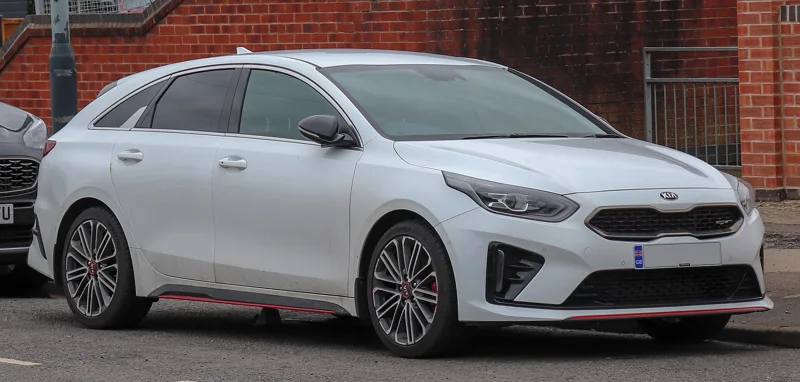
The five-door reached Germany on 20 January 2007 with five engine options and four equipment variants. The estate cee'd_sw followed in August 2007, and the sportier three-door pro_cee'd arrived in December 2007. Unlike the Cerato it succeeded, the cee'd had no saloon body.
The bodies differed in design details. The pro_cee'd shared only its bonnet and front wings with the cee'd, while the interior was the same in all versions apart from the door trims. Every body was a five-seater.
At launch the trims were LX Basis, LX, EX and TX. LX Basis was offered only on the five-door with the smallest petrol engine, and the TX came only with 2.0-litre engines.
The autumn 2009 update renamed the entry model Attract and added Vision, Spirit and a new top model, Mind. Two-zone automatic climate control became an option, and a hill-start function was added to the ESP.
Standard kit included six airbags, ABS, ESP (except Attract), traction control, electric front windows and central locking. Water-repellent side windows from the EX version upward, along with chip-controlled wipers, were a feature unusual in the C-segment.
The audio system, standard in every trim, was tuned specially for the car, the first Kia model to receive that treatment. It had an RDS radio with CD and MP3 player, four speakers (six from the LX version) and a steering wheel with integrated controls.
What did the sport package add?
In Germany all three bodies could be ordered with a sport package. It added dark-rimmed front headlamps, a radiator grille with four chrome bars similar to the cee'd concept car, and 5-spoke aluminium wheels on 225/45 R17 tyres.
In the cabin, the sport pack brought black trim, stainless steel sill plates, aluminium pedals and contrasting light grey stitching on the seats, wheel and leather armrest. Five-door versions also had front seat heating, and from August 2008 they gained tyre pressure monitoring and a passenger seat that adjusts for height.
The facelifted sport package added piano-black trim: a sport radiator grille, headlamp surrounds and decorative strips. Optional extras included metallic paint, leather seats (until 09/2009 on the TX) and an electric glass sliding and tilting roof from EX and Spirit.
How many cee'd cars were built?
Production at Zilina ran from December 2006 to February 2013. More than 63,000 hatchbacks were built by June 2007, the 100,000th cee'd rolled off the line on 3 October 2007, and the 1,000,000th vehicle left the Kia plant on 26 January 2012.
Output records came quickly. In April 2007 one day produced 830 units, and in May 2007 the monthly total reached 14,000 against a plan of 10,000. In April 2008 new records were set at 915 units a day, 4,474 a week and 19,300 a month.
The estate started production on 20 July 2007, a month earlier than planned, and built more than 1,000 units in its first week. The pro_cee'd followed on 25 October 2007, six weeks ahead of schedule.
Kia aimed for 100 vehicles per employee a year at full capacity, which would have made the Slovak plant the most productive car factory in Europe. A white cee'd_sw was the 500,000th European-built Kia model, produced in January 2010.
Recalls, awards and the second generation
The first generation won ten national Car of the Year prizes from European trade publications, and it became Kia's biggest European success to date. The magazine Der Stern called Kia's automatic gearboxes somewhat antiquated and in need of getting used to.
A June 2010 recall called back every cee'd with electronic stability programme built between April 2008 and March 2009. In Germany 12,500 vehicles were affected, because a brake circuit could fail and reduce braking force.
Kia gave two cars from the production line to charity. The 500,000th went to a transplant centre in Martin, and the 1,000,000th went to the Rote Nasen Clowndoctors International foundation.
The second generation, designated JD, was presented at the Geneva Motor Show in 2012.