A limited run of up to 1,350 cars from 2016 to 2023, chosen through an application process, with a track record that began at Daytona.
The Ford GT was a mid-engined supercar built by Ford from 2016 to 2023, in limited numbers of up to 1,350 cars. Buyers were chosen through an application programme, and the car used a 656 PS twin-turbo V6 with a seven-speed dual-clutch gearbox.
Ford built this mid-engined supercar in limited numbers between 2016 and 2023. Buyers could not simply order one, since the company picked them from a large pool of applicants. The car took over from the GT40 and from the 2004 to 2006 Ford GT.
How did buyers get a Ford GT?
Buyers had to pass a formal application programme that asked how often they would drive the car, how active they were on social networks and how many Ford vehicles they owned. The process could be completed in 21 countries, Germany among them, and a personal interview came before any purchase.
Ford first planned at least 300 cars, with 150 each for 2017 and 2018. It then raised the total to 1,350, built over six years. Applications for the first 500 units ran from 13 April 2016 to 12 May 2016, and more than 6,500 people applied in total.
The 250 cars of the 2019 production year went only to applicants who had been turned down in the first round. New applications opened on 8 November 2018 for a further 350 units, which were earmarked for the final production years, 2021 and 2022.
Up to 1,350 cars, more than 6,500 applicants, and a race record that started at Daytona.
When did production and deliveries start?
Production started on 16 December 2016 in a new manufacturing facility in Markham, Canada, and the first cars reached customers shortly afterwards. European deliveries began in February 2018. In Germany the price was around 530,000 euros, and nine of the first 250 cars from 2017 were reportedly delivered there.
Selected customers had learned in July 2016 that their applications had succeeded, before production started in Markham in December 2016.
Why did one buyer's resale end in court?
Wrestler John Cena resold his Ford GT a month after receiving it in October 2017. Ford sued him, pointing to clauses in the application process and in the order confirmation contract. Those terms reportedly banned resale for the first two years after delivery.
The dispute shows that the application process did not end at delivery. The order contract carried its own limits on resale, and Ford relied on both documents when it went to court.
What engine and chassis did the Ford GT use?
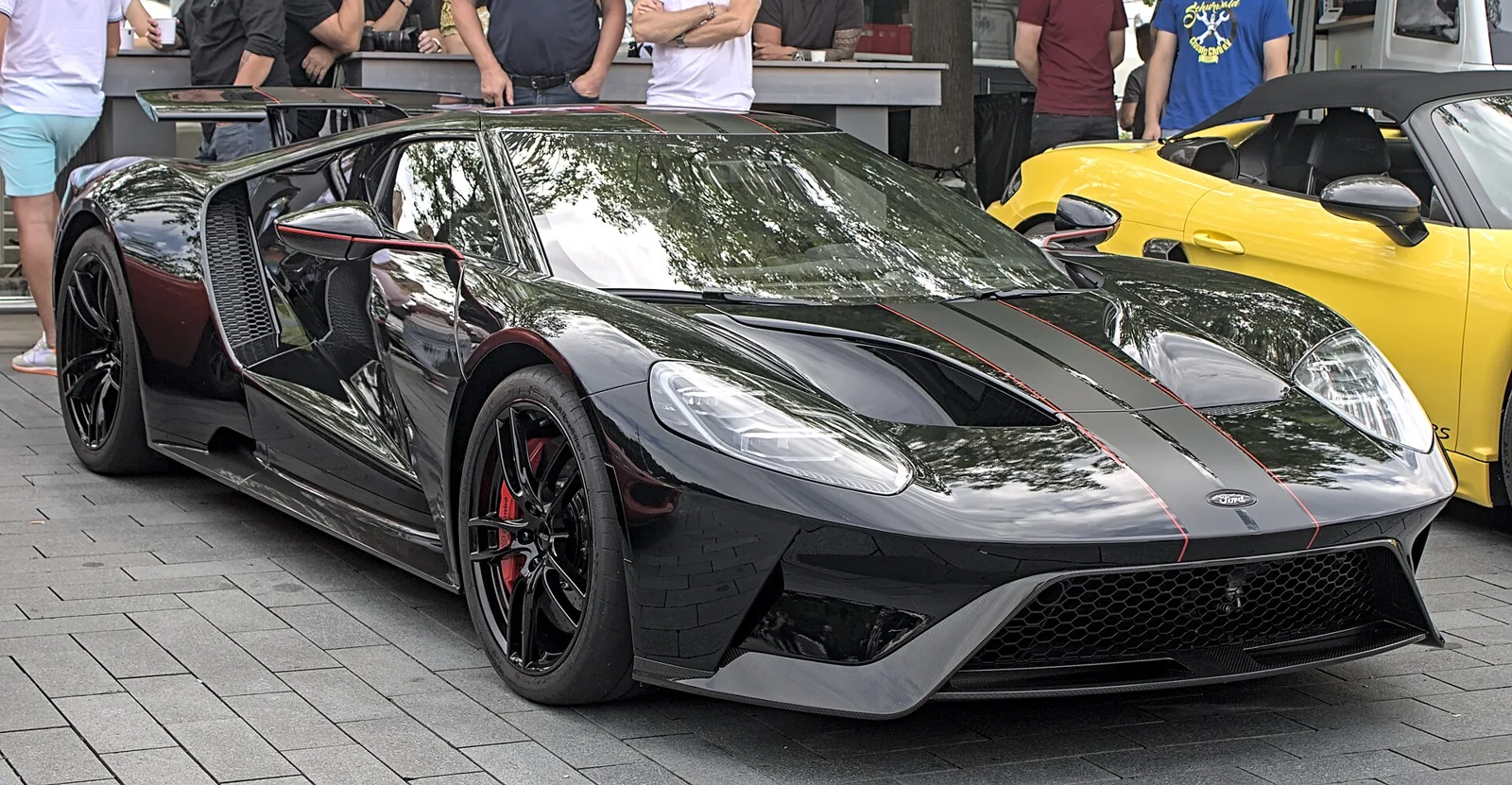
The Ford GT used a monocoque of carbon-fibre-reinforced plastic (CFRP) with an aluminium frame. Its EcoBoost V6 had 3.5 litres (213.6 cu in) and two turbochargers, producing 483 kW (656 PS; 647 hp). That was enough for up to 347 km/h (216 mph), sent to the rear wheels through a seven-speed dual-clutch gearbox with paddle shifters.
Unlike its predecessor, the Ford GT had butterfly doors. The suspension used height-adjustable push-rod arms with an active anti-roll bar, and the rear wing could be adjusted in both height and angle of attack. Several air-guiding parts reacted to the driving situation, and racing technology appeared throughout the car.
The car rode on 20-inch light-alloy wheels with carbon-ceramic brake discs. Its tyres, of the Pilot Sport Cup 2 type, were developed specially for the Ford GT.
What special editions did Ford build?
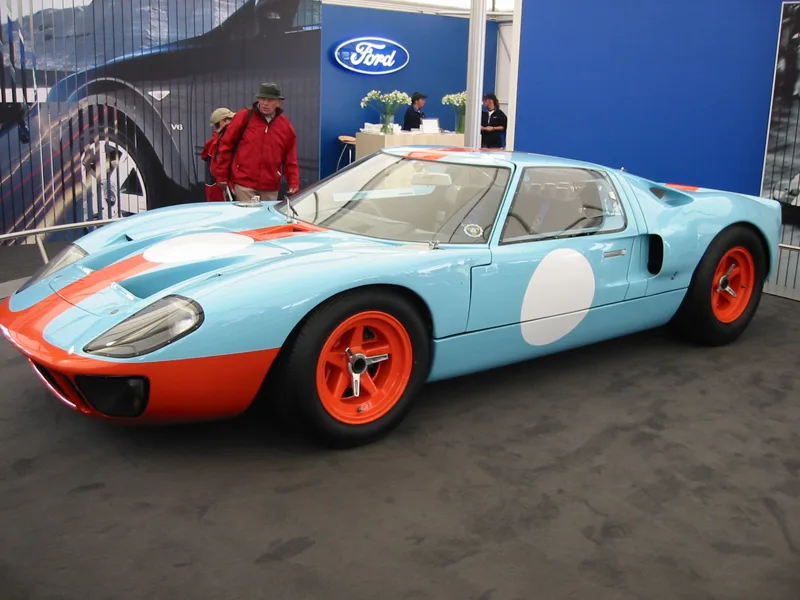
Ford built a run of Heritage Editions, most of them tied to a famous GT40 result. The first, the '66 Heritage Edition, was limited to 50 cars and honoured the GT40 that won Le Mans in 1966. Later editions recalled the 1967 Le Mans winner, the Gulf-liveried GT40 that won in 1968 and 1969, and two 1966 race cars.
The '66 Heritage Edition came in Shadow Black, with silver rally stripes and a visible carbon package. Its bonnet and doors carried graphics referring to the number 2 GT40 in Frozen White, and the aluminium wheels were glossy gold. Ebony leather, gold trim and blue safety belts completed the cabin.
The '67 Heritage Edition was finished in Race Red with white stripes and start number 1. It had red accent stitching, red safety belts and anodised paddle shifters, and it was offered for the 2018 model year.
The 2019 Heritage Edition used Heritage Blue with Heritage Orange stripes. Cars built in 2019 carried start number 9 and those built in 2020 carried start number 6. Its seats were embossed with a pattern inspired by the 1968 winning car.
The 2021 Heritage Edition, presented in August 2020, used a black bonnet, red elements, black stripes and start number 98. The Alan Mann edition, shown in Chicago in February 2022, wore red and gold paint with start number 16. The Holman Moody edition, shown in New York in April 2022, was said to be the last special model of the series.
The final run was the LM Edition, the last 20 cars, with a Liquid Silver base and red and blue designs. It was presented in October 2022.
How did the Competition and Carbon Series differ?
The Competition Series, presented in February 2017, was a lighter GT offered only in North America, with a carbon racing stripe and no air conditioning or radio. The Carbon Series followed in October 2018 for the American market. It was 18 kg (40 lb) lighter than the base car but kept an air conditioner and audio system.
The Competition Series lowered its centre of gravity with a lighter acrylic engine cover and carbon-fibre-reinforced A-pillars and exterior mirrors, which improved road holding. Air conditioning, the radio, speakers, luggage shelves and cup holders were all dropped to save weight. The car came in black, white, silver, blue, grey and yellow.
The Carbon Series used more carbon parts, titanium wheel nuts, a titanium exhaust and a polycarbonate engine cover. An optional accent package added colour to the mirrors, brake calipers and a thin stripe. Only one example per week was to be built.
What was the GT Mk II?
The GT Mk II was a non-road-legal expansion of the Ford GT, limited to 45 cars and shown at the Goodwood Festival of Speed in 2019. Ford said its track performance beat GT3 and GTD racing cars, yet it was homologated for no racing series and could only be used at track days.
The Mk II was developed with a specialist race-car builder and started at the Ford GT main plant in Markham before it was converted and completed at that builder's special factory. Ford said its aerodynamic add-ons generated more downforce than those of the GTE racing version, and many of its components came from that car.
Changes included an engine now producing over 700 PS, five-way adjustable dampers, race tyres, a newly calibrated gearbox, a large roof air intake, a racing seat with six-point harnesses and a telemetry system. The starting price was 1.2 million US dollars.
Demand was so strong that the builder's president said all 45 cars could have sold on the day of the presentation. The order window closed on 31 August 2019.
Ford GT specifications at a glance
| Item | Detail |
|---|---|
| Engine | EcoBoost V6, 3.5 litres (213.6 cu in), two turbochargers |
| Output | 483 kW (656 PS; 647 hp) |
| Top speed | Up to 347 km/h (216 mph) |
| Drive and gearbox | Rear-wheel drive, seven-speed dual-clutch with paddle shifters |
| Body and chassis | CFRP monocoque with aluminium frame, CFRP body, butterfly doors |
| Wheels and brakes | 20-inch light-alloy wheels, carbon-ceramic brake discs |
| Carbon Series | 18 kg (40 lb) lighter than the base model |
| GT Mk II | 45 units, engine over 700 PS |
| Production | Up to 1,350 vehicles, 2016 to 2023 |
How did the Ford GT perform in racing?
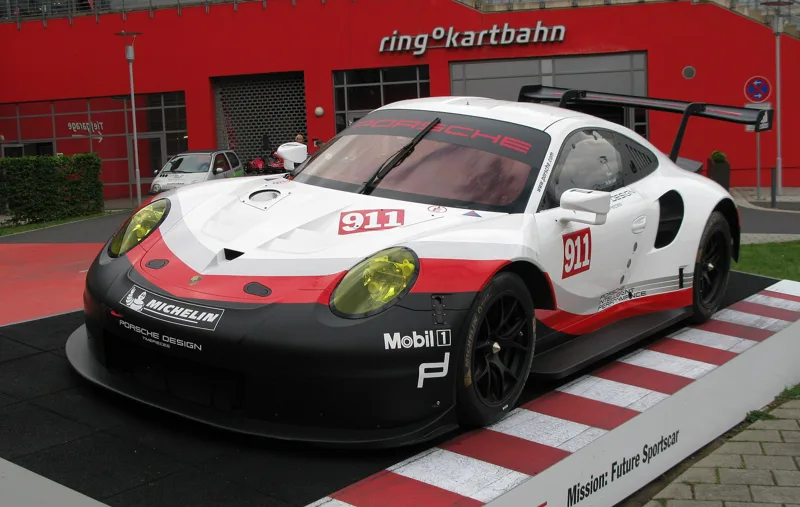
The Ford GT made its racing debut at the 2016 24-hour race at Daytona, where the Chip Ganassi Racing cars finished seventh and ninth in the GTLM class after technical problems. That season, Ryan Briscoe and Richard Westbrook won three IMSA races and finished second in the overall standings.
Ford also fielded two cars in the 2016 FIA World Endurance Championship in the LMGTE Pro class, through Chip Ganassi Racing UK. At Le Mans in 2016 the team ran two more cars under the Chip Ganassi Racing USA name. One of them won the class, and the other took third.
The best of the UK team's cars finished fourth in its class, a lap down. The Competition Series had been presented only weeks after the car's first class win at Daytona. In 2017 the Chip Ganassi crew of Sebastien Bourdais, Joey Hand and Dirk Muller won the GTLM class at Daytona.
Has the Ford GT appeared outside racing?
The Ford GT appeared in several racing simulations, and its video game debut came in a 2015 racing title, where it also featured on the cover. It later turned up in other simulators, including iRacing and Gran Turismo Sport. In March 2023 a 1:12-scale building set of the car, with 1,466 parts, was released.