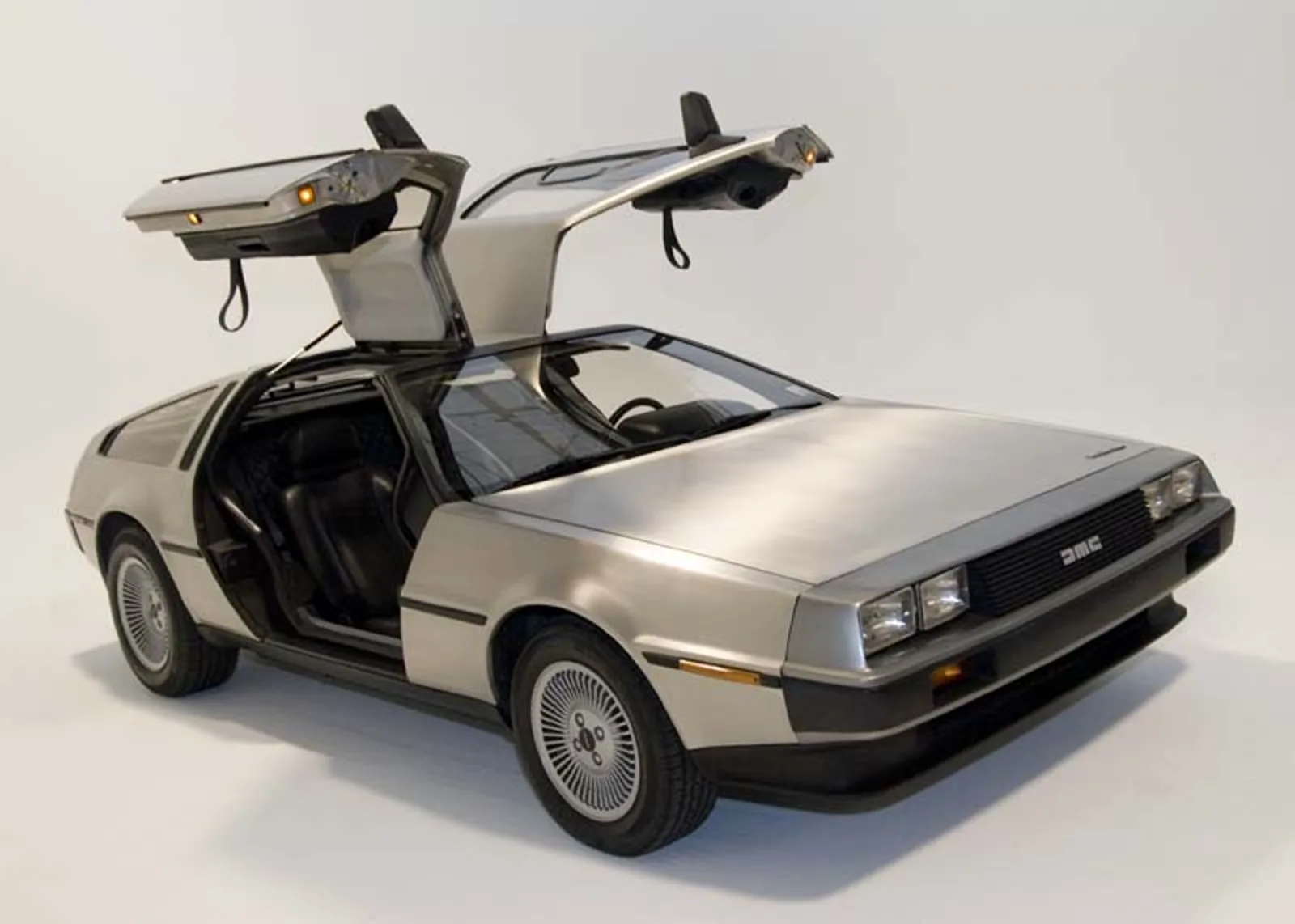
A rear-engined, gull-winged stainless steel sports car built for one brief American run, now best known as a time machine.
The DeLorean DMC-12 was a rear-engined, stainless steel sports car built from 1981 to 1983 by John DeLorean's company. It used a 2.85 L PRV V6 and gull-wing doors. An estimated 8,975 cars were built before bankruptcy ended production. Its styling came from Giorgetto Giugiaro of Italdesign.
The DeLorean DMC-12 is the stainless steel, gull-winged sports car that John DeLorean built in Northern Ireland. Only one car reached the market before the company collapsed in 1982, and it is far better known today from films than from its sales figures. This profile covers the design, engineering, production story and long afterlife of the car.
The car's story is one of ambition running ahead of engineering. Its look was ready years before its mechanics were settled, and the gap between the two shaped nearly every decision the company made.
What was the DeLorean DMC-12?
The DeLorean was a rear-engined two-seat sports car built for the American market from 1981 to 1983. Giorgetto Giugiaro of Italdesign styled it, and it used a brushed stainless steel body and gull-wing doors. It was the only car the DeLorean Motor Company ever brought to market.
John DeLorean left General Motors in 1973 to form his own company. The DMC-12 name came from the car's target price of $12,000, and the first prototype was completed in October 1976.
Even the name tells a story about change. The prototype began life as the DSV-1, short for DeLorean Safety Vehicle, and the name shifted as the design matured into the production car sold as the DeLorean.
Built for a brief American run and a sales figure that never matched the hype, the DeLorean outlived its maker through a single film.
Why is the body made of stainless steel?
Stainless steel was chosen to avoid the paint-finish problems of the ERM plastic process. Rather than solve the painting, the company used brushed austenitic SAE 304 stainless steel for the body panels, fixed to a fiberglass underbody.
The panels sat on an epoxy-coated steel backbone chassis derived from the Lotus Esprit platform. Lotus engineers replaced the unproven materials of the early plan with steel, and that change made the car buildable in volume.
Giugiaro drew on his earlier Porsche Tapiro concept of 1970 for the shape. The wooden styling mock-up was shipped to the DMC office on July 31, 1975, and it later went to the Ulster Folk and Transport Museum.
What engine did the DeLorean use?
The DeLorean used a 2.85 L PRV V6 with a 91 mm bore and a 73 mm stroke. It was derated to 130 hp (132 PS; 97 kW) at 5,500 rpm, and it produced 153 lb-ft (207 N m) of torque at 2,750 rpm. The engine sat in the rear, which gave the car its unusual weight distribution.
The compression ratio of 8.8:1 was paired with Bosch K-Jetronic fuel injection. That combination was typical of the period, and it balanced reasonable economy with usable low-speed pull for a car of its size.
Rated output was modest by the standards of the day, and it was one reason the car's performance fell short of the company's claims. Owners who expected a fast sports car often found a relaxed grand tourer instead.
How were the transmission, steering and brakes set up?
Buyers could choose a 5-speed manual or a 3-speed automatic, and both transmissions used a final drive ratio of 3.44:1. The automatic was the only extra-cost factory option, priced at $650.
Steering used a 14.9:1 ratio, giving 2.65 turns lock to lock, and the car had power-assisted disc brakes with 10-inch front rotors. Wheels were staggered, with 14 inch fronts and 15 inch rears.
Front suspension used double wishbones, while the rear used a multi-link setup. The weight distribution was 35%-65% front to rear, which shaped how the car behaved on a fast bend and under hard braking.
The car also suffered from a nose-high stance. That look came from springs of poor quality rather than from bumper rules, and it was a visible flaw that buyers noticed straight away.
How many DeLoreans were built?
An estimated 8,975 DeLoreans were built. The 1981 model year accounted for 6,700 cars, the 1982 model year for an estimated 1,999 and the 1983 model year for an estimated 276. Those totals are estimates rather than confirmed counts.
By the end of 1981 DMC had built 7,500 cars but sold only 3,000. October 1981 remained the best month, with 720 vehicles sold, before demand fell away sharply.
Only 350 cars sold in January 1982, and the company went into receivership in February 1982. Telegrams to 343 dealerships asked each one to buy six cars, but none of them responded with an order.
What went wrong with sales and production?
The gap between output and sales was the central problem. The factory kept building cars that buyers were not taking, and the inventory piled up on dealer lots and at the docks.
Quality issues made the position worse. Early cars needed as much as 200 hours of work before they were shipped, and the factory issued four recalls. Dealers were reluctant to do warranty work, and no proper service manual was ever issued.
The company filed for bankruptcy on October 26, 1982. Consolidated International bought the unsold cars and assembled about 100 more, finishing the run in December 1982. The episode left the DeLorean with a reputation that the car itself never fully escaped.
What did the DeLorean cost?
The base MSRP was $25,000 when the car launched in 1981, the equivalent of about $89,000 in 2025. The price rose to $29,825 in 1982 and to $34,000 in 1983, even as sales were falling.
Dealer options were limited to accessories such as a car cover, floor mats and a ski-rack adapter, so the core price was the figure that mattered to buyers.
How fast was the DeLorean?
DMC claimed 0-60 mph in 8.8 seconds with a manual, but Road & Track measured 10.5 seconds. The claimed top speed was 130 mph, while testers recorded 110 mph.
The gap between claims and measurements was part of why the car was judged a disappointment on the road. Reviewers who had expected a sports car found a comfortable car with modest pace, which suited daily driving better than fast corners.
What is the Back to the Future connection?
The DeLorean became the time machine in the Back to the Future films, and six cars were used during production. Only three of the film cars still exist. One of them sold at auction for $541,200 in December 2011.
The film made the car instantly recognisable, and it kept a following long after the company shut down. Clubs run across North America and Europe, and about 6,500 DeLoreans were estimated to be on the road in 2015.
Film exposure gave the car a second life that few sports cars of its era enjoyed. Today it appears in museums, car shows and video games, and its gull-wing silhouette is one of the most recognised shapes in car culture.
Which DeLoreans were turbocharged or gold-plated?
Legend Industries of Hauppauge, New York, converted four DeLoreans to turbo power for DMC. The twin-turbo car ran 0-60 mph in 5.8 seconds and the quarter mile in 14.7 seconds. DMC planned a turbo option at $7,500 in 1984, but bankruptcy ended the plan.
DMC had ordered 5,000 engines from Legend Industries before the company failed. Gold-plated cars were also planned, with 100 offered for $85,000 each to American Express card holders, but only two sold.
How were right-hand-drive and prototype cars handled?
Every production car was left-hand drive. A post-production conversion by Wooler-Hodec produced 13 right-hand-drive cars, and three factory-authorised RHD cars were registered AXI 1697, 1698 and 1699.
About 28 pilot cars were built for evaluation and regulatory testing. Prototype-1 sold at the 1984 bankruptcy auction for $37,000, while the Visioneering car, which cost $750,000 to assemble, sold for $21,000.
What are the DeLorean DMC-12 specifications?
The table gathers the core figures for the production car, from the 1981 launch to the final 1983 cars. Each row names the element it covers, so the engine, body and pricing details are easy to find without searching through the text.
| Specification | Detail |
|---|---|
| Production | 1981 to 1983 |
| Estimated total | 8,975 cars |
| Engine | 2.85 L PRV V6, 130 hp (132 PS; 97 kW) at 5,500 rpm |
| Torque | 153 lb-ft (207 N m) at 2,750 rpm |
| Transmissions | 5-speed manual or 3-speed automatic; final drive 3.44:1 |
| Steering | 14.9:1 ratio, 2.65 turns lock to lock |
| Body | Brushed SAE 304 stainless steel |
| Base MSRP | $25,000 in 1981; $29,825 in 1982; $34,000 in 1983 |
| Claimed 0-60 mph | 8.8 seconds with a manual |
| Factory | Dunmurry, Northern Ireland |
The figures show a car built around a modest engine and a distinctive body. The specification sheet explains much of the on-road character that reviewers described.
Why does the DeLorean still attract owners?
The DeLorean keeps a following because its design is instantly recognisable and its story is unusual. Its stainless steel body never needed paint, and its gull-wing doors give it a look that few production cars have matched in the decades since production ended.
Owners often describe the car as a hands-on project. Because the factory has closed, parts and repair know-how have passed between enthusiasts rather than through a dealer network, which has created a close community around the car.
Collectors also value the early cars for their details. Hood styling, wheel centre caps and radios changed during production, so model-year quirks give enthusiasts plenty to study and compare.
The car also appears in discussions about failed ventures and industrial history, which keeps its story alive for people who were not born when it was built and who see it as a case study in ambition.
What was it like to drive the DeLorean?
On the road the DeLorean felt more like a grand tourer than a sports car. Its seats were comfortable on long drives, and its ease of entry and exit in tight parking spaces made it easier to live with than its looks suggested.
Reviewers praised its daily-driver qualities, including a spacious boot for such a low car and a pleasant leather interior. They also noted that its handling was enjoyable on winding two-lane roads rather than on a racetrack.
The mismatch between the sporting look and the relaxed performance is the car's central tension. It is why many owners now see it as a styling exercise as much as a driving machine.
That tension also explains why the DeLorean remains an interesting case for car historians, who can trace how a striking design met a difficult engineering and business reality.
Frequently asked questions
Is the DeLorean still popular?
Enthusiasm has lasted well beyond the company's collapse. Owners' clubs operate in several countries, and the car remains a fixture at shows and museums.
Who designed the DeLorean body?
Giorgetto Giugiaro of Italdesign designed the body, drawing on his Porsche Tapiro concept from 1970.
Did a turbo version ever reach buyers?
No. Legend Industries developed a twin-turbo car and tested it, but the planned 1984 option never reached buyers before the company went bankrupt.
How much did the DeLorean cost?
The base price was $25,000 in 1981, or about $89,000 in 2025. It rose to $29,825 in 1982 and to $34,000 in 1983.