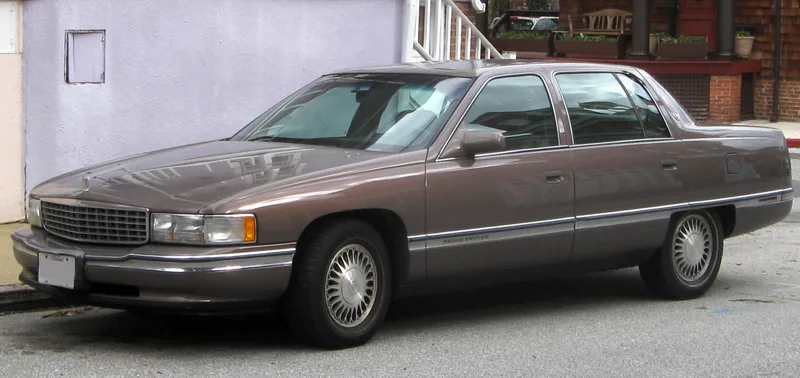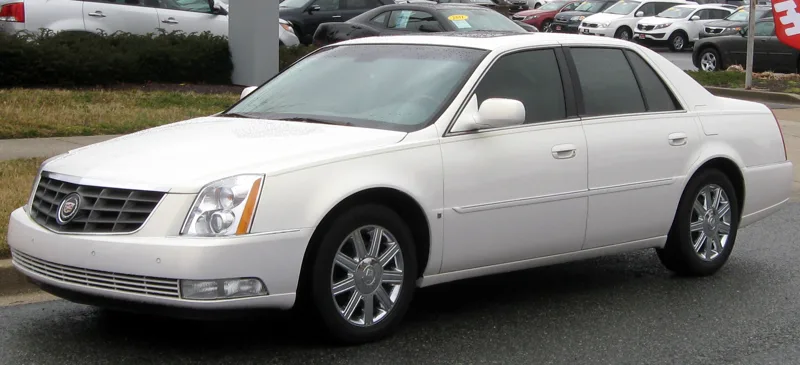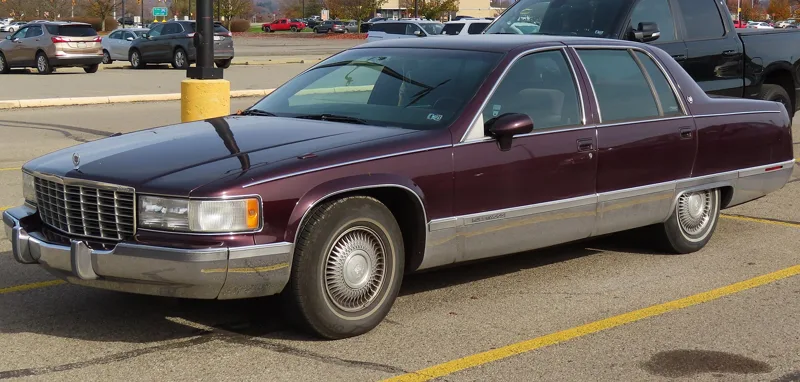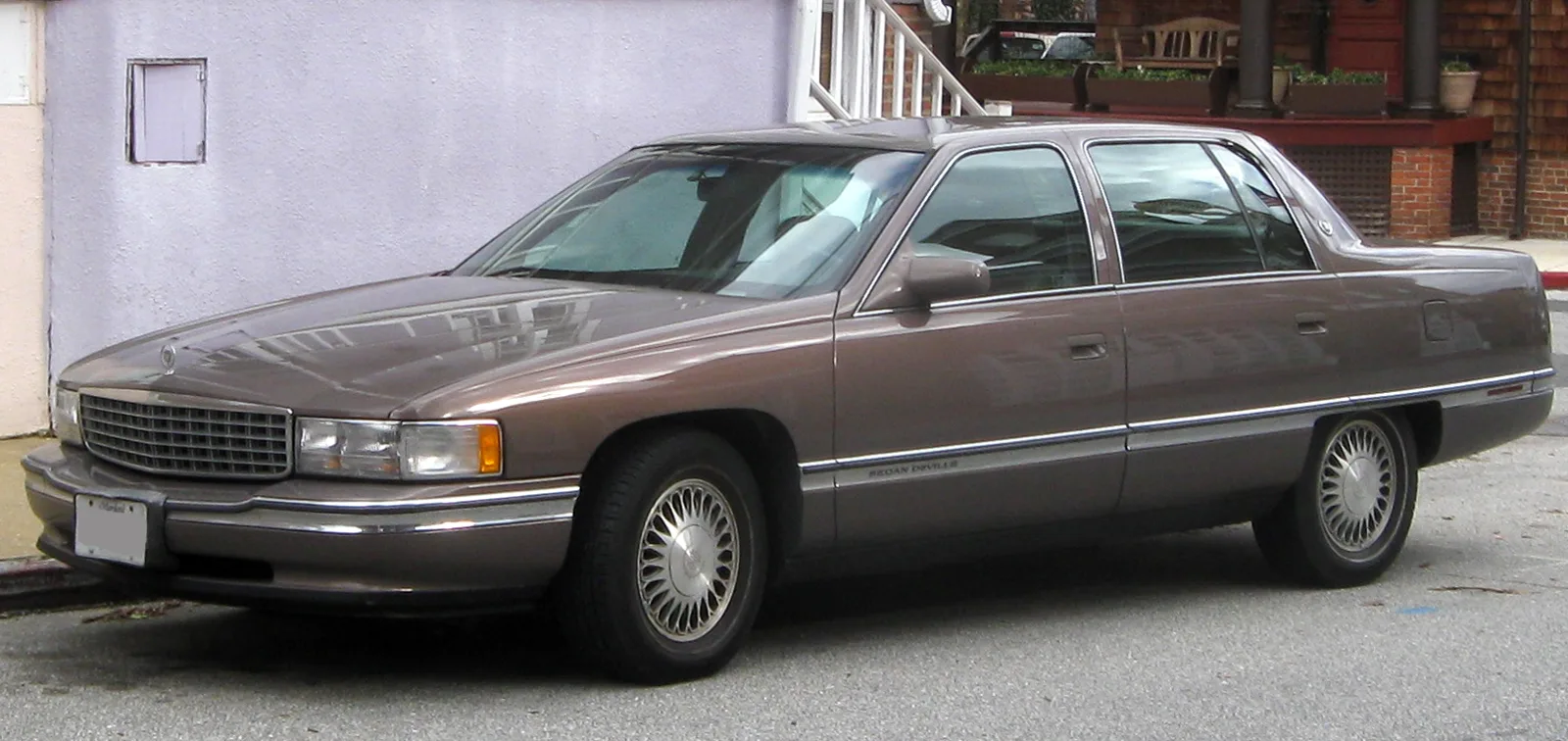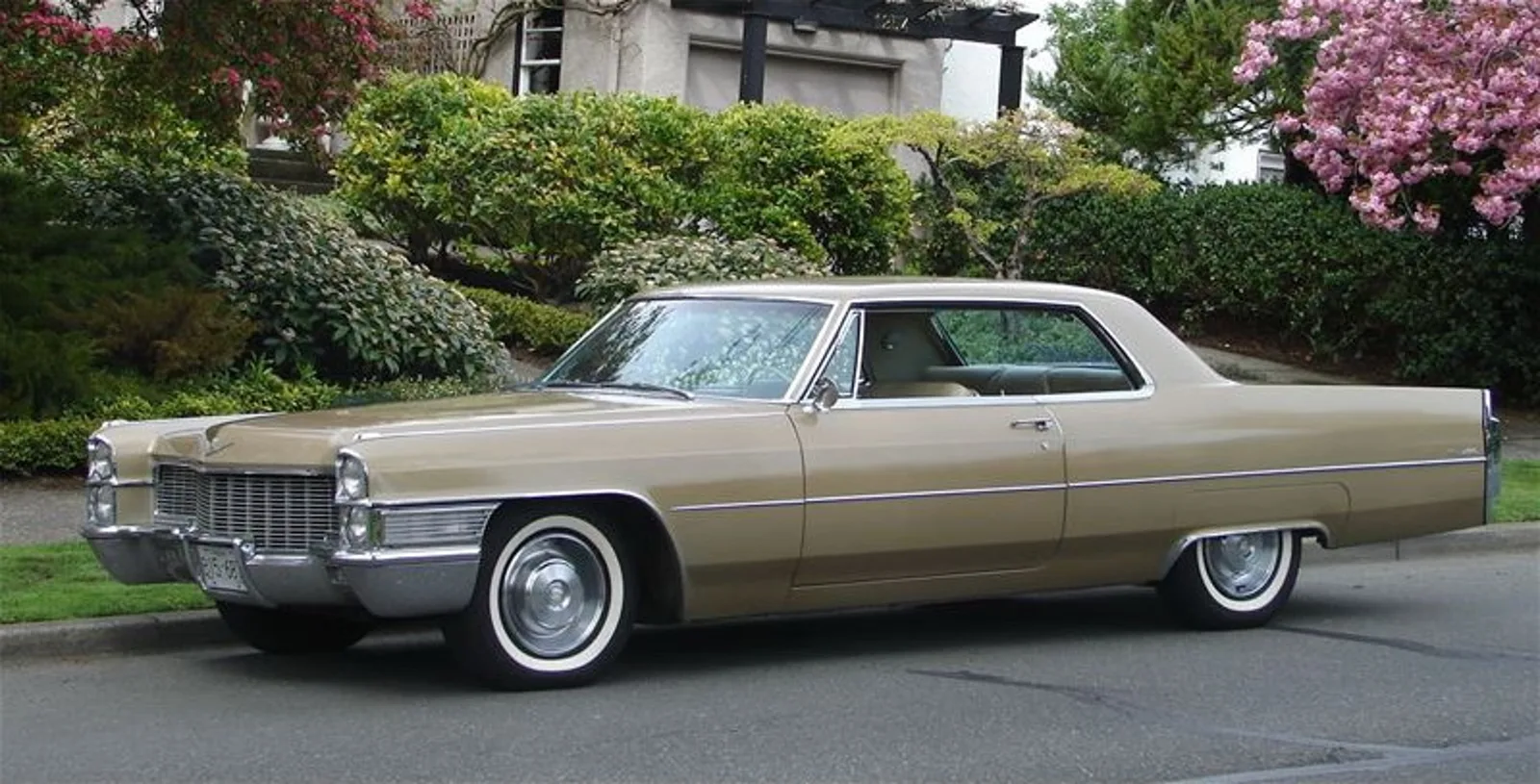
The full-size Deville after its 1964 plant rebuild, from stacked headlights and a 7-litre V8 to the 7.7-litre engine of 1968.
The Cadillac Deville was a full-size car from General Motors' Cadillac division, produced from 1949 to 2005. In the 1965 to 1970 model years it was redesigned, grew longer and used a 7-litre V8 that gave way to a 7.7-litre unit in 1968.
The Cadillac Deville ran from 1949 to 2005. The focus here is the 1965 to 1970 model years, when the car was redesigned and grew a little longer. Output rose from 123,080 cars in 1965 to 181,719 in 1970.
Where did the Deville sit in the Cadillac range?
The Deville sat in the middle of the Cadillac line-up, above the entry-level 62 series, Calais and Seville and below the top-class 75 series and Eldorado. In this period the range included the Coupe Deville, the Sedan Deville and the Deville Convertible.
The name was written both as Deville and as de Ville. The family covered two-door coupes, four-door sedans and open convertibles, all built on General Motors' Cadillac division.
A 340 hp V8 in the 1965 Deville became a 375 hp, 7.7-litre engine by 1968.
Why did the Deville plant close in 1964?
Sales kept climbing faster than the plant could build cars. Cadillac halted the Clark Street Assembly plant in Detroit on 8 July 1964 for reconstruction and reopened it on 24 August. The 1965 cars went on sale on 24 September, after the longest stop in the plant's history.
The rebuild made it possible to increase output substantially. Cadillac also dropped series numbers from most of its model lines that year, as the company reworked the whole range.
What did the new 1965 Deville look like?
The 1965 cars were slightly longer on an unchanged 129.5 in (3,289 mm) wheelbase. The headlights were stacked vertically, which widened the grille and gave the car more dignity, and a wide chrome trim under the windows set the Deville apart.
The upper lamp served the dipped beam, and both lamps came on for main beam. The parking lights sat in the front bumper, and decorative grilles hid the side lamps at the ends of the front wings. The vertical rear lamps carried red reflectors at their centres.
Four models were on offer that year: the coupe, a sedan with narrow centre pillars painted in the body colour, a hardtop sedan without centre pillars, and a convertible. Every car had frameless curved door glass.
A new perimeter frame allowed a wider track, a forward engine position and more cabin space. The cabin offered eight colour options in fabric and leather trim, or seven all-leather interiors, and the door opening became wider with lower sills.
Inside, the front seat cushion of the 1965 cars was longer. The new door locks worked more quietly and smoothly. The three-spoke steering wheel could be ordered with reach and tilt adjustment, and a single pull of a lever raised the spring-loaded steering column to its highest position for easier entry and exit.
How did the 1965 engine and transmission work?
The 7-litre (429 cu in) V8 was unchanged, rated at 340 hp (bhp). Computer-designed engine mounts cut the vibration passed into the frame, and a new exhaust silencer suppressed resonance as far as possible. The Turbo Hydra-Matic transmission gained a stator with variable-pitch blades.
In the torque converter, the stator blades were set to deliver maximum torque when the pedal was pressed hard. When it was pressed gently, the blades changed pitch to give finer control of thrust, which helped when parking.
The gearbox had two ranges. In the second one, top gear was blocked, which gave a sharper throttle response and stronger engine braking. The propeller shaft became one piece with constant-velocity joints at each end.
The front suspension gained lower-arm braces moved further forward. The rear used one longitudinal arm with a diagonal brace on each side, and the springs sat directly on the axle beam.
An optional automatic level control kept the rear height constant. When the floor dropped more than half an inch (12 mm) under load, a valve admitted air from the pump and tank into the gas-filled rear dampers, and the car rose again.
What changed on the cars in 1966 and 1967?
In 1966 the grille was split by a horizontal bar that carried the parking lights, and the stereo radio became an option. In 1967 the grille lost that bar and became rectangular with large cells. Front and rear lap seat belts became standard in 1966.
The 1966 front end looked more compact. The new radiator grille was split in two by a horizontal bar, with the parking lights made part of it, and the vertical headlights were separated by a body-coloured frame. The rear bumper, plainer than before, took body-coloured paint on its lower section.
The 1966 stereo amplifier sat under the instrument panel, with two loudspeakers at its sides and two more on the rear shelf. One channel fed the front left and rear right speakers, and the other the front right and rear left, which was meant to create a concert-hall effect.
New aluminium pistons with steel inserts and thicker piston rings improved durability. California cars carried an Air Injection Reactor system, which pumped clean air into the exhaust to finish the combustion reaction. A variable-ratio steering gear cut the turns from lock to lock by a third without extra effort.
The 1967 body changed shape as well. The flanks became complex again, the window line gained a kink, and the coupe's rear pillars grew wider.
In 1967 the car gained a collapsible steering column, a softer centre for the steering wheel and a rubber coupling between the column and the steering gear. A warning light for failure of one brake circuit appeared, and the climate control offered OFF and VENT, AUTO and LO, HI, and FOG and ICE modes.
A higher-performance Rochester and Carter carburettor arrived in 1967, and lighter valve lifters and rocker arms, together with a new camshaft, reduced engine noise. Convertibles were fitted with perforated leather in thirteen shades, while closed cars offered eight fabric-and-leather options or nine all-leather interiors.
Separate front seats with headrests and electric heating could be ordered in 1966. The rear brake drums were now cast entirely from iron, where they had previously been compound units with a cast-iron rim and a steel disc, which made them more dependable.
In 1967 a shoulder belt could be fitted to either front seat and a centre lap belt at the rear. The interior mirror had shatterproof glass in a frame that came loose on impact, and the emergency stop signal, which flashed every turn lamp, became standard.
Vinyl roofs came in six colours in 1967, and the body paint offered 21 shades, seven of them pearlescent under the Firemist name.
How big was the 1968 engine?
The 1968 model had a new 7.7-litre (472 cu in) V8 rated 375 hp (bhp), the largest-displacement engine among American cars at the time. Its external dimensions stayed the same while the parts count fell. It also met the emission limits introduced in the US that year.
The cast-iron block had coolant and thermostat passages built into its front, and its cylinders were spaced widely for better cooling. The high-strength crankshaft was cast so accurately that its counterweights needed no machining.
The exhaust pipe diameter rose, the silencer lengthened and moved nearer the engine, and a resonator sat behind the rear axle. Larger constant-velocity joints in the rear propeller shaft drive carried the extra torque.
The 1968 car was also longer than 5.7 metres (18.7 ft) overall, with a grille lowered at the edges to form a clear rectangle. The wipers hid below the edge of the lengthened bonnet, and side marker lenses sat on either side of the rear lights.
Disc brakes with ventilated front discs could be fitted for an extra charge. A larger left-hand outside mirror with adjustment from inside was fitted, and the same mirror on the right was available without adjustment.
The 1968 seating followed the body style. Coupe and convertible front seats had split backrests and an armrest, with a rear armrest as standard, while sedans came with solid cushions and backrests and folding armrests. Separate front seats were an extra. Lap belts covered every seat, a diagonal belt could be fitted to the front or rear seats, and a child seat could be fixed to a seat with the standard belt.
What changed in 1969 and 1970?
In 1969 the headlights returned to a horizontal layout with parking lamps on the wing corners, and the front quarter-lights disappeared. In 1970 the V was removed from the bonnet and replaced by a larger Cadillac emblem. Winged emblems also appeared on the front ends of the wings.
The optional vinyl roof of 1969 had chrome edging running over the windows and down the rear pillar. Coupes and hardtop sedans had a distinctive rear window, V-shaped in the old style and split in the middle. The rear of the car looked heavier because the lamps were combined into compact units above the bumper, which filled the lower part of the car.
The glove box grew by a third, a cassette player in the Stereo 8 format could be ordered, and the interior mirror got bigger. A transparent expansion tank made the coolant level easy to check, and a fuel pump of higher capacity and simpler design fed the engine.
The 1969 cars gained safety bars welded into all doors to carry side-impact loads into the body. The number of rubber-mounted body points to the frame rose by 20%, and the frame had deeper sides at the front wheels.
Three-point belts became standard on the front seats of all models except the convertibles. Front seats could be ordered with two-way or full six-way electric adjustment, and front head restraints were standard on every type of seat.
The horn sounded from a light press on the inside of the new steering wheel rim, and a two-tone horn was optional. The ignition lock locked the steering wheel when the key was removed, and the wipers began to move in parallel instead of towards each other.
In 1970 convertibles had leather in ten colours, and the radio antenna was built into the windscreen as two invisible wires 0.1 mm thick. It was standard whether or not a radio was fitted. An odometer protection mechanism showed shiny strips between the digits if someone tried to roll it back.
The updated cruise control was switched on from the instrument panel. After the car had accelerated, the required speed was locked by a button on the end of the turn-signal lever. The new steering wheel let the horn sound from anywhere on its face, whether centre or spokes.
The 1970 rear axle used bigger bearings, and the front received a one-piece cast-iron steering knuckle. Radial tyres of size L78-15 (240R15) were fitted from that year.
Cadillac Deville production by model year
| Model year | Built | Sedans | Coupes | Convertibles |
|---|---|---|---|---|
| 1965 | 123,080 | 60,535 | 43,345 | 19,200 |
| 1966 | 142,190 | 72,410 | 50,580 | 19,200 |
| 1967 | 139,807 | 68,702 | 52,905 | 18,200 |
| 1968 | 164,472 | 82,512 | 63,935 | 18,025 |
| 1969 | 163,048 | 80,848 | 65,755 | 16,445 |
| 1970 | 181,719 | 90,504 | 76,043 | 15,172 |