Opened in 1870 for professional sprinters, Powderhall staged a famous New Year race for a century before greyhounds took over.
Powderhall began as a professional running ground in Edinburgh in 1870, when its New Year sprint started. The stadium became a greyhound venue in 1927 after pedestrianism faded, and it closed in 1995 after several owners, its site later given over to homes.
Powderhall was a running ground in northern Edinburgh that opened in January 1870 for professional sprinters and walkers. For a century its New Year sprint was one of the most celebrated races of its kind, and when pedestrianism lost its audience the ground became a greyhound stadium. It shut in 1995, and houses now occupy the site.
Who built the Powderhall grounds, and why?
The name came from an industrial past. In 1695 James Balfour, Laird of Pilrig, received a charter to manufacture gunpowder in Scotland, and his powder-mill was built beside the Water of Leith. In 1742 Thomas Mylne, Surveyor of the City of Edinburgh, put up a house with gardens nearby and named it Powder Hall, and the area took its name from the house.
By mid-1869 a group of investors had set up a company to create sporting grounds that could compete with London's. Its leader, Charles R. Bauchope, had once claimed a Scottish grass-track record while racing as an amateur. The design was based on the famous Stamford Bridge ground in London.
The first layout combined a 440 yard cinder oval with a 180 yard straight along its southern edge, and a roofed stand seated 1400 spectators. Much of the material came from the recently defunct Newington grounds, bought for one hundred pounds.
A running ground built to rival London ended as a housing estate on the Water of Leith.
What was the Powderhall Sprint?
The Powderhall Sprint began as a 160 yard handicap at the New Year gala of January 1870, which ran over three days. The inaugural winner was Dan Wight of Jedburgh, a very young runner who started 12 yards back. On the day nobody expected it to be special; it was just one of several professional sprint handicaps held that year at different distances.
Each New Year the race ran at the ground for one hundred years. It became one of the most famous professional sprints in the world, and its only serious rival was the Stawell Gift in Victoria, Australia, held each Easter since 1878. The Powderhall Sprint moved to Meadowbank Stadium in 1971, and under the name New Year Sprint it continues at Musselburgh Racecourse.
How did the grounds change hands in 1889?
William Lapsley took over the lease in January 1883. A council committee wanted the ground turned into a public park in October 1888. A three-month extension was agreed for the old ground, which closed with races on 25 May 1889.
A warrant to lay out the new running ground on Beaverhall Road was granted on 29 August 1889, with two grandstands and changing rooms planned. The opening meeting at the new site, which carried the name New Powderhall, was the 1890 New Year Handicap.
Who ran Powderhall in its later years?
William Lapsley was a sportsman of many talents. St Bernard's F.C. counted him among its founders, he kept goal for Hanover F.C., and he rode and ran as well. He died on 28 February 1903 after a horse-drawn cab bolted down a steep hill and overturned.
The trustees who took over after his death did not renew the lease. The grounds went to Frederick Arthur Lumley, who made gym equipment and taught boxing, and his first meeting was held on 13 May 1903. Lumley exercised his option to buy the grounds outright in 1923.
Who officiated at the races?
Alexander McKenzie started races at Powderhall from 1879 until 1907, when his successor James Lynch took over as starter. Lynch officiated until his death in May 1930. Chris Lynch, a son of James, took on the handicapper's role in 1920.
The 1907 meeting went ahead after a long spell of rain, with 24,000 people in the stands. That was the last year McKenzie acted as starter there.
Did athletes train at Powderhall?
Edinburgh University Athletic Club began training at the grounds in March 1871 and held its Spring Athletic Games there in February 1872. William Lapsley won the 880 yards handicap at an Edinburgh Athletic Club meeting in July 1872.
The Olympian Eric Liddell began training at Powderhall after 1921. He was coached three times a week by Tommy McKerchar, a printer who coached professional pedestrians on the side, and McKerchar did it for free.
What records were set at Powderhall?
The Scottish AAA first held its championships at Powderhall in June 1883, and the meeting returned there several times. At the 1890 Scottish Championships Kenneth Whitton of Edinburgh Harriers threw the hammer 103 ft 0in (31.40m), a record for the event.
Track and field carried on at the ground for a further century, with competition moving to Meadowbank Stadium in 1971.
How big were the crowds at Powderhall?
The crowds were often very large. In the early 1880s the cycle races drew one hundred thousand paying customers, and the pony show that accompanied them was never repeated. Rain fell for hours before the 1907 New Year meeting, yet 24,000 people still came, and boxing in 1920 attracted over 13,000 people to a fundraiser for the Edinburgh Royal Infirmary.
Greyhound racing drew similar numbers. More than 10,000 people attended the first greyhound meeting in 1927.
What other sports were staged at Powderhall?
As well as athletics and walking races, cycling had its own place at the grounds from 1874. Quoits handicaps and pigeon shooting competitions were held there too. In 1876 a medley event had competitors walk a mile, run a mile and ride a horse a mile, and Peter McKellar of Edinburgh set the best time of 16:22.
Association football came to the ground in 1881, and it was the home ground of Heart of Midlothian and Hibernian before they moved to their own grounds. Scotland played two rugby union internationals there, beating Ireland 8-3 in 1897 and drawing 3-3 with England in 1898. In 1920 boxing matches were introduced, and the Edinburgh Royal Infirmary received the proceeds.
The Edinburgh Highland Society moved its Highland Games to Powderhall in 1891. Events ran from foot races and field events through Highland dancing, bagpipe playing and tug-of-war, and in 1898 the society added camanachd, now better known as shinty.
Which events came after the pedestrians?
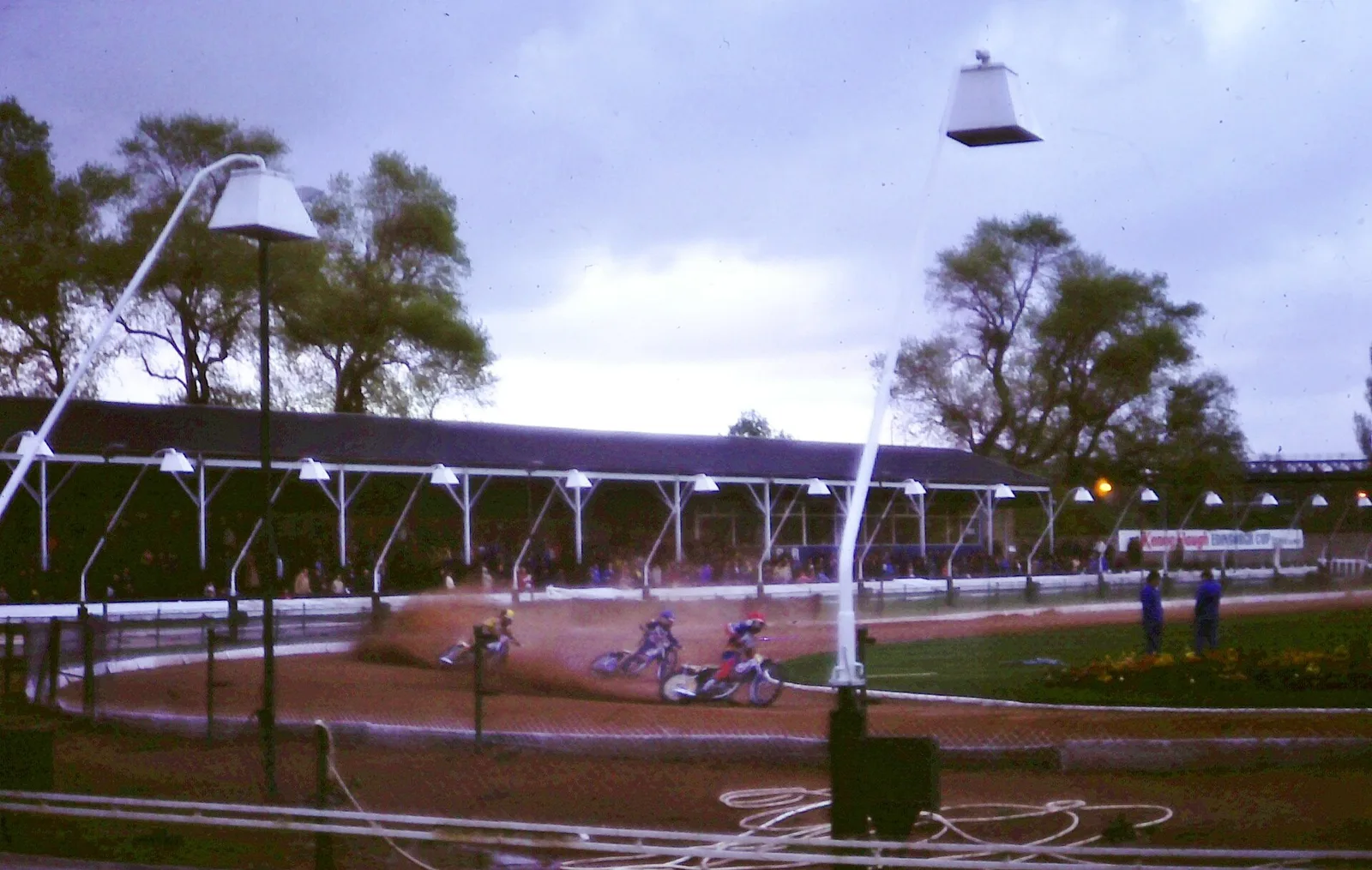
Leith Athletic played there in the late 1920s, and Edinburgh City followed in the early 1930s. Speedway also took over, and the Edinburgh Monarchs raced there from 1977 until 1995.
When did greyhounds take over the stadium?
By the 1920s the sport of pedestrianism was losing its audience. The old cinder loop was grassed over, and a fresh straight went down for the New Year pedestrians, and New Powderhall was converted into a greyhound stadium.
The first greyhound meeting under the Greyhound Racing Association was held on 3 August 1927. The first race, the Leith Stakes, was won by Eager Hands. The first trainers included John Snowball and Tom Storey, and Boher Ash, trained by Tommy Johnston Sr., won the English Greyhound Derby in 1928.
The Greyhound Racing Association Trust bought the stadium in 1930. The track introduced its own major event, the Edinburgh Cup, in 1933, and the venue hosted the Scottish Grand National, a hurdles competition run from 1954, and the Scottish St Leger, held from 1959.
When the track opened to greyhounds in 1927 it had easy bends and long straights, and the first meeting drew more than 10,000 people. The kennels, the hare and the racing programme all had to be built around a stadium that had been a cinder path for pedestrians only a few years earlier.
What was life like on the greyhound track?
The track sat over a low-lying ground, and a culvert ran beneath it so the Puddockie stream could flow past. Despite the culvert the track was prone to flooding, and a heated blanket was later installed under the surface so that racing could go ahead in cold spells. Its track circumference was 440 yards.
Management changed hands regularly. Bill Glennie was general manager and Bill Mulley racing manager during the 1970s, and Stuart Strachan replaced Mulley in 1978. In 1982 the trainer Graham Mann moved to White City, and Jane Glass became the Scottish track's first female trainer.
The venue hosted the Stewards Cup on several occasions and staged the BBC Television Trophy in 1964. Those prestige events gave the track a national profile that its neighbours in Edinburgh did not always match.
How did Powderhall end?
A 1970 renovation added a 100-seat Silver Hound restaurant with a glass front, so that the public could watch, and the bars were increased to seven. Powderhall marked its 60th anniversary with a new grandstand costing 400,000 pounds. The Scottish Greyhound Derby was run at the track in 1987, the first time the event had left Glasgow.
The track changed hands several times in the late decades of its life. The Greyhound Racing Association sold it in 1988 to the local businessman Norrie Rowan for a little under two million pounds, and Coral bought it soon afterwards for 2.2 million pounds. Eddie Ramsay bought the stadium in 1992 for 3 million pounds, and a Channel Islands company paid the same amount in January 1995. The stadium closed that year and was demolished for housing.
When did dog racing and whippet promotions start?
Dog racing first appeared at the grounds in August 1878. The Caledonian Whippet Racing Club held a 160 yards handicap in June 1904, and the following June it staged dog races with no restriction on breed, the first time in over twenty years. From then on these promotions were held at regular intervals through the season, and they gradually grew in importance.
Trotting had been tried earlier, in June 1877, when a special turf track was laid beside the running path. The experiment was halted after a series of mishaps, and the racing that followed was dominated by dogs and runners.
What did the early cycle races involve?
From 1874 the grounds hosted cycle races, known at the time as velocipede races. The Scottish Cyclists Union was formed in 1880 and held its first meet at Powderhall, and and a pony show staged to draw more crowds was never repeated.
Who trained the first greyhounds at Powderhall?
The first trainers included John Snowball, Tom Storey, Arthur Graham, C Hughes and Tommy Johnston Sr. Johnston's Boher Ash became the most notable of the early greyhounds when it won the English Greyhound Derby in 1928, a result that brought the stadium national attention.
The track's racing was not without distinction. Ravage Again, a locally trained dog, came close to surpassing the world record in 1990, and its run of 29 successive wins ended on 26 January 1990. Races of that kind kept the stadium on the sporting pages until the closing years.
Key dates at Powderhall
| Year | Event |
|---|---|
| 1870 | First New Year Pedestrian Gala, January |
| 1889 | Last races on the original grounds, 25 May |
| 1927 | First greyhound meeting under the Greyhound Racing Association, 3 August |
| 1928 | Boher Ash wins the English Greyhound Derby |
| 1930 | Greyhound Racing Association Trust buys the stadium |
| 1971 | New Year Sprint moves to Meadowbank Stadium |
| 1995 | Stadium closes and is demolished for housing |