A semi-banked asphalt oval in West Salem, from a 1957 dirt start to weekly NASCAR racing, its Oktoberfest finale and its record book.
Opened as a dirt track in 1957, the speedway now runs weekly NASCAR racing, hosts an Oktoberfest finale and keeps track records from touring and local divisions.
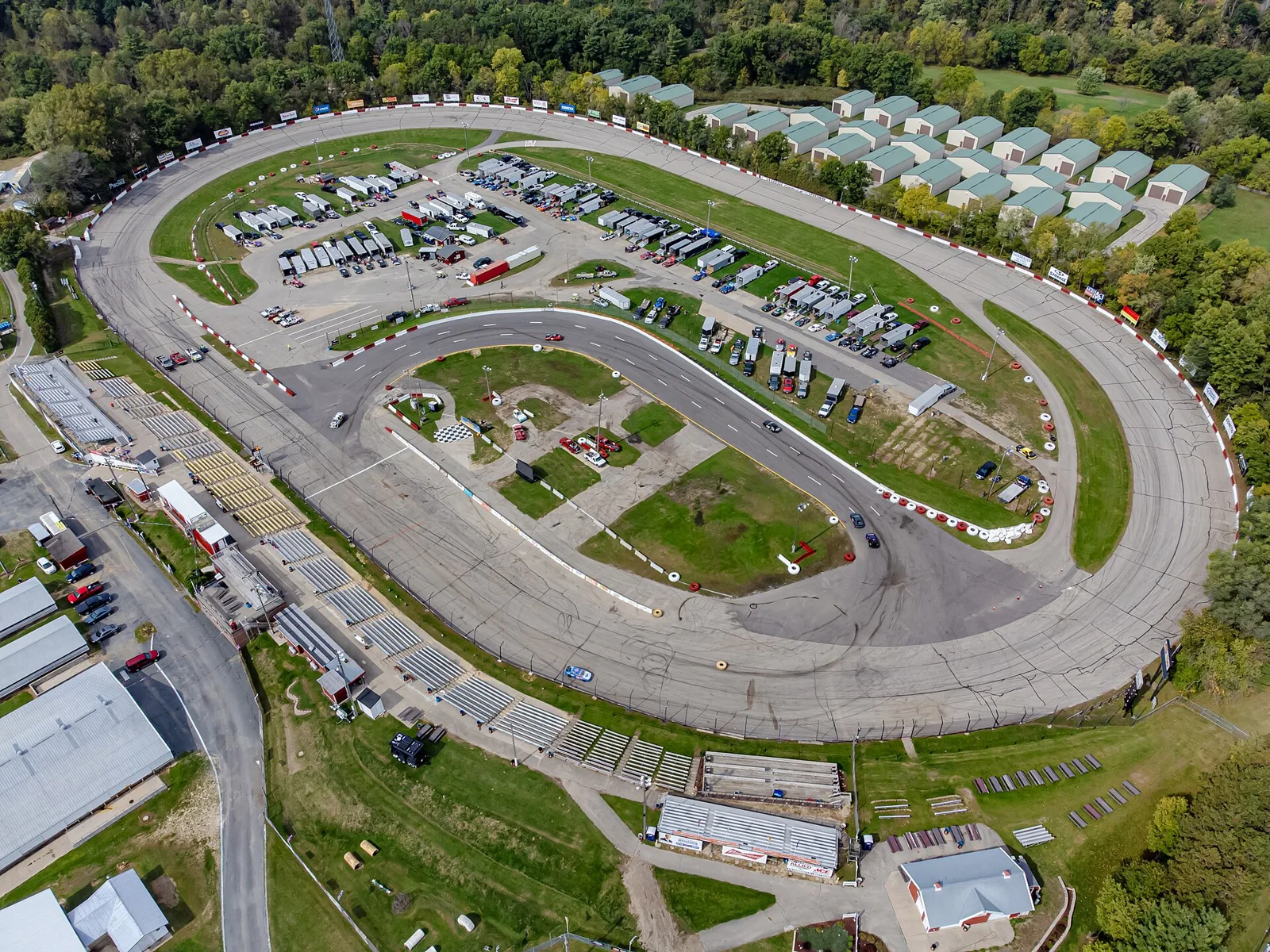
La Crosse Fairgrounds Speedway is a track in West Salem, Wisconsin, with an outer 5/8 mile circuit and an inner 1/4 mile circuit. It began as a dirt track in 1957, joined the NASCAR Winston Racing Series in 1989, and still stages weekly stock car racing and an Oktoberfest finale.
Where is the speedway and how is it built?
The speedway sits on the La Crosse County fairgrounds. Its outer track measures 5/8 mile and the inner track a quarter mile. Corner banking rises progressively, from 5 degrees at the bottom of the turns to 11 degrees at the top, which gives the oval its semi-banked character.
The La Crosse County Agricultural Society owns the racetrack and chooses who runs it.
A semi-banked oval that brought NASCAR racing to Wisconsin in 1989 and still closes its season every October.
How did the track start and grow?
The track opened in 1957 as a half mile dirt oval after the fairgrounds moved from the Veterans' Memorial Stadium site on the University of Wisconsin-La Crosse campus. It first ran a single annual International Motor Contest Association card, and that programme continued until 1966.
Early cards featured IMCA Big Car, which is now called sprint cars, along with midgets and New Model stock cars. Among the drivers who raced there in those years were Tom Bigelow and Johnny Rutherford, alongside Parnelli Jones, Ramo Stott, Dick Hutcherson, Jim Hurtubise and Johnny Beauchamp.
The track was paved in 1970 as a half mile, and its banked grandstand went up at the same time. Jim Sauter won the first event on the new surface on July 14, 1970. The Central Wisconsin Racing Association Late Models headlined the programme from 1970 until 1991.
Promotion changed hands several times. Robert Morris and Larry Wehrs ran the first two seasons, and Wehrs became the sole promoter in 1972. After the 1986 season the county society handed the job to Midwest Motorsports Management, whose leaders included John McKarns and Jody Deery.
When did NASCAR racing arrive in La Crosse?
In 1989 La Crosse became the first Wisconsin track to join the NASCAR Winston Racing Series, the national weekly short track programme now called the NASCAR Advance Auto Parts Weekly Series. NASCAR shows took over Saturday nights, and they became the main race night from 1992.
Five local drivers went on to win a regional, divisional or state title: Kevin Nuttleman, Paul Proksch, Charlie Menard, Steve Carlson and Nick Panitzke. Carlson won the national crown of the Whelen All-American Series in 2007, becoming the first Wisconsin driver to take it. Nuttleman won that championship under all three formats, in 1989, 2005 and 2009, and is counted among the 25 greatest drivers in the series' history.
What does a typical race week look like?
Saturday nights carry the weekly programme. The NASCAR late models are the headline division, supported by Sportsman, Hornets, Street Stocks, Six Shooters and Mini-Vans, plus High School Racing Association races and several novelty events through the season.
Visiting fields add variety. The Upper Midwest Vintage Racing Series, the American Super Cup Series and the Milwaukee Stock Car Racing Association have all turned up, as have the INEX Great North Legends and the CWRA Late Models.
Friday night street drags began in 2008, held on the second Friday of the month from May to September. They moved to the third Thursday of each month from 2023. From 2009 the season closed with the 300' Bracket Nationals on the Saturday after the Oktoberfest weekend.
What are the big events on the calendar?
Two events stand out. The Eve of Destruction takes place on the first Saturday after Labor Day, with a trailer race in which the last car still towing a trailer wins, a jet car, hornets, skidders, monster trucks and motorcycle stunt riders on the card.
Oktoberfest Race Weekend is the season finale, usually held the weekend after La Crosse's own Oktoberfest celebration. It has run each year since 1970. It began as a two-day meeting, grew to three days in 1975 and reached its present Thursday to Sunday format in 1998.
Touring fields that race over Oktoberfest weekend are the ARCA Midwest Tour, the Midwest Truck Tour, the Big 8 Late Model Series and the Mid American Stock Car Series. A similar event called the Smash-O-Rama takes place on the third Saturday night in June.
How does the Dick Trickle 99 work?
The Dick Trickle 99 is the Friday night headliner of the Oktoberfest weekend, a 99 lap super late model event. It runs as three 33 lap segments, and each driver earns points by finish, with one point for first, two for second and so on. The lowest total across the three races wins the meet.
The format follows the Vermont Milk Bowl at Thunder Road International SpeedBowl. The 99 comes from the number Dick Trickle carried in Wisconsin before he moved to NASCAR. The 2017 meet was rained out, and Ty Majeski has won it four times, in 2015, 2021, 2022 and 2023.
Who has won the Oktoberfest main event?
The main event has been sanctioned by several bodies. Central Wisconsin Racing Association rules applied from 1970 to 1986, the ARTGO touring series ran it from 1987 to 1997, and the ASA Midwest Tour has held it since 2007. Joe Shear was the first driver to win five main events, a total matched by Ty Majeski in 2025.
Travis Sauter and Dan Fredrickson have four victories each. The 2011 race was reversed after the fact. Johnny Sauter first took the win, but parts from vendors the ASA Midwest Tour had not approved led to his points and purse being removed, and the speedway then stripped him of the win and the overall Oktoberfest title, which went to Travis Sauter.
The 2018 result changed too. Ty Majeski was disqualified over intake height, Johnny Sauter over left side weight and Jacob Goede over an intake issue, so Andrew Morrissey, who had finished fourth on track, was declared the winner. The 2006 main event was a Wisconsin Late Model race, even though the NASCAR AutoZone Midwest Series ran its final race that Friday night.
What are the track records?
The all-time 5/8 mile qualifying mark is 18.177, set by Kody Swanson in USAC National Midgets on 5/16/08. The stock car record belongs to Ty Majeski at 18.405 in the Dick Trickle 99. On the 1/4 mile, Cory Kemkes holds the all-time qualifying record at 13.814, set in the Outlawz division.
| Record | Holder | Time | Date |
|---|---|---|---|
| 5/8 mile, all-time qualifying | Kody Swanson (USAC National Midgets) | 18.177 | 5/16/08 |
| 5/8 mile, all-time stock car qualifying | Ty Majeski (Dick Trickle 99 Super Late Model) | 18.405 | 10/8/21 |
| 5/8 mile, Super Late Model Knights | Dalton Zehr | 18.498 | 10/6/22 |
| 5/8 mile, CWRA Late Models | Dick Trickle | 19.537 | 6/22/89 |
| 5/8 mile, NASCAR Late Models | Dan Fredrickson | 19.374 | 5/28/22 |
| 1/4 mile, all-time qualifying | Cory Kemkes (Outlawz) | 13.814 | 10/4/18 |
| 1/4 mile, CWRA Late Models | Darek Gress | 14.178 | 7/17/24 |
Several records belong to divisions and series that no longer run. The American Indycar Series entry, set by Ken Petrie in 1999, is one of them. The Super Late Model Futures and Super Late Model Knights series have posted qualifying times close to the all-time marks.
Why does the speedway still matter?
The speedway matters because it has hosted NASCAR racing in Wisconsin since 1989, kept a long Oktoberfest tradition alive and produced a run of regional and national champions. It remains a weekly home for stock car drivers in the state.
Ty Majeski appears on the all-time stock car qualifying list and has won several main events. Joe Shear's five main event wins were matched only by Majeski in 2025. The finale has been part of the calendar since 1970, the same year the track was paved, which makes it one of the longer-running fixtures in the speedway's life. The Dick Trickle 99 keeps a Wisconsin driver's car number alive on the programme.