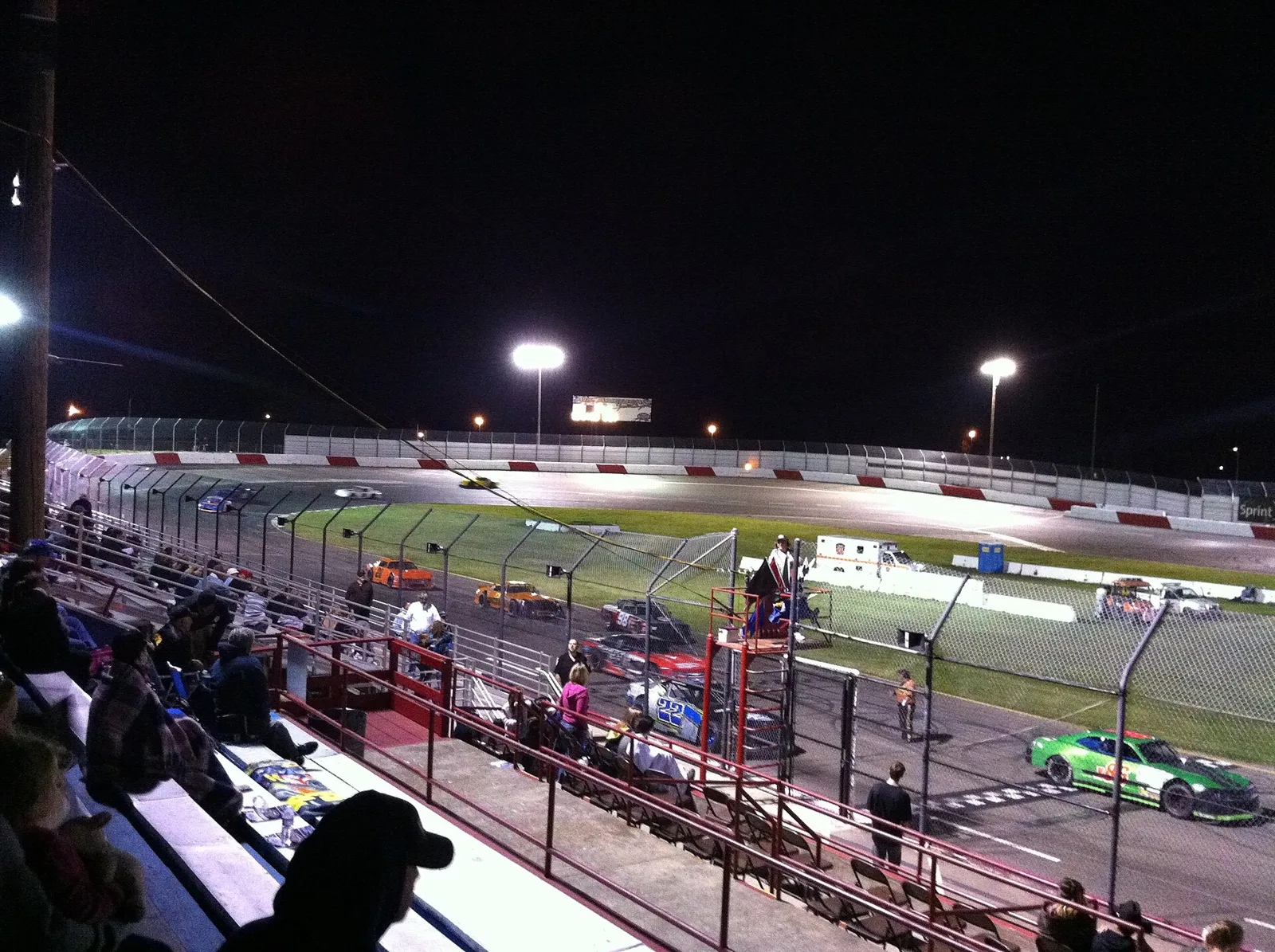
A Placer County dirt track that was paved in 1970, fought a long battle over its noise and location, and now runs as a NASCAR-linked oval.
All American Speedway is a 0.333 mi oval in Roseville, California, built on Placer County fairgrounds. It opened as a dirt track in 1955, was paved in 1970, and today hosts an annual ARCA Menards West Series event alongside local NASCAR and INEX divisions.
Roseville, California, is home to All American Speedway, a track of 0.333 mi (0.536 km) on the Placer County fairgrounds. Opened as a dirt track in 1955, it was paved and renamed in 1970, and its history since then has been shaped by noise disputes, failed relocation plans and a series of promoters.
Where is All American Speedway and who owns it?
The track sits on the Placer County fairgrounds, which the county owns as part of an area known as The Grounds. Interstate 80 and California State Route 65 serve the site, and the speedway has 4,000 bleacher seats. The arrangement puts racing inside the county's fair complex.
The track is operated by a promoter under arrangement with the county, and that arrangement has changed several times since the 1980s. The current promoter, Tim Huddleston, took over in January 2024.
The banking has two settings. The first two turns are paved at 8 degrees, and the last two use progressive banking of 10 to 14 degrees.
A fairground dirt track that became a paved NASCAR-linked oval after years of noise fights and failed moves.
How did the track open in 1955?
The Roseville Firemen's Association asked the Placer County Fair Board for permission to build a racetrack at the fairgrounds in February 1955, and the board approved the plan that April. The track opened on 29 May 1955, and Dick Queen took the first feature.
Bruno Romani and Pete Radovinac spoke for the Roseville Firemen's Association, and the fair board agreed to use the existing grandstand for the races. Romani estimated the cost at about $3,000, and local businessmen covered it.
The track was called Roseville Speedway in local newspaper advertisements. A test session was held on 25 May, and renovations to the banking and public address system followed the first race.
The 1960s brought further work. In 1964 the lighting was upgraded and poles were removed from the infield for better sight lines, and five years later new safety barriers, more lighting and a wider backstretch followed.
Paving, a new name and the noise fight
In April 1970 the Central State Racing Association backed paving the track. Romani and Larry Burton formed All American Sports Promotions, and the group announced both the paving and a new name, celebrating Roseville's All-America City title.
The final dirt event was held on 9 May, and the county supervisors approved the $28,000 paving project on 12 May. The reopening was delayed until 12 June, when Rick Henderson won the first feature on the paved surface.
In 1971 the city of Roseville sued the track over noise, calling it a public nuisance even though the county owned it. In April 1972 a Nevada County Superior Court judge ruled that it was not a public nuisance, but he reversed the decision that December, barring races until noise limits were met.
Mufflers were required in 1973, despite initial reluctance from Burton. That year Romani stepped away from the promotion while he recovered from a heart attack, and Burton ran the track alone.
NASCAR started sanctioning races there at the start of 1977, and Winston, part of the R. J. Reynolds group, became the sponsor. On 26 July 1977 a flying tyre from a competitor's car killed crew member Ivy Steenburgen, and the next year Joe McKenzie died of a heart attack during a bomber race.
Why did Burton's replacement tracks never get built?
Burton planned to replace the track several times in the 1980s, but each site faced opposition from neighbours, businesses or county boards. The Board of Supervisors rejected his 1984 Placer County plan, and by March 1987 the project was declared dead after a land dispute and a cancelled purchase.
The first relocation plan was announced on 18 November 1982 for the Sunset Industrial District between Roseville, Rocklin and Lincoln. Hewlett-Packard, a tenant there, planned to appeal the rezoning, and a public petition sought to halt racing at the existing track.
A later plan near the West Placer Regional Landfill won the support of NASCAR president Bill France Jr., who promised to sanction the track if it was built. On 9 February 1984 the planning commission approved a 5,000-seat track on 39 conditions, but on 13 March the Board of Supervisors rejected it.
Burton then moved the idea to Lincoln, to a 78-acre site he called Lincoln International Speedway, before a dispute over annexation and public opposition stalled it. A later site on Route 65 and Sunset Boulevard grew into a $4,000,000 complex with two ovals, a motocross course and a cycling course, alongside an industrial park.
The Board of Supervisors rejected the track on 26 June 1985, but after an appeal approved it 3-2 on 28 July with a two-year use permit. By mid-March 1987 no work had been done. The land had been returned to its original owner through an arbitrator's decision, and Burton's financial partner, John Attebury, withdrew support. The Placer County Superior Court later cancelled the land purchase.
Who ran the track after Burton left?
After Burton's lease expired at the end of 1982, the Placer County Fair Board recommended that Arnold Brink and Al Youngblood take over for three years. The pair planned repairs to the track and the paving of a parking lot at a cost of $90,000.
Burton's exit also cost the track its hosting rights to the Rose Classic, a major late model event. Five groups, Burton's among them, had expressed interest in running the track under new limits on racing hours.
Brink and Youngblood stopped promoting the track before the 1986 season, citing extenuating circumstances. The Placer County Fair Board then took over managerial and promotional operations, and in March 1986 fair board manager Ruben Martinez renamed the track Placer County Speedway.
The fair association's first season in charge brought lighting upgrades and a grass infield.
Renovations, NASCAR and the 1988 season
Before the 1988 season the track regained NASCAR sanction and was repaved, with new billboards, an electronic scoreboard and walls painted red and white to match its title sponsor, Winston. The name reverted to All American Speedway in early 1990.
In 2006, after the closure of Stockton 99 Speedway, AAS gained its NASCAR Weekly Series races. The track invested $1.2 million in a renovation that added an enlarged pit area on the backstretch, new lighting, safety barriers and catchfencing.
The track was reconfigured in the same work. Each straightaway was lengthened by roughly 90 ft (27 m) toward the north, the backstretch gained 32 ft (9.8 m) in width and the frontstretch 12 ft (3.7 m). The work ran from Thanksgiving weekend 2006 to April 2007, and the track was remeasured at 1/3 mi (0.54 km).
How did safety work change over the decades?
Safety improvements came in steps. New barriers were added in the 1960s, mufflers were required in 1973 after the noise ruling, and new safety barriers and catchfencing came with the 2006 renovation. Each step followed a specific dispute or upgrade rather than a single overhaul.
Three fatalities are recorded at the track, and each had a different cause: a flying tyre in 1977, a heart attack during a bomber race the following year and a heart attack during a spectator race in 2012. The later racing rules and track works were shaped by the noise and planning fights more than by any single incident.
What did the grand jury reports find?
Residents complained about noise after the 2006 work. A February 2011 grand jury report found that environmental studies had not been properly carried out before the track was lengthened. A second report in March 2012 said the county had been negligent in overseeing the contracts behind the extension.
The 2012 report also recommended that the county find an alternative nonprofit group to run both the fairgrounds and the speedway. In July 2012 a spectator race ended in tragedy when musician and driver Ron Pestana suffered a heart attack and then hit a tyre barrier near the pit entrance.
| Year | Event |
|---|---|
| 1955 | Opened as Roseville Speedway, a dirt track; Dick Queen wins the first feature |
| 1970 | Paved and renamed All American Speedway |
| 1977 | NASCAR sanctioning begins; Winston becomes the sponsor |
| 1982 | Burton announces the first relocation plan |
| 1986 | Fair board takes over; renamed Placer County Speedway |
| 1988 | NASCAR sanction regained after repaving |
| 2006 | Stockton 99 Speedway closes; the $1.2 million renovation begins |
| 2017 | Placer Valley Tourism takes over the fairgrounds |
| 2024 | Tim Huddleston replaces Bill McAnally as promoter |
Who runs All American Speedway today?
Placer Valley Tourism took over operating control of the fairgrounds in 2017 and invested millions in renovations. The tourism agency worked with the county government on the investment. The promotion changed hands again in January 2024, when Tim Huddleston replaced Bill McAnally.
As part of the fairgrounds work, AAS signed a long-term contract with Bill McAnally, a Roseville native and former NASCAR driver who owns a team. McAnally had promoted events at the facility since 2008, and his company, Bill McAnally Racing Promotions, carried on under the new arrangement.
Huddleston also runs Kevin Harvick's Kern Raceway, and under the 2024 arrangement his team and McAnally's company share the job of staging races.
What races and events happen at the speedway?
ARCA Menards West Series races have been held at the track annually since 2008. The venue also hosts NASCAR Local Racing Series and INEX divisions. As of 2026 those include limited late models, modifieds, street stocks, mini stocks and Legends cars.
The speedway also held NASCAR Southwest Series races between 1986 and 1990, and the CARS Tour West and SRL Southwest Tour have raced there too.
A rock concert headlined by Berlin took place on 20 July 1984. Sacramento Union writer Steve Martarano criticised the setting, calling it depressing and the track pitiful.