A Los Angeles electric car start-up that promised a luxury crossover, struggled through years of funding gaps and now sells robots as well as cars.
Founded in May 2014 by Jia Yueting, the El Segundo based company promised the FF 91 luxury crossover in 2017. It struggled through repeated funding crises, delivered only a small number of cars and has since moved into the Faraday X brand and embodied-AI robots.
Faraday Future, an electric vehicle company set up in 2014, has its headquarters in El Segundo, California. It promised a luxury crossover in 2017, has delivered only a small number of cars since, and in 2026 became as much a robotics business as a carmaker. Its history is a sequence of ambitious plans, financing crises and reinventions.
Who founded Faraday Future and why the name?
Faraday Future was founded by the Chinese businessman Jia Yueting in May 2014. At the time it was based in the Harbor Gateway area of Los Angeles, next to Carson, and it had grown to 1,000 employees by January 2016.
The company takes its name from Faraday's law of induction, a principle of electric motor technology named after the English scientist Michael Faraday, who discovered electromagnetic induction.
A luxury electric crossover promised in 2017, a funding saga across three continents and, in 2026, a turn to robots.
What was the FF ZERO1 concept?
On 4 January 2016, at the US Consumer Electronics Show, Faraday Future revealed the FF ZERO1, a 1,000 hp (750 kW) single-seat sports car with a top speed over 200 mph (320 km/h) and a 0-60 mph time under 3 seconds. The car was never validated, because it existed only as a clay and styrofoam model.
The ZERO1 would have had four electric motors, one for each wheel, and a glass roof with a racecar-style head and neck support system. A demonstration video showed a Variable Platform Architecture, which the company said would allow many body styles and battery configurations, although that system was not part of the concept car and no production schedule was given.
Commentators reacted with disappointment, since the only design on show was a high-end concept race car that would never be produced.
How did Faraday plan its factories?
In November 2015 Faraday Future announced that it would invest up to $1 billion in its first manufacturing plant. In December 2015 it chose a site in North Las Vegas, to be built by AECOM for $500 million, with a $215 million tax incentive from Nevada and a planned railway spur.
Construction began in April 2016 on infrastructure that Nevada had agreed to build, but work was suspended in November 2016 until the first $300 million of a claimed $600 million in funding was realised. On 10 July 2017 the company dropped its North Las Vegas plan after financial setbacks.
Other sites came and went. Vallejo, California, offered an exclusive negotiating agreement in May 2016, but the company ended it in March 2017. In August 2017 Faraday signed a lease for a former Pirelli tire plant in Hanford, California, saying it could employ up to 1,300 people and build up to 10,000 cars a year.
What did the FF 91 promise in 2017?
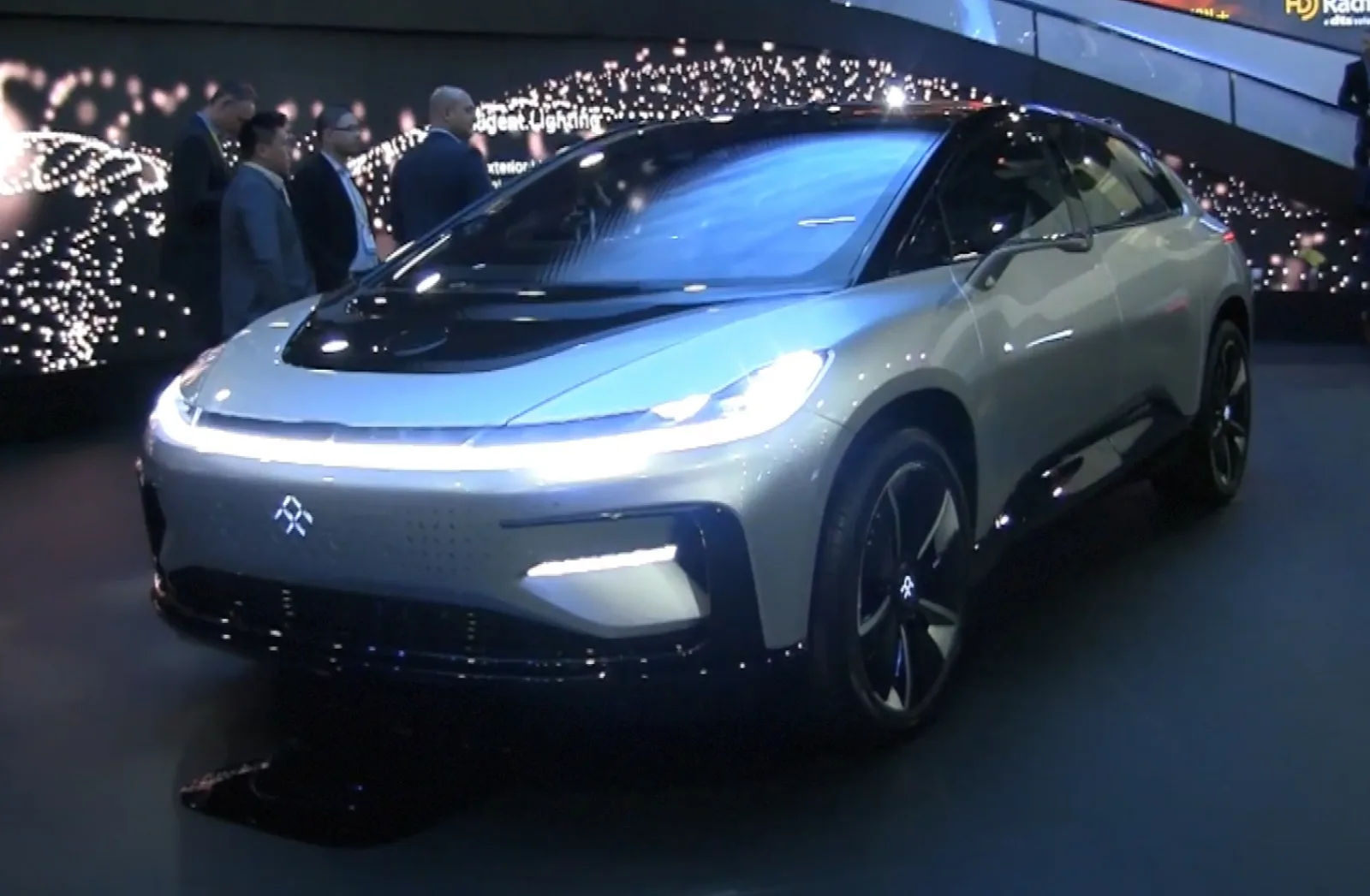
Faraday Future unveiled its luxury FF 91 crossover, its first production vehicle, at the January 2017 Consumer Electronics Show. It had a 130 kWh battery and connected car features, and it was claimed to accelerate from 0-60 mph in under 2.5 seconds at a price of less than $300,000.
Reservations reached 64,124 within 36 hours, even though the demonstration did not go especially smoothly. The FF 91 was also described as a large crossover SUV with suicide doors, a big infotainment screen and a limited autonomous driving mode.
Production was planned to start in Hanford in late 2020. In August 2018 the company completed the first pre-production FF 91, but the timetable slipped repeatedly as funding problems grew.
Why did funding dry up between 2016 and 2018?
By 2016 former employees and government officials were questioning the company's finances, and in July 2016 several investment officers and managers voiced concern. Faraday had failed to fund even small escrow accounts, which led some analysts to doubt its financial solidity.
Late 2017 brought a dispute when CFO Stefan Krause and CTO Ulrich Kranz left over financing and the coming exhaustion of cash. They founded Evelozcity, now called Canoo, a competing electric car maker, and took former employees with them. Jia then became CEO himself and secured a funding round, which involved US$1 billion for 25% of the outstanding shares.
Early in 2018 an undisclosed Hong Kong investor committed $1.5 billion to the company. Of that, $550 million was to arrive first, with the balance tied to milestones. A report indicated that the lifeline came with a lien on the company's assets as collateral.
How did Evergrande and other investors come in?
In August 2018 Faraday received US$854 million from Evergrande Group for a 45% stake. In October 2018, however, the company sought to call off the deal, and Jia entered arbitration with Evergrande. The same month it announced layoffs, a 20% salary cut for staff and a revised salary of $1 for Jia.
In December 2018 the company announced major layoffs because of a cash crunch, with the staff planned to fall by 40%, from 1000 to 600. In March 2019 it announced a new 50-50 joint venture with the Chinese online game operator The9 to make EVs in China, with The9 contributing up to $600 million.
In May 2019 the company was reported to be restructuring, and in June it fired dozens of employees on unpaid leave. In April 2019 it had also announced a partnership with The9 to develop a minivan called the V9, for the China market only.
What happened to Jia Yueting and the leadership?
Faraday's founder, Jia Yueting, filed for personal bankruptcy in federal court in Delaware on 14 October 2019. He stepped down as CEO to become Chief Product and User Officer, and Carsten Breitfeld, formerly of the rival start-up Byton, took over as chief executive.
Breitfeld was later removed. On 26 November 2022 the board appointed Xuefeng Chen as CEO. Matthias Aydt served as co-CEO from 2024 to 2026. In May 2026, after an 8-K filing, the leadership was listed as Yueting Jia as founder and chief executive, Jiawei Wang as global executive chairman and Chad Chen as lead independent director.
How did Faraday go public?
In January 2021 Faraday announced that it would go public through a reverse merger with the special-purpose acquisition company Property Solutions Acquisition Corp. The combined company was to be valued at US$3.4 billion, with Geely expected to become a strategic partner and Foxconn an additional partner.
The shares were listed on the Nasdaq stock exchange on 22 July 2021, initially under the ticker FFIE. On 10 March 2025 the ticker changed to FFAI. In March 2026 the company disclosed a Nasdaq notice for trading below the $1 minimum bid price, and it was granted 180 days to regain compliance.
What did the SEC investigation involve?
On 31 March 2022 the US Securities and Exchange Commission subpoenaed several members of Faraday Future's management team over statements made to investors. The board then changed its chief executive later that year.
In July 2025 the SEC sent Wells Notices to the company and several executives, indicating that staff intended to recommend enforcement. On 18 March 2026 the enforcement division said it did not intend to recommend action. The notice added that its statement must in no way be taken as meaning the parties were exonerated.
When did FF 91 customers finally receive cars?
Production of the FF 91 Futurist Alliance started at Hanford on 29 March 2023, and the first production build vehicle came off the line on 14 April 2023. The first three owners were announced in June 2023, and the first delivery went to the luxury dealer Private Collection Motors on 12 August 2023.
Later that year, owners including Jason Oppenheim, Kelvin Sherman and Emma Hernan took delivery at the company's headquarters or at delivery events. On 8 October 2023 the company delivered an FF 91 to Jia Yueting himself. TechCrunch reported that Faraday delivered four vehicles in 2025 and posted a net loss of nearly $400 million for the year.
In September 2025 an FF 91 prototype on display at the Los Angeles facility caught fire and damaged a building on the property, although no one was injured.
What is the FF 91 2.0 Futurist Alliance?
The FF 91 2.0 Futurist Alliance is the first product of Faraday Future. It has three motors with a maximum output of 1,050 horsepower (780 kW), a 142 kWh battery and an EPA-certified range of 381 miles (613 km). It accelerates from 0-60 mph in 2.27 seconds and costs $309,000, with production limited to 300 units worldwide.
Its software and connectivity package included an Nvidia DRIVE Orin computer, two Qualcomm 8155p system-on-chip processors and a Super AP 5G modem. The company said it had more than 10 screens with over 100 inches of total display area.
Why did Faraday pivot to Faraday X?
The company delivered 16 vehicles by January 2025, and after two funding rounds in late 2024 totalling about $60 million, the company turned to a cheaper second brand, Faraday X. At CES 2025 the head of the sub-brand said it would sell electric cars and plug-in hybrids in the roughly $20,000 to $50,000 range.
In July 2025 the company unveiled the FX Super One, a multi-purpose vehicle described in US coverage as a minivan. Independent reporting said it was based on the Great Wall Motor Wey Gaoshan. The first pre-production FX Super One rolled off the line at Hanford in December 2025, but in May 2026 the company paused the original 400-volt programme and said it was evaluating an 800-volt version or an extended-range variant.
How did Faraday move into robotics?
In February 2026 Faraday unveiled its FF EAI-Robotics line at a Las Vegas dealers' trade event, the National Automobile Dealers Association Show. It comprised two humanoid series, FF Futurist and FF Master, and a quadruped robot, FX Aegis. Starting prices were $34,990 for FF Futurist, $19,990 for FF Master and $2,499 for FX Aegis.
In April 2026 the company said the FX Aegis had completed US compliance certification. It reported first-quarter revenue of $512,000 and said the robotics business had begun generating revenue, with 68 EAI robots shipped through 30 April 2026. It raised its full-year shipment target from more than 1,000 units to more than 1,500.
In May 2026 Faraday agreed a memorandum of understanding with RobotShop, an online robotics retailer, for distributing its EAI robots. The company also pursued education initiatives around the products, including an education lab and summer-camp programmes.
What are the key Faraday Future figures?
| Item | Figure |
|---|---|
| FF 91 2.0 price | $309,000 US, limited to 300 units |
| FF 91 2.0 range | 381 miles (613 km), EPA-certified |
| FF 91 2.0 power | Up to 1,050 hp (780 kW); 0-60 mph in 2.27 seconds |
| Reservations for FF 91 | 64,124 in the first 36 hours |
| Vehicles delivered | 16 by January 2025; four in 2025 |
| Evergrande stake | US$854 million for 45% |
| Hong Kong commitment | $1.5 billion; $550 million invested initially |
| Nasdaq listing | 22 July 2021 as FFIE; FFAI from 10 March 2025 |
| Robots shipped | 68 EAI robots through 30 April 2026 |
| First-quarter 2026 revenue | $512,000 |
Where does Faraday Future stand today?
In March 2026 Faraday reported that it was downsizing and moving its headquarters from a Gardena facility to a building of about 99,000 square feet at 1990 East Grand Avenue, El Segundo. In April and May 2026 it announced financing totalling $70 million, including a $45 million note purchase and a $25 million sale of senior convertible notes.
The company's dealings with its founder have also drawn attention. According to a 2026 proxy filing and TechCrunch reporting, Faraday paid about $7.5 million in 2025 to FF Global Partners LLC, an affiliate of Jia, including monthly consulting fees of $100,000, a $2 million bonus and $1.7 million in loan repayments.
Did Faraday Future race?
Faraday's racing record is brief. In June 2017 it raced a beta-level FF91 in the exhibition class at the Pikes Peak International Hill Climb in Colorado, where a performance-tuned Tesla Model S P100D also competed. It was an exhibition entry rather than a competitive programme.
The company joined the FIA Formula E Championship through the Dragon Racing team for the series' third season, beginning in October 2016, with a car called the 701-EV. In August 2017 it reduced its role because of a lack of cash, and by November 2017 it had dropped the partnership and left Formula E.
How is Faraday Future remembered?
Faraday Future is remembered as a high-profile electric start-up whose biggest promise, the FF 91, arrived years late and in small numbers. Its story is also one of concept cars, factory plans that were announced and cancelled, and repeated funding crises.
The company's later years show a clear pivot. Its Faraday X brand and robotics lines are the new centre of gravity, and its 2026 financing and Nasdaq compliance issues will shape what it becomes next.