What causes the front or the rear to lose grip first, how weight and drive layout bias a car, and what engineers say about holding a slide.
Understeer means the front tyres lose grip first and the car runs wide; oversteer means the rear tyres lose grip first and the tail swings out. Weight distribution, drive layout, brake bias and suspension decide which happens. An understeering car stays stable at the limit, while an oversteering one tends to spin.
In the strict engineering sense, understeer and oversteer have nothing to do with a car sliding. They describe how much extra steering a car needs as the corner gets faster, and a single car can understeer in one situation and oversteer in another. What most drivers mean by the words is something different, and the gap between the two meanings explains why this subject confuses so many people.
What is understeer and what is oversteer?
The everyday meaning is easy to picture. Go into a bend too quickly and the car runs wide, ignoring the steering you have given it. That is understeer. Alternatively the back end slides out and the car turns tighter than you asked. That is oversteer.
Race drivers prefer their own words for these limit situations: push, or plough, for the front sliding, and loose, or spin, for the rear stepping out. The engineering description of understeer and oversteer is about something else, and it is wise to keep the two apart.
To follow either, it helps to know that a tyre has one pot of grip. Tyres pass sideways and forward-and-back forces to the road, and the grip available is the combined total of those two, set by the load on the tyre and the friction between rubber and road. Ask for more than the pot holds and the tyre is said to be saturated: it lets go and starts to slip. Brake hard while turning and you spend part of the pot on braking, leaving less for cornering.
A tyre has one pot of grip, and braking, accelerating and cornering all draw from it.
What happens when the front runs out of grip?
If the front tyres saturate before the rears, the front can no longer supply extra sideways force while the rear still can. The nose follows a path of larger radius than the tail. If the steering wheel stays where it is, the front of the car slides towards the outside of the curve.
At the limit, engineers describe an understeering car as dynamically stable. It follows a wider line than intended, and lateral acceleration cannot be raised any further, but the car does not try to turn itself round.
What happens when the rear runs out of grip?
If the rear tyres saturate first, the front tyres keep the nose on the intended path while the rear tyres slip onto a wider one. The back end swings out and the car turns towards the inside of the curve. Leave the steering unchanged and the front wheels trace a smaller and smaller circle while the rear end keeps coming round. That is what is happening when a car spins out. A car prone to this is sometimes called tail happy, after the way a dog wags its tail, and the typical symptom is fishtailing.
An oversteering car taken to the limit is dynamically unstable, with a tendency to spin. Engineers add that a skilled driver can keep control past the point of instability by countersteering and by using the throttle or brakes correctly, and this is done on purpose in the sport of drifting.
How do engineers define understeer and oversteer?
The formal definition comes from the Society of Automotive Engineers in document J670 and from the International Organization for Standardization in document 8855. It is set for a level road in a steady-state condition. Engineers start from the Ackermann steer angle, the angle at which a car would follow a curve at negligibly low speed, when no sideways acceleration is needed. As speed builds, a real car needs extra steering at the road wheels, not at the hand wheel, beyond the Ackermann angle. That extra is the understeer angle, and its rate of change as lateral acceleration rises is the understeer gradient.
A positive gradient means understeer, a negative one means oversteer, and zero means neutral steer.
Testing it is fussy. Engineers can hold the radius constant and vary speed, hold speed constant and vary steering angle, or hold steering constant and vary speed, and the results depend on which test was used, so quoting a value in degrees per g is not enough without the procedure. A car is also a nonlinear system. The gradient shifts across the test range, which is why speed and lateral acceleration must be stated whenever someone reports a car's behaviour.
Why does a tyre slide in the first place?
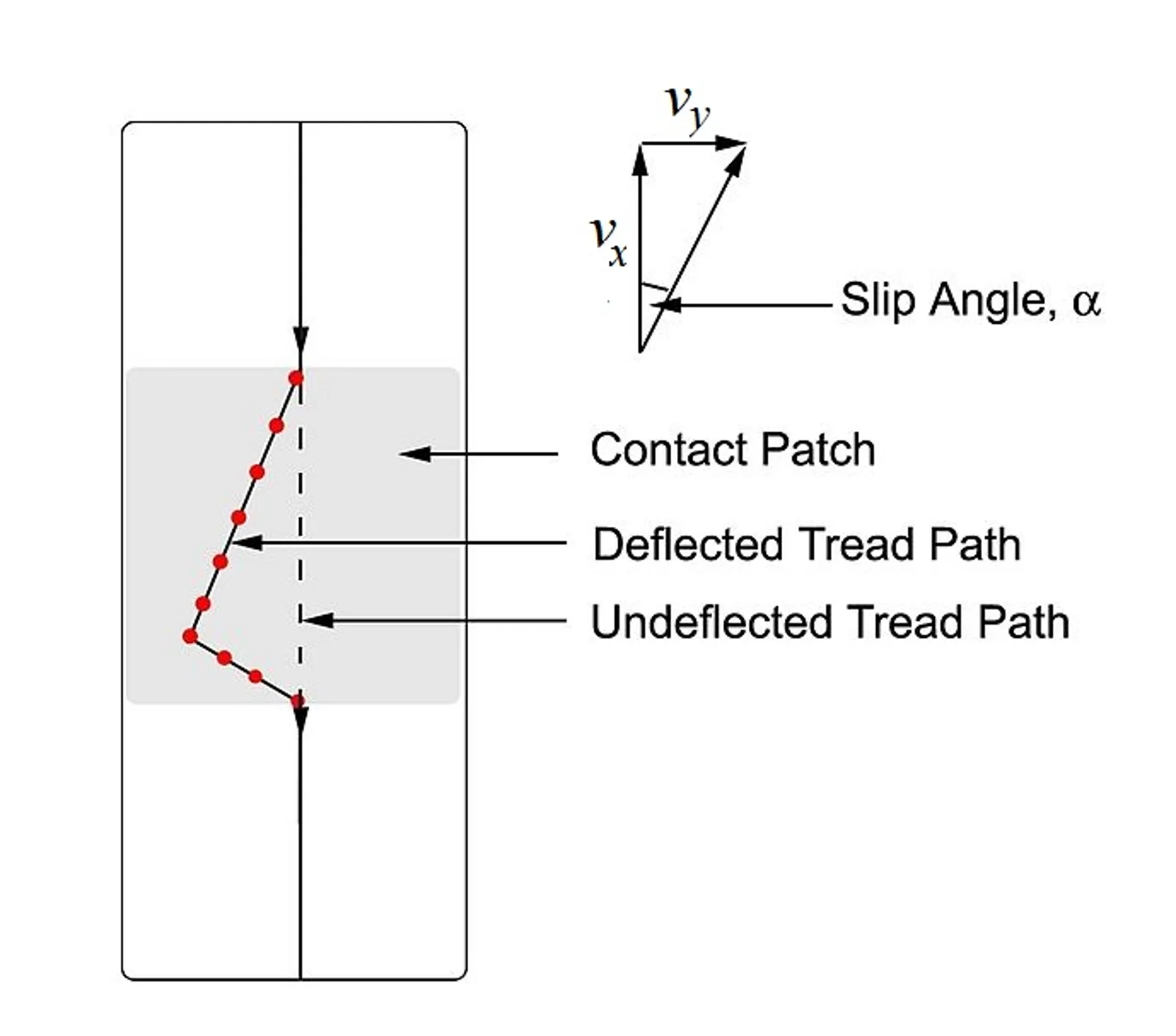
Tyres do not simply point where the car is going. The slip angle is the angle between the direction a wheel is pointing and the direction it is actually travelling, and it is the slip angle that produces cornering force. The force rises roughly in proportion over the first few degrees, then grows less quickly to a peak, then begins to fall.
The cause is the rubber itself. Each piece of tread stays stationary on the road as it passes through the contact patch while the tyre carries on moving sideways, so the tread is deflected and the tyre carcass deforms.
The balance between the slip angles at the front and rear axles decides how a car behaves in a given turn. When the front slip angle is larger than the rear, a ratio above 1:1, the car tends to understeer. A ratio below 1:1 gives oversteer. Designers adjust this through the relative roll couple, meaning how quickly weight shifts from the inside wheel to the outside one, front against rear. They can alter roll centre heights, change roll stiffness through the suspension, or fit an anti-roll bar.
How does weight shift change which end lets go?
Everything above is moved by weight. Moving the centre of mass forward tends to raise the understeer gradient, and moving it rearward tends to lower it. In motion the centre of mass does not stay put: braking puts more load on the front tyres, accelerating moves load rearward, and cornering moves it to the outside. In extreme cases an inside or front tyre can lift off the ground and stop passing steering input to the road.
| What changes | What it does |
|---|---|
| Centre of mass moves forward | Understeer gradient tends to increase |
| Centre of mass moves rearward | Understeer gradient tends to decrease |
| Braking | More load on the front tyres, less on the rear |
| Accelerating | Load shifts to the rear tyres |
| Lower centre of mass | Less load transfer in both directions |
| Longer wheelbase | Less load transfer front to back |
| Wider track | Less load transfer side to side |
How large are the numbers? Take a worked example. In a 0.9g turn, a car that has a track of 1650 mm and a centre of mass 550 mm high sees load transfer equal to 30% of its weight. The outer wheels carry 60% more load than before and the inner wheels 60% less, and the total grip available falls by around 6%. That loss is the work of tyre load sensitivity: the pair of tyres doing more of the work cannot make up for the pair doing less. By comparison, the actual movement of the centre of mass is tiny, no more than 30 mm in that example, which costs under 2% in weight transfer and 0.01% in grip.
This is why performance cars are built to sit very low, and most have a stretched wheelbase and a wide track. It is also why a tall or narrow vehicle on racing tyres, driven hard, can end up rolling over: if lateral load transfer reaches the tyre loading on one end, the inside wheel lifts, and at half the vehicle's weight it starts to roll.
Part of the confusion is vocabulary. Load transfer and weight transfer are often used as if they were one thing, but they are two. Load transfer is the change in load carried by each wheel when the car accelerates, brakes or corners, and it happens even in a perfectly rigid vehicle with no suspension at all, because the tyre forces act at road level while the car's inertia acts through the centre of mass, higher up. The gap between the two creates a turning moment, and the longer that lever is, the more load moves. Weight transfer in the strict sense is the small movement of the centre of mass itself, from the body leaning on its springs or from fuel and cargo sloshing about. As fuel is burned, the centre of mass shifts and the car gets lighter as well.
For cars and SUVs the first effect is far more important than the second. The front-to-back version can be calculated: the change in front axle load equals the acceleration divided by gravity, multiplied by the centre of mass height divided by the wheelbase, multiplied by the vehicle's weight. A taller car or a shorter wheelbase moves more load under braking.
Why do front-wheel-drive cars understeer and rear-wheel-drive cars step out?
In a steady-state test, weight distribution and suspension geometry move the measured gradient most. On the road, power distribution, brake bias and the shifting of weight from front to rear also decide which wheels lose grip first.
Power is the clearest example. When a car is accelerating, load moves to the rear and traction at the front falls, which is why very powerful cars are rarely front-wheel drive. Sports cars usually have rear-wheel drive or all-wheel drive, with the power biased towards the rear under normal conditions. The flip side is that a rear-wheel-drive car with enough power can start oversteer at any moment by sending enough torque to spin its rear wheels. Once traction is broken they are free to swing sideways.
Brakes matter too. Under braking the front brakes typically do more of the work, and if that forward bias is too great the front tyres can lose traction, which causes understeer.
How to correct oversteer, and what to do about understeer
In oversteer the car is unstable, and an experienced driver holds it with countersteering, throttle control or, sometimes, brake pressure. The reason is plain from the mechanics: with the steering left alone, the front wheels trace a tighter and tighter circle while the rear keeps swinging round them.
In understeer the car is stable but cannot turn harder, since the front tyres have no more sideways force to give. The path it follows has a radius larger than intended, and leaving the steering where it is only keeps the front sliding to the outside. Because grip is shared between braking and cornering, and because braking moves weight onto the front tyres, the load on those tyres is changing all the time.
Other ways engineers describe the same thing
The understeer gradient is a main yardstick for steady cornering, and it feeds other numbers. For an understeering car there is a characteristic speed, the speed at which the steering angle needed to get round a turn is twice the Ackermann angle. For an oversteering car there is a critical speed, at which lateral acceleration gain becomes infinite. Engineers also quote lateral acceleration gain in g per degree and yaw velocity gain per second, and they use a Bundorf analysis to separate the contributions of tyres, suspension and steering to the gradient.