How chains, winter tyres and studs find grip, what the sidewall symbols prove, and how the rules differ from Japan to Europe to North America.
Snow chains generally give the best traction in severe conditions but limit speed to around 50 km/h (30 mph) and must be fitted by the driver. Winter tyres are built for snow and ice, studded versions add grip, and the 3PMSF and Ice Grip symbols show tested performance. Laws on chains and studs vary by place.
Winter tyres took 35% of the Canadian tyre market in 2016 and only 3.6% of the American one. Two neighbouring countries with plenty of snow, two very different answers to the same question: when the road turns white, do you bolt something on or buy something different?
Snow chains and winter tyres each get grip in a different way, each wins in different conditions, and the rules and sidewall ratings that govern them vary widely from country to country.
What are snow chains and how do they work?
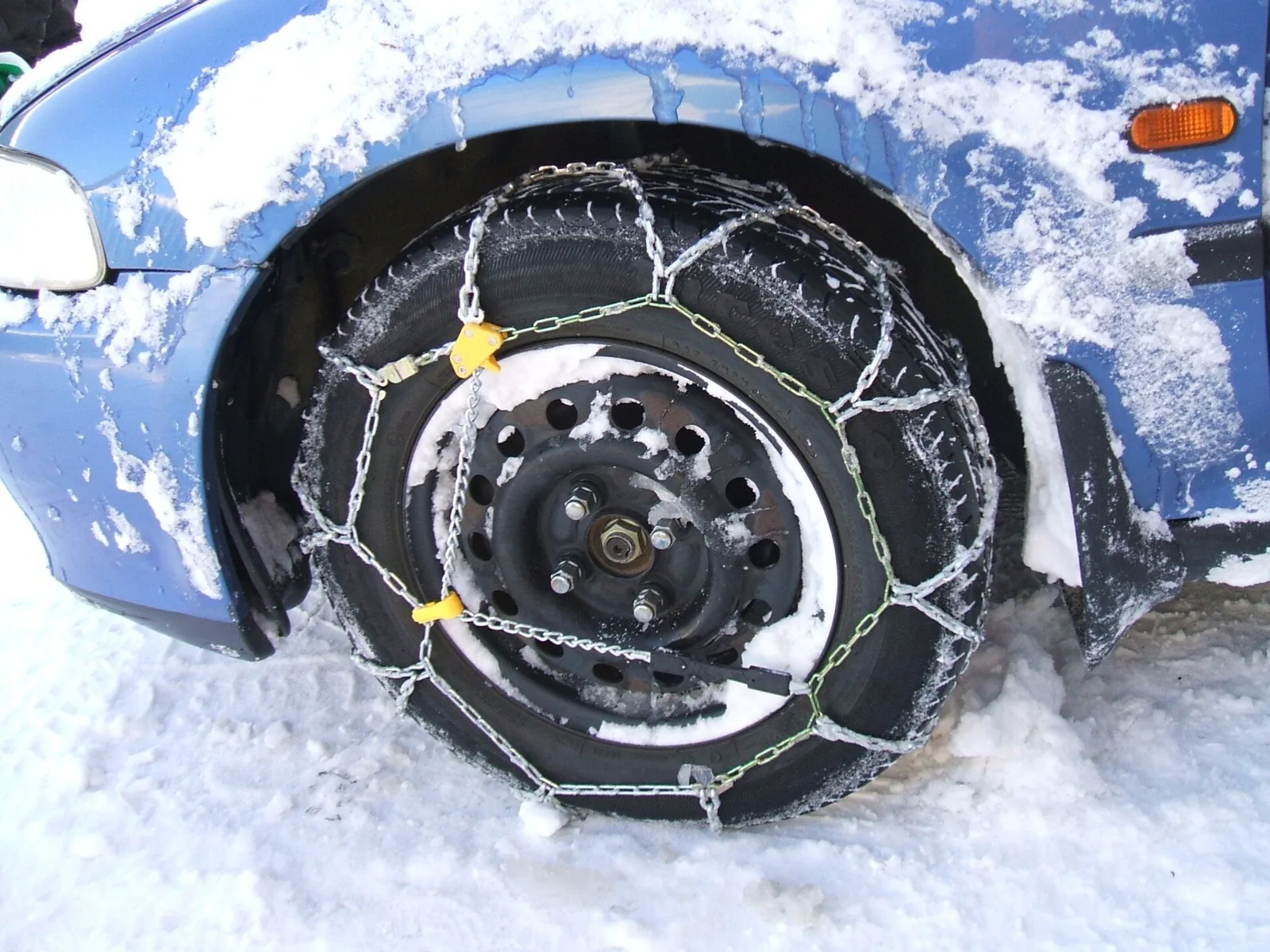
Snow chains, also called tyre chains, are devices fitted to a vehicle's tyres to add traction on snow and ice. They go on the drive wheels, and some systems deploy chains automatically so they swing down under the tyres. Despite the name they are not always made of steel chain, and they come in a range of patterns and strengths. They are usually sold in pairs and often have to match a particular tyre size, although some designs adjust to fit several sizes.
There is a cost to having them on. Chains reduce fuel efficiency and can cut the allowable speed to approximately 50 km/h (30 mph), in return for better traction and braking on snow and ice. The chain maker's manual typically sets the ceiling at 30 to 50 km/h (20 to 30 mph).
The idea is older than most people expect. Harry D. Weed of Canastota, New York, received a United States patent on 23 August 1904 for his Grip-Tread for Pneumatic Tires. According to his great-grandson, he got the idea from watching drivers wrap rope, or even vines, round their tyres to cope with mud and snow. At the time rural roads in northern regions were rolled for horse-drawn sleighs rather than ploughed, and cars were not generally used in winter, in some areas until the 1930s or 1940s. Oscar E. Brown obtained a patent for a non-skid attachment in January 1923, and the Canadian Auguste Trudeau patented a tread and anti-skidding chain in July 1935.
Two neighbouring countries with plenty of snow, two very different answers to the same question.
What kinds of chain are there?
The range is wider than the classic ladder of steel links. Chains can be made from steel links or cables, polyurethane, rubber and fabric, and the steel ones come in carbon steel and alloys, with links that are standard, twisted, square or reinforced. The link shape changes the flexibility, grip and strength, and added studs or V-bars make the traction more aggressive. Alloy and hardened steel add durability. Cable chains, or snow cables, attach in the same way but use cable.
Patterns matter too. Ladder-type chains have cross chains at right angles to the road, diagonal chains angle them, and pattern types form a net such as a diamond or multiple diamonds over the tyre. Most wrap around the circumference of the tyre and are held by rim chains, cables, or elastic or adjustable tensioners. Some mount from one side only, others use a ratchet for easier fitting, and automatic chains fall from units permanently fixed under the vehicle, triggered by an electronic solenoid switched on from the cab. Each type strikes its own balance of price, smoothness, grip, toughness, ease of fitting and advised speed.
How do winter tyres get their grip?
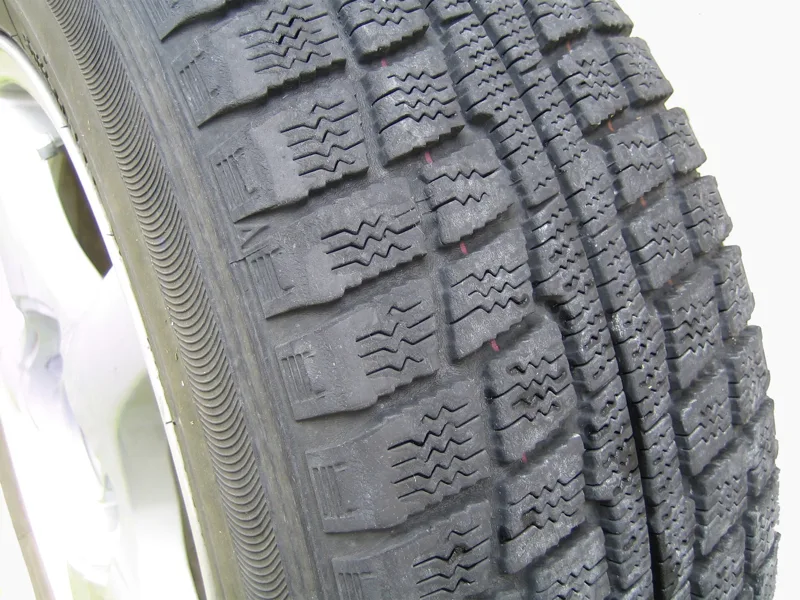
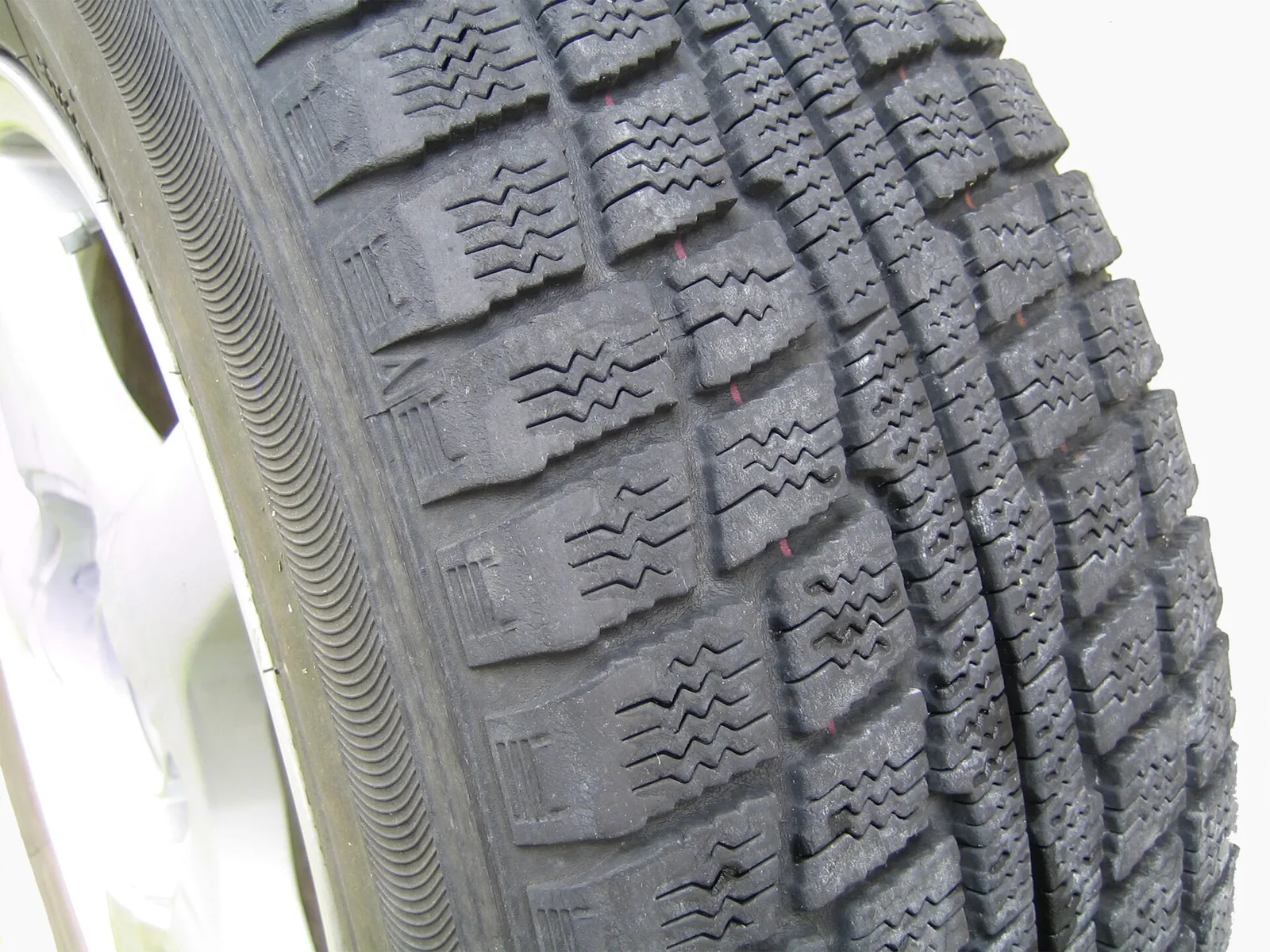
Snow tyres, also called winter tyres, have tread gaps larger than conventional tyres and are often optimised for temperatures below 7 C (45 F). The design lets snow push into the tread, where it packs down and resists slipping. How well that works depends on the snow itself. Wetter, warmer snow compacts better than dry, cold snow, up to the point where it is so wet that it lubricates the join between tyre and road. Fresh powder snow weighs 0.1 to 0.3 g/cm3 (6 to 20 lb/cu ft), but once packed it can reach 0.45 to 0.75 g/cm3 (28 to 47 lb/cu ft).
Temperature changes the friction. Colder than -7 C (20 F), the crystals are harder and the tyre meets more friction passing over them. Warmer than -2 C (28 F), meltwater increasingly lubricates the surface and friction falls away. Water-attracting rubber compounds are one answer, helping to create friction where water or ice is present.
Think of the tread as a set of scoops. Each rotation the tyre packs snow into its grooves, grips against the snow it has packed, then has to throw it out in time to scoop again. That compaction works for pulling away, for braking and sideways for cornering. In deeper snow the tyre meets more resistance because it plows some snow aside as well as compacting it, and a climb without wheelspin gets harder. The same plowing effect does help braking, since it adds rolling resistance.
The features that set a winter tyre apart from an all-season or summer tyre are an open, deep tread with plenty of void between the rubber, shoulder blocks at the outer edge of the tread for more snow contact, a narrower aspect ratio to cut plowing, hydrophilic compounds, and extra siping, the thin slits that give more biting edges. All-season tyres sit in the middle: their tread gaps are smaller than a snow tyre's and larger than a conventional tyre's, so they run quieter on clear roads and cope less well with snow and ice.
Snow chains vs winter tyres side by side
| Option | Strengths | Limits |
|---|---|---|
| Snow chains | Usually the strongest grip when conditions are severe | Fitted by the driver, around 50 km/h (30 mph) top speed, fuel efficiency falls, can damage roads |
| Winter tyres | Tread and rubber built for snow and ice | Should go on all wheels; wet-film conditions on hard snow or ice call for studs or chains |
| Studded tyres | Greatly reduce risk on ice and snow, no fitting by the driver | Do not stop skidding altogether; abrade dry pavement; banned or restricted in many places |
| Snow socks | Fabric cover, higher speeds than chains | Chains usually grip harder in severe conditions |
| All-season tyres | Quieter on clear roads | Less capable on snow or ice |
What about studded tyres?
Studded tyres carry metal or ceramic pins to bite into hard-packed snow or ice. The pin is often tungsten carbide set in a softer jacket that anchors it in the rubber. As the tyre wears, the jacket wears level with the rubber while the hard pin keeps protruding, and for the tyre to work properly the pin should stand out by at least 1 millimetre (0.04 in). Studdable tyres are moulded with usually 80 to 100 holes each, and studs can be inserted only before the tyre has been driven on.
They do not stop skidding on ice and snow entirely, but they greatly reduce the risk. The price is road damage: studs abrade dry pavement, which creates dust and wear in the wheel path, so many jurisdictions allow them only seasonally and others prohibit them.
Do I need snow chains? What the rules say
It depends where you are. In snowy conditions transport authorities may require chains or other traction aids to be installed or at least carried. A rule can apply to every vehicle or only to those without four-wheel drive or special tyres, and it may be enforced at checkpoints or by inspection. Chains belong on one or more drive axles, and the requirement ranges from one pair of tyres on a driven axle to all tyres on all driven axles, perhaps including a steering wheel.
Chain laws themselves run from no restrictions, through restricted use, such as only from 1 October to 30 April or only if conditions require, to a total ban to protect road surfaces. In large countries such as the United States and Canada they vary by state, province or local area.
Japan shows how tight a regime can be. Every prefecture except Okinawa requires winter tyres or chains when the road is covered in ice or snow, and chains must be fitted on rural designated highways in snow country whenever signs call for them. In many prefectures a snow tyre must be replaced once its grooves are worn away by more than 50% of their original depth. Drivers are fined for non-compliance and checkpoints operate on major highways. Studded tyres have been restricted nationwide for passenger vehicles since April 1991 and for commercial trucks since 1993, and running them on dry asphalt or concrete is a criminal offence.
In Europe, as of 2024, the rules varied by country. Winter tyres were mandatory between set dates, or whenever roads were snowy or icy, in countries including Austria, Croatia, Czechia, Finland, France, Germany, Norway, Romania, Sweden and Russia. Studded tyres were restricted seasonally in places such as Austria, Denmark, Finland, France, Iceland, Ireland, Norway, Spain, Sweden and Switzerland, and banned outright in others, including Belgium, Germany, Hungary, the Netherlands, Poland and Portugal. Minimum tread depths may also apply: 6/32 inch (about 4.75mm) in the United States or 4mm in Europe.
What do the sidewall symbols mean?
Three markings tell a buyer how a tyre performs in winter. The oldest, M+S for mud and snow, dates from the 1970s and shows a tread design that does better than a regular tyre in those conditions.
The Three-Peak Mountain Snow Flake, or 3PMSF, was standardised in 1999 and marks a tyre rated for severe snow use. In the American industry standard a passenger tyre must achieve a traction test result 10 to 12% better than a reference test tyre. In grip index terms, with the reference at 1.00, a 14-inch tyre needs 1.10 and a 16-inch tyre 1.12. Under UN Regulation 117, a passenger car tyre must reach 1.07 in a brake test and 1.10 in a traction test, a light commercial tyre 1.02 on the brake test, and a heavy-duty tyre 1.25 in an acceleration test.
The Ice Grip Symbol, standardised in 2021, marks passenger tyres rated for ice, which must brake at least 18% better in a straight-line test than a reference tyre, or an index of 1.18 or greater. It sits next to the 3PMSF and M+S marks. A studded-tyre symbol joined the set in 2022: the snowflake mark paired with the Cyrillic letter Sha, which begins the Russian and Ukrainian words for studs, plus the word STUDDED in letters at least 4 mm high. Snow, ice and studded tyres should all be fitted to every wheel, never just the front, because it could lead to adverse handling.
A set of 68 countries has signed up to the UN tyre regulations, with the United States and Canada the notable exceptions that follow their own standards.
How do you fit snow chains and what goes wrong?
Where you are meant to put them is on the drive axle. Chains fitted to non-drive wheels are a recognised mistake. In the United States the right class of chain must also match the car's wheel clearance. SAE Class S suits vehicles with restricted clearance, a common situation on newer cars especially with wider, low-profile or larger wheels, Class U suits regular clearance, and Class W covers light truck components.
After fitting, the commonest failures come from use:
- Driving too fast. Keep to the maker's maximum, typically between 30 and 50 km/h (20 to 30 mph).
- Running on dry roads for long. The car can slide under braking, and the chains wear quickly.
- Leaving them loose. The manual recommends tightening a second time after a short drive and checking now and then. A loose chain should be refastened or removed before it wraps round the drive axle.
- Accelerating hard. Wheelspin puts stress on the chain.
- Using extra tensioners on chains that have automatic ones, which may be damaged.
The stakes are real. A chain that breaks can slap around inside the wheel arch, may wrap around the axle and can sever brake lines.
What does the tyre label tell you about winter grip?
Very little. The European Union tyre label, required since November 2012, rates fuel efficiency, wet grip and noise from A in green to G in red. A set rated A rather than G can cut a passenger car's fuel use by 9%. But the label leaves out aquaplaning resistance, stability, handling, durability, dry braking and capability in winter conditions, and it does not apply to studded tyres at all. Published tyre tests cover those other factors.
Where this goes next
The rule book for winter tyres is still being filled in. UN Regulation 164 came in during late 2022 to bring studded tyres under the severe snow standards, and was amended the following year so that studded tyres meeting the ice grip requirements can carry the Ice Grip Symbol. The ISO definitions of tyre industry terms, dating from 2017, have yet to be updated to reflect the ice grip test methods released in 2021.