Why roads are salted, how spreaders work, what the chemistry does to bodywork, concrete and water, and how self-serve, tunnel and touchless washes differ.
Road salt lowers the freezing point of water so ice melts, but it also accelerates corrosion of vehicles and infrastructure and pollutes water. The EPA estimates about $5 billion a year in US repair costs. Drivers choose between self-serve, tunnel, in-bay and touchless washes, each with trade-offs.
The same salt that tamed black ice in Paris in the early twentieth century soon turned out to be eating iron structures and damaging the hooves of draft animals. The drawback that now worries car owners showed up early, and the practice spread anyway because it worked.
Road salt sits behind a lot of what a winter does to a car, to the road under it and to the water nearby.
Why do councils spread road salt?
Known variously as deicing salt, rock salt, snow salt or grit salt, road salt is spread in winter to stop ice forming or to melt what has formed, on roads, pavements and other surfaces. Sodium chloride is the usual choice, with calcium chloride and magnesium chloride brought in especially for colder temperatures. Solid salt is often pre-wet so that it starts working sooner.
The principle is freezing-point depression. Salt dissolves into the thin film of water on the ice and lowers the temperature at which that water freezes, so as long as the road is warmer than the new freezing point, the ice melts. Picture the ice as a crowd linked arm in arm, and the dissolved salt as strangers pushing in between to break the chain.
The trick has a ceiling. Ordinary rock salt is effective only down to between -6 and -10 degrees C (21 to 14 degrees F), and below that range it can do the reverse of what is wanted. Salt is sometimes still used in the cold if milder weather is on the way. Bitter, dry cold roughens the surface and reduces the call for de-icing. Extreme cold with rain is another matter: roads can become extremely hard to pass and may sometimes be shut.
Millions of tons are applied each year, and the practice is standard in snowy regions, especially in Europe and North America. Effectiveness, low cost and ease of application explain its popularity.
The drawback car owners worry about now showed up in Paris early on, and the practice spread anyway because it worked.
How did road salt become standard practice?
After Paris, the method was taken up in other cities and countries. In the United States, New Hampshire experimented with granular sodium chloride in 1938, and by the winter of 1941 to 1942 it had adopted a statewide salt-spreading policy, with about 5,000 tons applied on American highways that season. Before that, winter maintenance meant ploughing and scattering abrasives such as sand and cinders, with salt used only occasionally, for example to slow freezing in stored sand piles.
The post-war highway boom changed the scale. As networks expanded and drivers came to expect bare pavement, use soared. During the 1950s and 1960s, American consumption roughly doubled every five years. Starting near 1 million tons in the mid-1950s, it reached nearly 10 million tons within a decade. Much of the supply came from underground rock-salt deposits, the remains of ancient seas. The Detroit salt mine, found in 1895, grew into a well-known example, and the city of Detroit was one of the first to salt its roads, around 1940, which is believed to be down to the nearby mine.
Europe followed a parallel path. Germany made salt spreading routine in the 1960s, when motorisation grew and safety demands rose. Authorities built salt stores and workers handed out salt from trucks until mechanical spreaders arrived. Wet-salt application, which replaced dry spreading in the early 1970s, was a further step forward, because saturated salt clung better to the road and resisted wind.
Later, American use levelled off at tens of millions of tons a year, and attention moved to better application and to limiting side effects.
How is road salt spread?
Two strategies dominate. De-icing means applying salt after snow or ice has formed. Anti-icing is preventive: salt or brine goes onto dry or wet pavement before snow or freezing rain arrives, so ice cannot bond to the surface, and the total amount of salt can fall. With a good forecast behind it, anti-icing is generally judged the more efficient of the two.
The material is spread in three main forms: loose crystals, pre-wetted salt and brine. Loose crystals are the traditional and most widely used form, although they work less well at low temperatures and traffic tends to blow them off the road.
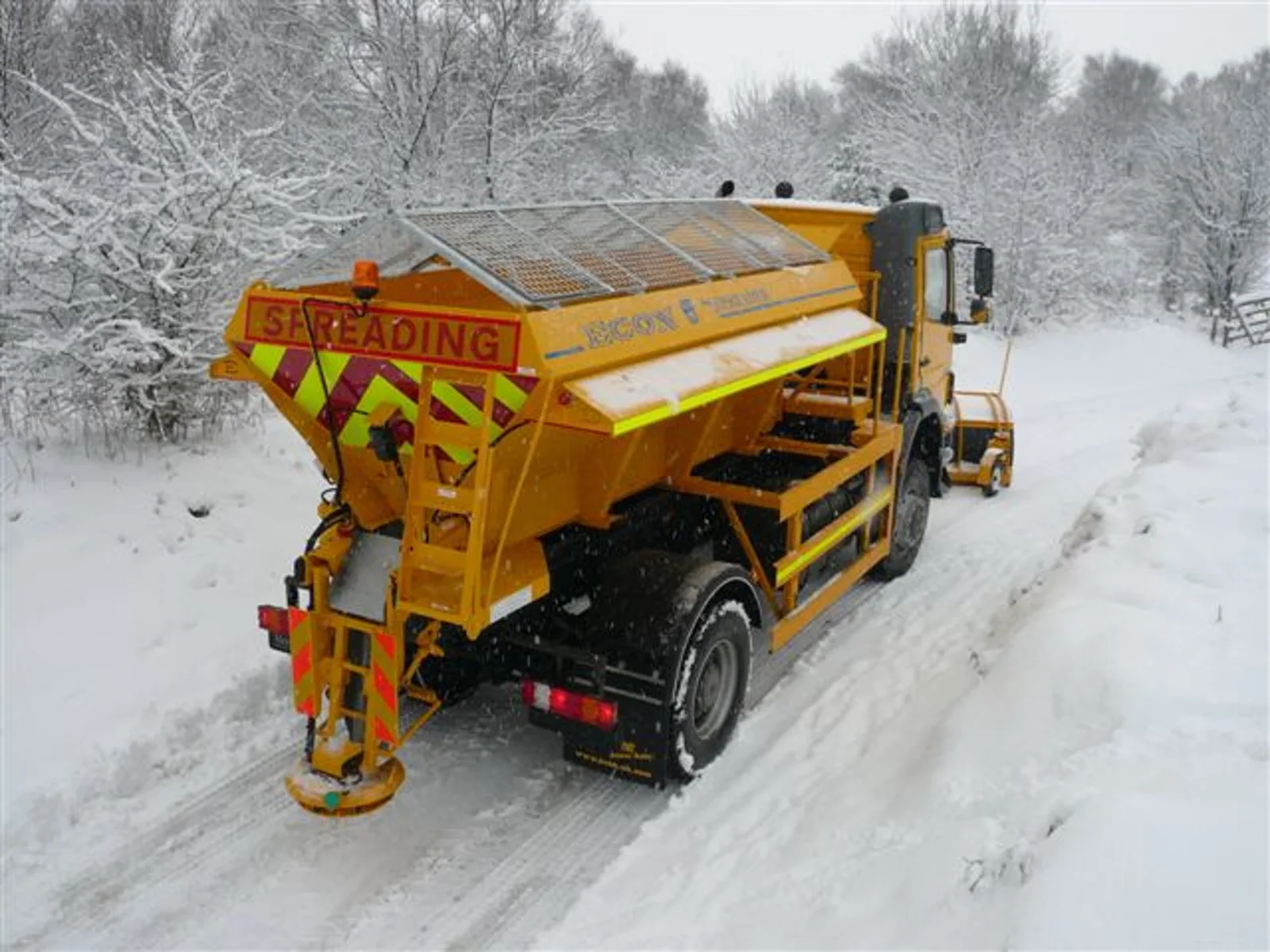
The job falls to a winter service vehicle known as a salt spreader. Spreaders are fitted to trucks and loaders, and brine goes out from tankers. The salt sits in a large hopper at the rear, covered in wire mesh so foreign objects cannot jam the mechanism, and an impeller driven by a hydraulic system and a small onboard engine flings it across the road. Until the 1970s it was often spread by hand, by workers shovelling it off trucks or by wheelbarrow-like machines, which are still used for personal needs.
Does road salt cause rust and other car damage?
It does accelerate corrosion. Chlorine bonds readily with metals that have lower electronegativity, so the chloride in road salt corrodes structures, vehicles and water infrastructure alike. When traffic throws salt or brine off the road, it lands on the bodywork and adds to the problem.
The clearest car-specific figure comes from a study of cosmetic corrosion, which found that damage was 50% lower on cars used on unsalted roads than on those driven on salted ones. Across the United States, the Environmental Protection Agency (EPA) puts the annual repair bill for road salt damage to vehicles and road structures at about $5 billion.
Cars are not the only casualty. Salt speeds up damage to concrete, partly through its effect on the embedded steel reinforcement and partly by worsening the freeze-thaw cycle, which hits porous concrete particularly hard. Used heavily, the abrasive crystals also erode concrete and asphalt. Copper, lead and iron in plumbing are vulnerable too, and a study predicts that close to a quarter of New York's private wells could feel the effects of salting.
What does road salt do to water, soil and wildlife?
The salt dissolves into snowmelt, which runs into storm drains and on into sewers, rivers and lakes. When runoff is heavy, freshwater salinisation follows. Chloride is toxic to fish, amphibians and macroinvertebrates, and high concentrations could lead to the loss of freshwater species. It also seeps into groundwater, and water starts to taste salty once chloride exceeds 250 mg/L. People drinking heavily salted tap water risk electrolyte imbalances, especially hypernatremia, whose symptoms range from thirst, weakness and nausea to, in severe cases, confusion, muscle twitching and bleeding around the brain.
Road salt also feeds eutrophication. Nutrients including nitrogen and chloride build up quickly in water and support algal blooms. When the algae die and decompose, they strip oxygen from the water, and the conditions that follow favour still more algae.
On land, salt in roadside soil stunts plants and can kill sensitive species. In Beijing, de-icing salt was found to have killed 11,000 pavement trees, 1.5 million shrubs and 200,000 square metres of lawn grass. Deer and moose are drawn to the salt, and roadside pools have been linked to an increase of nearly 80% in vehicle collisions with moose.
Are there road salt alternatives?
| Salt | Cost and reach | Drawbacks and advantages |
|---|---|---|
| Sodium chloride | Cheapest, at $20-30 per ton; by far the most common | Works to about -6 to -10 degrees C, counter-productive below; raises salinity of water and soil; erodes concrete and asphalt |
| Calcium chloride | Costs five times more to make; covers a far larger area | Melts ice almost three times quicker; less environmental and concrete damage |
| Magnesium chloride | $100-180 per ton | Very low environmental impact and effective, but far more damaging to concrete, so largely dropped on paved roads |
Calcium chloride is rising in popularity because it does less environmental damage than sodium chloride and clears ice better. Magnesium chloride remains widespread for settling dust and stabilising soil on unpaved roads and in warmer weather, and gardeners often prefer it because it harms plants far less than other road salts.
Salt-organic blends are among the other de-icers being tried, along with calcium and magnesium salts, as occasional supply shortages and environmental concerns push authorities toward reduced-salt strategies. Anti-icing is itself a way to use less.
What car wash options does a driver have?
Car washes come as self-service bays, full-service sites with attendants, or fully automated machines, sometimes attached to a filling station. The first US patent for a mechanised wash was filed in 1900. The Automobile Laundry in Detroit, which Frank McCormick and J.W. Hinkle opened in 1914, is regarded as the first American business to call its service a car wash. The first conveyor-driven automatic wash appeared in Hollywood, California, in 1940.
The industry today is big. By 2024 the United States was estimated to hold about 60,000 car washes, a $14 billion industry that grew around 5% a year in the early 2020s, which some analysts attribute to subscriptions. The share of washes done professionally rather than at home rose from 50% in 1996 to an estimated 79% in 2021.
Self-serve versus automatic
A self-service bay is typically coin-operated or token-operated, although newer ones take cards. The driver parks in a bay equipped with a high-pressure sprayer on a wand, plus a foam brush for scrubbing, and picks from soap, tire cleaner, wax or a clear water rinse. Separate vacuum stations clean the inside, and some bays offer hand-held dryers. The trade-off is flexibility and lower cost against a few drawbacks: in cold climates meltwater from the wash can freeze around the bay, and the vacuum stations may harbour bacteria that can be transferred to the interior.
Automatic washes take two main forms. In an in-bay automatic, the car stays parked while a machine rolls back and forth over it. In a tunnel, the car rides a conveyor through fixed cleaning stations, using either friction (brushes or cloth curtains) or high-pressure nozzles with no contact.
A typical tunnel starts with presoak chemicals applied through arches, plus applicators that remove brake dust and build-up from wheels and tyres. A high-pressure arch follows, then a fresh-water rinse. Extras come next: a polish wax, a protectant that leaves a thin water-repelling film and so helps drying and visibility in rain, and a drying agent. A final spot-free rinse uses soft water stripped of the salts it normally carries by semi-permeable membranes, so it leaves no spots. Dryers finish the job. At a full-service wash, attendants can dry the car by hand and clean the interior, and many sites offer detailing.
Touchless, hand and lift systems
Touchless washes operate mainly as in-bay automatics and use high-pressure water in place of foam or cloth. To make up for the lack of contact they run higher pressures and more caustic detergents. Because nothing touches the car, the risk of physical damage is lower, yet they find tough dirt and hard-to-reach spots harder to clean, and the stronger chemicals can potentially harm the paint finish. Newer machines carry sensors that detect the shape of the vehicle, allowing more precise cleaning and less water.
Brush-type machines may risk the exterior finish, though paint and washing processes have improved, and more sites use brushless cloth or touch-free equipment and closed-cell foam wheels. Hand washes use cloths, brushes and hoses. Mobile operators bring the equipment to the customer. Lift systems raise the car on a platform so it can be washed underneath. Steam washing uses high-temperature steam and is water-efficient, and waterless washing relies on cleaning agents and microfibre cloths, though it is recommended only for light dirt to avoid paint damage.
Is washing at home worse for the environment?
Most professional car washes are legally required to treat or reuse their water and may need discharge permits. Washing on a driveway is different, because the wastewater can run into the storm drain and so reach streams, rivers and lakes. Chief pollutants in wash water are phosphates, oil and grease, and lead, and professional sites can capture them in interceptor drains before the water enters the sanitary system.
Rules vary widely. Switzerland and Germany prohibit people from washing their cars at home, and the New Jersey Department of Environmental Protection has run campaigns encouraging professional washes over driveway ones. Poland, Portugal, Italy and many others have no rules on car-wash wastewater at all.
Where this goes next
On the road, the direction is toward using less salt. Reduced-salt strategies and alternative de-icers are being tested, and anti-icing is considered more efficient than de-icing when forecasts are good.
In the wash bay, industrial robots are being tried for touchless washing in place of the traditional gantry, with computer vision used to generate precise paths for the sprayers. Water reclamation systems may be mandatory where water restrictions apply, and regulation and consumer demand are expected to keep pushing the industry to cut its footprint. Some US municipalities have already introduced bans on new washes being built in clusters.