German area codes name a district, Japanese class codes show engine size, Chinese plates open with a province and Indian plates build up from state to RTO to series.
German plates open with a one-to-three-letter area code naming the district, Japanese plates carry an issuing office and a class code, Chinese plates start with a province character, and Indian plates run state code, RTO number, series letters and a number from 1 to 9999.
A German child on a long drive can guess which district a car comes from, because the first letters of its plate name the place. A Japanese mechanic can read a plate and know whether the car has an engine above or below 2,000 cc. Different countries hide the same two answers, where a vehicle is registered and what kind of vehicle it is, in very different places.
Germany puts the place in front. Japan puts the class on top. China stamps the province first and shuffles the rest at random, and India builds its code in four parts, from state down to the individual vehicle.
How do German number plates work?
German plates have existed since 1906 and the current system dates from 1956. District authorities issue them, and every motorised vehicle on public roads must carry them at the front and rear. Motorcycles and trailers need only a rear plate. A black-on-white plate for a car, truck or bus measures 520 mm by 110 mm, or 340 mm by 200 mm in the two-line version, and its characters are 75 mm high.
Each plate opens with a district code of up to three letters. Next come one or two letters, then up to four digits, and the whole plate may not exceed eight characters. The district code names a place: B stands for Berlin, for example, and HSK for Hochsauerlandkreis. Short identifiers with one letter and a one- or two-digit number are often kept for motorcycles, which have less room.
The typeface is called FE-Schrift, short for tamper-hindering script. It is designed so a P cannot be altered into an R, or an F or L forged into an E, and all characters have equal width, which suits automatic number plate recognition better than the older DIN 1451 script used from 1956. The style arrived in 1994 and became mandatory in 2000. A blue strip on the left carries a D and the circle of 12 stars of the European flag. Plates have traditionally been aluminium, with plastic allowed since 2013 because it resists damage and creates less CO2 in production, although it costs more.
Four countries, one question: where is this vehicle registered, and what kind of vehicle is it?
What do German area codes and letters mean?
The area code was meant for police, as a way to identify speeders and other offenders. It soon turned into a shorthand for home turf, which people cherished or mocked, and merger disputes over whose code survived could turn fierce. When the system began, each district received exactly one abbreviation. Since 2013, however, long-abolished codes have returned, so many districts use more than one code and some codes serve more than one district.
One municipality has a special plate. Busingen am Hochrhein, a German exclave surrounded by Swiss territory, belongs to the district of Konstanz but sits in the Swiss customs area. Since 1968 its cars have worn BUS instead of KN so Swiss customs officers can tell they are domestic. About 700 cars carry the code, making Busingen the smallest registration precinct in the country.
The letters after the area code cover A1 to ZZ9999 within the eight-character limit. Certain letters were once left out of the serial section to avoid mix-ups with digits: B, F and G were allowed in 1992 and I, O and Q in 2000. The gap between the area code and the serial letters matters. F ST 683 is a different plate from FS T 683, which is why police radio the town name first and then spell the letters. For 10.20 euros extra an owner can choose a personalised identifier, typically initials and a birth date, so a Mrs Ulrike Mustermann, born on 2 May 1965 in Essen, might pick E-UM 2565.
What are the stickers on a German plate for?
A plate becomes valid with the official seal, a coloured 45 mm sticker carrying the seal of the Land and the issuing authority. Federal vehicles, such as those of the Bundespolizei, carry the federal eagle instead. The rear plate also bears the safety test sticker. The test falls due three years after a car's first registration and then at two-year intervals. The sticker is applied with the expiry month pointing upwards like a clock hand, the year is printed in the middle, and its colour repeats every six years.
The technical inspection began in 1951, and a rear decal marked the due date from 1961. Between 1985 and 2010 a hexagonal sticker on the front plate showed the emissions test, until a 2010 change folded it into the safety test. All stickers are treated so they transfer onto the plate easily but resist removal, which makes them hard to counterfeit. Cargo or a bicycle carrier covering the rear plate requires a repeater plate.
How do Japanese plates show the class of a vehicle?
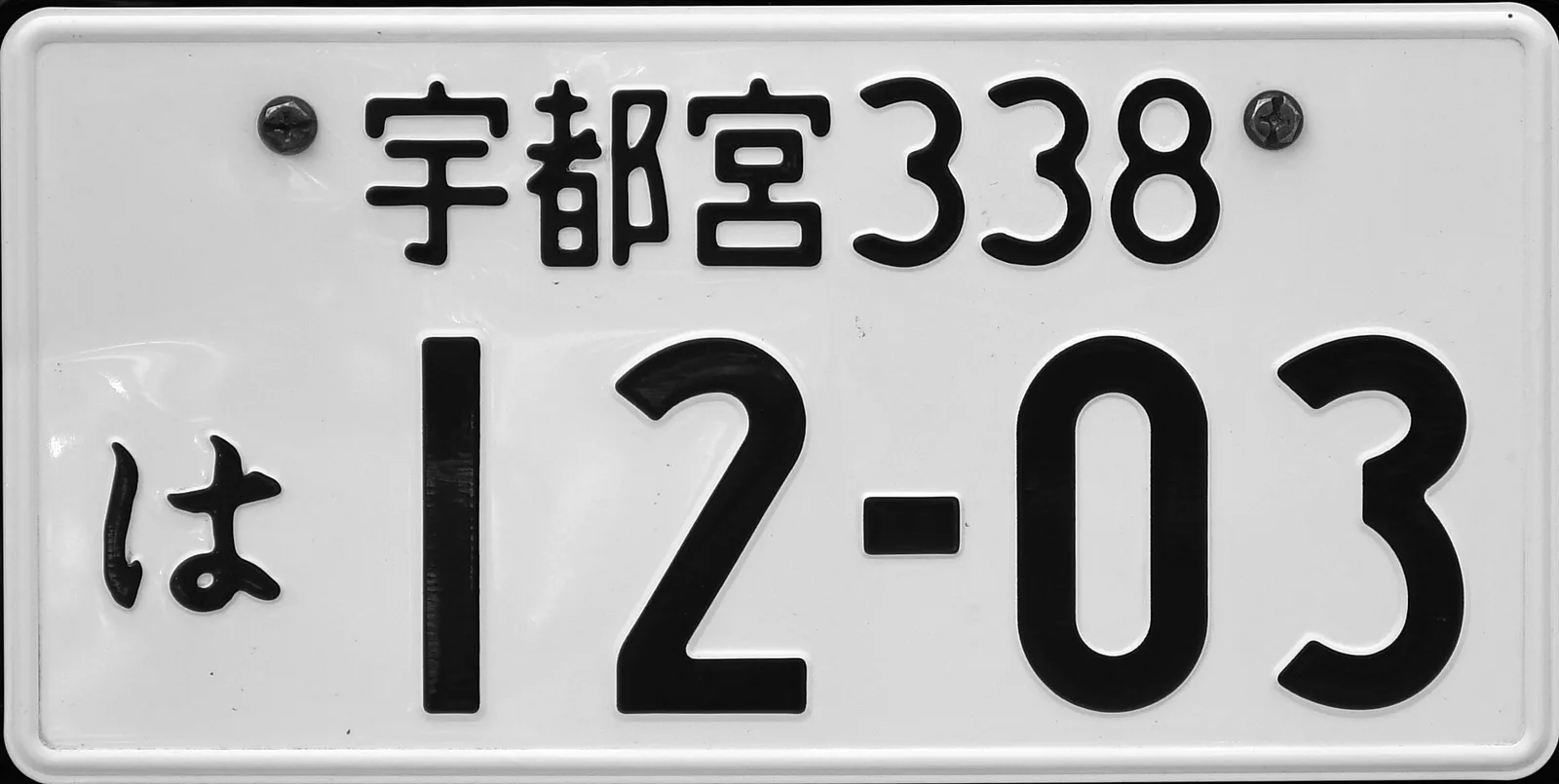
Japan's national government issues plates through Land Transportation Offices of its transport ministry, though local municipalities register some small-engine vehicles. The top line holds the name of the issuing office and a vehicle class code. Passenger cars with engines at or under 2000 cc broadly receive the 5-series, and those with larger engines the 3-series. The bottom line has a hiragana character and four digits split into two pairs, with leading zeroes shown as centred dots.
Class codes have grown over time. Since 1962 plates on vehicles with three or more wheels have carried them. Double-digit codes were introduced in 1967 and became national in April 1971 once the single digits ran out, and by May 1998 busy prefectures had begun issuing triple-digit codes for the most common classes, such as 599 and 799. Some prefectures used 77, 78 and 79 as an overflow series for cars of 2000 cc and under.
Colour carries meaning too. Everyday private cars wear white plates lettered in green, while commercial vehicles reverse the scheme: green plates, white lettering. Kei cars, the lightweight class, have yellow plates with black text, and lightweight commercial vehicles black plates with yellow text. Sizes range from large, 44 cm by 22 cm for vehicles over 8 tons or carrying 30 people or more, down to extra small at about 20 cm by 10 cm. Until 31 December 1974 kei cars wore small green-and-white plates.
Plates are fitted at the dealership before delivery. The rear plate is attached permanently, with a prefecture seal covering one of its bolts. It comes off only when the car is sold to someone in another prefecture, scrapped or exported. An illuminated version became available at the owner's request on 1 November 1970, and since 19 May 1998 drivers can ask for specific numbers if free.
Why are some Japanese characters never used?
Several hiragana characters are barred from plates. One looks too much like another, which could cause confusion after a crash. Another can be read as the word for death, and a third as a rude word for flatulence. Two are very old and rarely used, and a final one is hard to convey quickly over the phone. Characters with voicing marks are also off limits.
Special groups have their own markings. Vehicles owned by United States military personnel under the Status of Forces Agreement carry a Y on a white plate or an A on a yellow one, and an E means Japanese sales tax has not been paid. Imperial household cars are exempt from the standard plates and wear a special one. A car going abroad can receive a plate with Roman letters instead, so a plate from the Tokyo district of Adachi might read TKA 50K KI 21-41.
The issuing office tells a story as well. Until 1964 it was a single character, and from then on up to four, as for Okinawa. In 2006 new place names were approved for areas wanting more recognition, provided they had at least 100,000 vehicles. Because the office follows the owner's home, some markings, such as Shinagawa in inner Tokyo, are considered more desirable than others.
How do Chinese number plates work?
In mainland China, local traffic management offices, which are part of local public security bureaus, issue plates under rules set by the Ministry of Public Security. Both Hong Kong and Macau run plate systems of their own. Vehicles from those regions need mainland plates, usually from Guangdong, to drive on the mainland, and mainland vehicles need Hong Kong or Macau plates to enter them. Cross-border cars carry black plates with a character for Hong Kong or Macau in place of the last number.
The current standard is GA36-2014, an update of the 1992 version, and plates are aluminium. Each begins with a single character abbreviating the province, then a Pinyin letter, then five more places filled with digits or letters. Early plates used five numbers alone, which capped each prefix at around 90,000 or 100,000 vehicles. As the vehicle count rose, big cities began inserting letters, leaving out I and O because they look like 1 and 0. Nanjing, for one, began by allowing a letter in the first of the five places, which raised the total to 340,000 combinations, and later changes allowed letters in the first two places, or the second place alone, adding 792,000 more.
Numbers are generated at random by computer, and sequences with 6s, 8s or 9s are considered lucky, so plates such as 88888 can be bought at auction. An older green series was numbered sequentially and became beset with corruption. Combinations from written-off vehicles can be reused after six months, though some Beijing series are withheld. In 2015 a former commissioner of the Beijing traffic bureau was sentenced to life in prison for corruption over the issuing of such combinations.
What do plates mean for foreigners, police and diplomats in China?
Foreign-owned cars once wore black plates. That ended in October 2007, when the practice was deemed discriminatory, and they now receive blue plates from a separate letter and number sequence. Embassy vehicles have had their own black plates since 2017, with six white digits and a status character. The first three digits identify the entity and the last three are sequential, with 001 normally the ambassador's car: 224-001 is used by the American ambassador.
People's Police, People's Armed Police and army plates are white with red and black text. Government and military vehicles are exempt from the Road Traffic Safety Law, and police are reluctant to stop them, which has encouraged people to buy fake military plates. Xinhua reported in 2008 that since July 2006 the government had seized more than 4,000 counterfeit military vehicles and 6,300 forged plates, and detained over 5,000 people from criminal gangs. Drivers caught with fake plates face fines of up to 2,000 RMB, and counterfeiters up to three years in jail.
Other plates mark roles: yellow with a test suffix for test vehicles, green for airports, blue for low-powered qingqi motorbikes, and paper interim plates valid for 15 days. A short-lived 2002 standard allowed customised plates in several cities and barred the letters CHN but, oddly, not PRC.
How do Indian number plates encode state and district?
A Regional Transport Office, the district-level authority in each state or Union Territory, issues the registration, and the Ministries of Defence and External Affairs issue plates where applicable. Plates are required front and rear, with Hindu-Arabic numerals and Latin letters. Since 1 July 1989, under the Motor Vehicles Act of 1988, ordinary plates have four parts: a two-letter state code, a two-digit RTO number, one to three series letters (or none), and a number from 1 to 9999.
The old three-letter codes left state and district hard to decode and caused confusion nationally. Now the first characters give state and district. Series letters show how far along an office's numbering has run: once 9999 is used up, a letter is added and the number resets, and the letters I and O are skipped to avoid confusion with digits.
Exceptions abound. Chennai has several RTOs with distinct numbers, from TN 01 onward. Rohtak in Haryana splits its numbers: HR 12 for private cars, HR 46 for commercial vehicles. In Meghalaya ML 01 is for government vehicles, ML 02 for police and ML 03 for state transport. Delhi omits the leading zero, so plates start DL 1, and Andhra Pradesh used a common district number, AP 39 as of 2023.
Letters can signal class. In Tamil Nadu G marks government vehicles and N state buses, so TN 60 AG 3333 could be a government vehicle in Theni and TN 58 N 4006 a government bus in Madurai. In Andhra Pradesh and Telangana Z is for state road transport buses and P for police, in Goa X is for state buses, and in Assam C marks commercial vehicles.
What are India's BH, VA, military and diplomatic series?
The Bharat series, set up by a notification of 26 August 2021, lets a car keep one plate when its owner moves between states. It is open to central and state government employees and to staff of private companies that operate offices in at least four states or Union Territories. The format has two digits for the year, BH, a four-digit number and one or two letters. The Vintage series, from 15 July 2021, covers cars and two-wheelers more than 50 years old that are kept in original form, with use limited to events such as rallies.
Armed forces plates start with a Broad Arrow, a legacy of the British Board of Ordnance, followed by the year, a letter for the class, a six-digit serial and a check letter. Class A is a motorised two-wheeler, B a light motor vehicle such as a passenger car, and X an active combat vehicle such as a tank. Diplomatic plates carry a mission number, then CD for an embassy, CC for a consulate, UN for United Nations bodies or IOD for other international organisations, and a serial number. Number 1 is reserved for the head of mission, with suffixes such as 1A for additional cars. A UN, CD or CC vehicle loses its immunity when it is driven without an accredited diplomat or consular officer.
Where a car is registered can matter for tax. Puducherry has attracted many luxury cars bought by residents of other states who register them there, in some cases fraudulently, and those states have cracked down.
German, Japanese, Chinese and Indian plates side by side
| Detail | Germany | Japan | China | India |
|---|---|---|---|---|
| Issued by | District authorities | National Land Transportation Offices | Local traffic management offices | District Regional Transport Offices |
| Place marker | One to three letters, such as B for Berlin | Name of issuing office on top line | One-character provincial abbreviation | Two-letter state code and RTO number |
| Class marker | Short identifiers often kept for motorcycles | Class code on top line; colour and size | Colour and suffix characters | Colour; series letters in many states |
| Serial | One or two letters and up to four digits | Hiragana and four digits | Letter plus five numbers or letters | Up to three letters and 1 to 9999 |
| Notable limit | Eight characters in total | Several hiragana banned | I and O excluded | I and O skipped in series letters |
What happens when a plate system runs out of numbers?
Every system has had to stretch. Germany caps plates at eight characters and has relaxed letter rules and reintroduced old area codes. Japan added digits to the class code. China adds letters to the serial and lets a provincial office move to the next combination type once 60% of the current type's theoretical capacity is used, with approval from provincial and ministry offices. India adds series letters to each RTO.