A supercharged eight-cylinder state limousine sold upon request, and the four-cylinder 170 V that carried Mercedes from 1936 into the 1950s.
The Mercedes-Benz 770 was a supercharged-eight state limousine built from 1930 to 1944 for governments and rulers. The W136 was the 170 V family of four-cylinder saloons, built from 1936 to 1955, that restarted Mercedes after the war.
In 1938 Mercedes-Benz sold what was understood to be the most expensive German passenger car to that date, and printed no price for it. The entry on the price list read auf Anfrage, upon request. Across the same years a far humbler car, the 38 PS four-cylinder 170 V, sold in the tens of thousands and, once the bombing stopped, supplied the tooling the company used to start again.
What was the Mercedes-Benz 770?
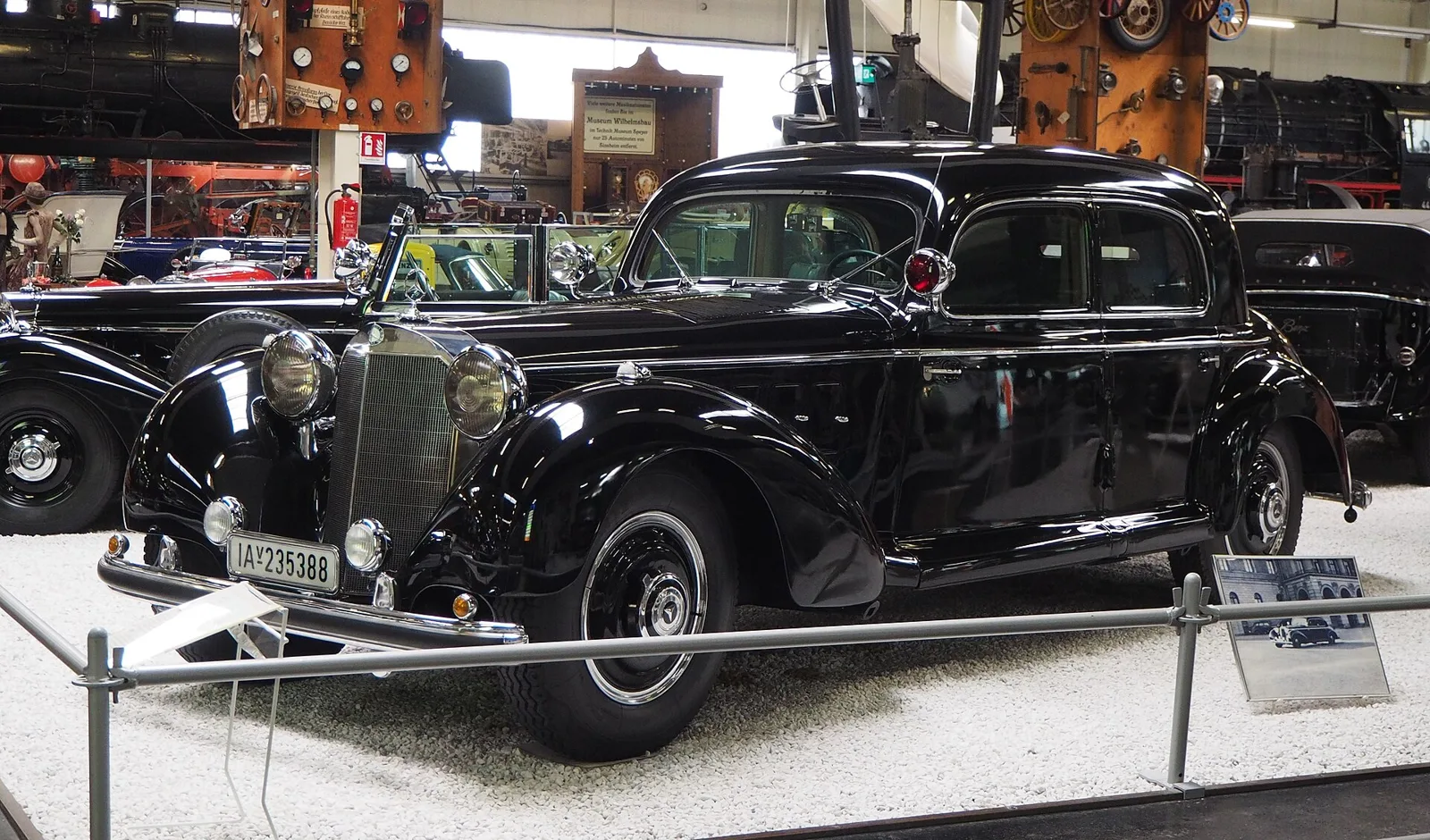
The Mercedes-Benz 770, known as the Grosser Mercedes or Large Mercedes, was an ultra-luxury car built from 1930 until 1944. Its customers were largely governments, and its second series, the W150, became best known for its use by senior officials of Nazi Germany and their allies.
It arrived in 1930 as the successor to the Typ 630, with the internal code W07. Reich President Paul von Hindenburg, Emperor Hirohito and Pope Pius XI were among the buyers, and Adolf Hitler used a 770 from 1931 onwards. Only 117 of the W07 cars were built before the series ended in 1938.
One car had no price list and the other had the tooling that restarted the company.
How did the first-series 770 work?
The W07 had an inline eight-cylinder engine of 7,665 cc (467.7 cu in) with an overhead camshaft and aluminium pistons. It made 112 kW (150 bhp) at 2800 rpm on its own. An optional Roots supercharger, engaged at full throttle, lifted that to 149 kW (200 bhp) at the same speed and could carry the car to 160 km/h (99 mph).
The four-speed gearbox had a direct third and an overdrive fourth. Underneath was a conventional boxed chassis on semi-elliptic leaf springs and beam axles at both ends. Dimensions depended on the coachwork, but the chassis had a wheelbase of 3,750 mm (147.6 in) and equal front and rear tracks of 1,500 mm (59.1 in).
What changed with the W150 of 1938?
Mercedes revised the 770 substantially in 1938 and gave it the code W150. The chassis was rebuilt from oval-section tubes and hung on coil springs all round, with independent suspension at the front and a de Dion axle at the rear. The earlier servo-assisted mechanical brakes were replaced by hydraulic ones.
The engine kept its basic architecture but was retuned to 116 kW (155 bhp) at 3000 rpm, or 172 kW (230 bhp) at 3200 rpm with the supercharger. A five-speed gearbox had a direct fourth and an overdrive fifth, and top speed rose to around 170 km/h (106 mph). A twin-supercharged version of 298 kW (400 hp) could reach about 190 km/h (118 mph), though only five were made.
| W07 (1930-1938) | W150 (1938-1944) | |
|---|---|---|
| Engine | 7,665 cc inline eight | Same basic engine, retuned |
| Output without supercharger | 112 kW (150 bhp) at 2800 rpm | 116 kW (155 bhp) at 3000 rpm |
| Output with supercharger | 149 kW (200 bhp) at 2800 rpm | 172 kW (230 bhp) at 3200 rpm |
| Gearbox | Four speeds, overdrive fourth | Five speeds, overdrive fifth |
| Top speed | 160 km/h (99 mph) | Around 170 km/h (106 mph) |
| Suspension | Leaf springs, beam axles | Coil springs, independent front, de Dion rear |
| Brakes | Servo-assisted mechanical | Hydraulic |
| Built | 117 | Eighty-eight |
Eighty-eight W150 cars were built before chassis production ended in 1944, and the last were bodied and delivered in March of that year.
Who owned a Mercedes-Benz 770?
Owners were heads of state and rulers: besides Hindenburg, Hirohito, Pius XI and Hitler, the list includes Wilhelm II, Faisal I of Iraq, Haakon VII of Norway, Oscar Carmona, Antonio Salazar and Abdullah I of Jordan. Some cars were presented by Hitler to allies, among them Ion Antonescu of Romania, Benito Mussolini, Francisco Franco, Marshal Mannerheim of Finland and Emil Hacha. Antonescu's car was bulletproof.
Hirohito owned at least seven 770K cars built between 1930 and 1938, including a cabriolet parade car. An armoured Grand Pullman limousine delivered to him in January 1935 is on display at the Mercedes-Benz Museum in Stuttgart. In more recent years, Clive Palmer has been a modern owner.
Which 770s survive today?
Several survive. The Canadian War Museum in Ottawa shows one of the seven cars Hitler used. It is an armoured W 150 II, built between 1940 and 1943, with 40 mm (1.6 in) glass all round, 18 mm (0.71 in) steel plate around the passenger compartment and a weight of 4,100 kg. It rode on 480 mm (19 in) armoured steel wheels with bullet-resistant 20-chamber tyres, and the factory advised a maximum of 80 km/h (50 mph) to protect them.
US troops of the 20th Armored Division found it in May 1945 on a railway flat-car at Laufen. A liberated Dutch forced-labour mechanic got it running and told the soldiers it was Hermann Goering's state car. Repainted army green, it served as a ranking officer's staff car and later toured the United States to sell war bonds. An army surplus auction at Aberdeen Proving Ground sold it in October 1956 to a Montreal businessman for $2,750, and restoration in Toronto cost CA$5,000. In 1970 it went to the museum in a tax settlement. Researcher Ludwig Kosche began detailed research on it in 1980, and with help from Mercedes-Benz he confirmed it as a Hitler car delivered to the Reich Chancellery on 8 July 1940.
The 770K once owned by Field Marshal Mannerheim went to an American collector after the war and appeared in the 1951 film The Desert Fox. At a 1973 auction it fetched $153,000, then the most ever paid for a car at auction, passing the $90,000 given for Greta Garbo's Duesenberg in autumn 1972. The buyer was a businessman from Lancaster, Pennsylvania, who wanted it for a park called Dutch Wonderland. The car has been privately owned since 1984. Another 770 sold at that auction for $93,000, though its high bidder, an Alabama developer, could not arrange finance and sold his option to the mobile-home maker Don Tidwell.
Others are scattered across museums.
- A 1938 armoured 770 at the Museu do Caramulo in Portugal was ordered by the Portuguese secret police after the 1937 bomb attempt on Salazar.
- A 770 Offener Tourenwagen brought to Norway in 1941 by General Nikolaus von Falkenhorst was used by the King of Norway after the war and won best unrestored pre-war car at Pebble Beach in 2003.
- A 1939 cabriolet in Czechoslovakia became a government VIP car, and in 1952 it was rebodied at Karosa so that nothing would recall its origins. It is in the National Technical Museum in Prague.
- At the Henri-Malartre museum in France, a 770K Tourenwagen taken from Berchtesgaden in May 1945 still has windows scratched by soldiers testing the armour. Before arriving in 1969 it toured France, Belgium and Holland for ten years to raise money for war widows and orphans.
- The Southward Car Museum in New Zealand has a 1939 770K believed to have been intended as a gift for Edward VIII after a planned German invasion of Britain.
Unusual among them is the 1939 770K Cabriolet B seen at Pebble Beach, a two-door, five-passenger convertible when most W150 cars were hardtop or convertible limousines. Some stories are less certain. In November 2009 one of Hitler's cars was said to have been bought by an unnamed Russian billionaire for several million euros.
What was the Mercedes-Benz W136?
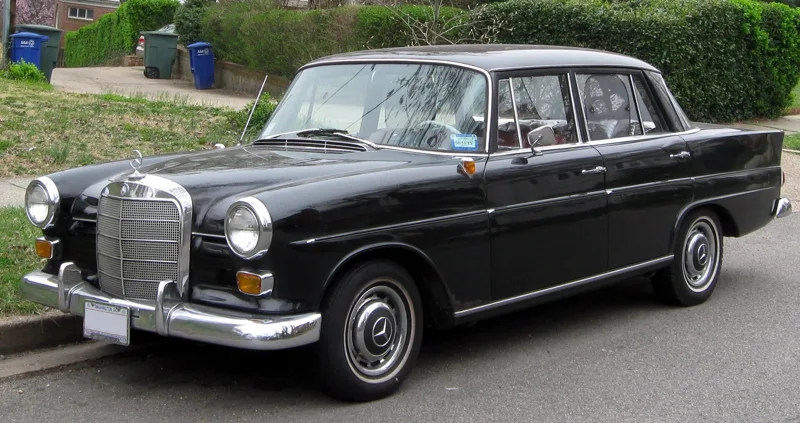
The W136 was Mercedes-Benz's main line of four-cylinder cars from the mid-1930s into the 1950s. Its first model, the 170 V, made its public debut in February 1936 as successor to the W15 Typ 170 and was the company's best seller from 1936 to 1939.
Production stopped in 1942, with over 75,000 built since 1936; counting light commercial versions, pre-war output was around 90,000. It was by far the most popular Mercedes-Benz up to that time. The V stood for Vorn, front, to separate it from the rear-engined 170H (W28), which used the same four-cylinder engine mounted at the back.
What was under the bonnet of the 170 V?
The 170 V used a 1.7 litre four-cylinder engine driving the rear wheels. It replaced a six-cylinder car of the same capacity, the 170 (W15), but the new side-valve M136 was more powerful, with a claimed 28 kW (38 PS; 37 hp) at 3,400 rpm and a compression ratio of 6:1. Fuel use was 10 litres per 100 km (28 mpg-imp; 24 mpg-US).
The gearbox was a four-speed with synchromesh. From 1940 synchromesh was fitted to every ratio, where before it had been only on the top two. Just two mountings held the engine, and it set the standard for smoothness among four-cylinder motors.
What body styles did the 170 V come in?
Most cars were two- or four-door Limousines, meaning saloons, but the range was unusually wide. A Cabrio-Limousine added a full-length folding canvas roof to the four-door body, and both four-door bodies could be ordered as taxis with big luggage racks. Buyers could also choose a two-seat Cabriolet A or a four-seat Cabriolet B. A roadster had a flap behind the seats that served as a luggage shelf or, less happily, as a bench known as the mother-in-law seat. All carried the spare wheel on the rear panel.
There were flatbed and box-bodied commercial versions, and special variants for ambulances, police, mountain rescue and the military. The Mercedes star sat directly on the grille for the first two years, and in 1937 a new grille moved it on top of the radiator cap.
What odd 170 V spin-offs did Mercedes build?
Several. In 1939 petrol was largely unavailable to civilians, so Mercedes showed the 170 VG, powered by wood gas. The generator sat at the back, pushing the spare wheel onto the roof, and output fell to 16 kW (22 PS) at 3200 rpm, enough for 80 km/h (50 mph). It was also sold as a kit for existing cars.
Mercedes tried three times to win military business. A 1935 all-wheel-drive staff car, the 170 VG (internal code W133 III), lost out to Stoewer after 62 were ordered for tests. The four-wheel-steering and four-wheel-drive 170 VL (W139) of 1936 reached only 42 cars. The G5 (W152) of 1937 used the larger engine from the 200 V; the German forces passed on it too, so Mercedes showed it at the 1938 British International Motor Show with no doors, half doors or full doors. Of 378 built from 1938 to 1941, nearly all were exported.
For reliability trials the company built the 170 VR in 1936, a lightweight two-seat roadster with magnesium and aluminium body parts that weighed 260 kg (570 lb) less than a standard car. For the 1938 German Alpine Rally came the 170 VS, with a 1912 cc engine making 37 or 44 kW (50 or 60 PS), and the 200 V (W149) had a 2007 cc unit of 39 or 47 kW (53 or 64 PS).
Far more numerous was the military 170 VK Kubelwagen, an open utility body built from 1938 to 1942. More than 19,000 were made for the Wehrmacht, the second most-produced German light open military vehicle of the war.
How did the 170 V help Mercedes recover after the war?
Its tooling survived, or could be recreated, which let the 170 V become the foundation for rebuilding. Mercedes also kept something rivals had lost. Adler, BMW and Ford in Germany depended on Ambi-Budd of Berlin for steel bodies, but its plant was destroyed in 1943 and then lay in the Soviet zone, as did the Horch, Wanderer and BMW factories. Mercedes still owned and could use its car plant.
Production restarted in May 1946, with just 214 vehicles that year, all light trucks or ambulances. Passenger cars returned in July 1947, with 1,045 170 Vs, and only the four-door Limousine was offered. In 1949 output went above 10,000 again. By 1947 the car was Mercedes' top seller again, and it stayed on top until 1953.
In May 1949 a diesel arrived as the 170 D, with the OM636 engine producing 28 kW (38 PS; 37 hp) at 3,200 rpm. It was the world's third diesel passenger car and the first launched after the war.
What were the 170 S and the later 170 upgrades?
The 170 S (W191) of 1949 gave Mercedes a more luxurious, costlier and slightly larger car. It is sometimes called the first S-Class, but that designation did not yet exist. The 170 Sb and the 170 DS diesel followed. When the Ponton-bodied 180 arrived in 1953, the 170 S was cut down to the 170 V body with its stronger engine to become the 170 S-V, which stayed in production to 1955. The 170 SV and SD were also built in Argentina from 1952 to 1955.
The standard car improved in steps. In May 1950 the 170 V and 170 D (now the 170 Va and Da) gained a 1.8 litre M136 engine, telescopic shock absorbers, a wider rear track, stronger brakes, a cabin 50 mm (2.0 in) wider and, at last, a boot lid reachable from outside. In May 1952 the 170 Vb and Db brought one-piece bumpers, another 18 mm (0.71 in) of rear track, new bonnet slats and wipers hinged at the bottom of the screen. They lasted until August 1953.
A police special, the 170 D OTP, was built in 1951 and 1952 as a four-door cabriolet and introduced the boot lid on a 170 first. Though the specification called for Police Green, most were delivered in blue. A fully restored example sold to a private collector for more than 350,000 euros in 2015.
With the Ponton 180 on sale, the 170 models looked old-fashioned. The 170 V left the list in September 1953, a 170 S-V with a 45 PS engine had replaced the 170 S in July, and the diesel became the 170 S-D. The last W136, a 170 S, was withdrawn in September 1955.