A Korea-only city car that became a best-selling electric, two small crossovers sold in different markets, and a compact saloon with a new Sportswagon.
The Kia Ray is a Korea-only light car with a 2023 electric version, the Stonic and Sonet are small crossovers sold in different markets, and the K4 is a compact car replacing the Forte, K3 and Cerato as a saloon, hatchback and Sportswagon.
Kia's Ray EV, a boxy city car with a sliding door, led South Korea's home-built electric sales in early 2024, with 2,442 sold in the first quarter. Among all electric cars there, only the Tesla Model Y did better, at 6,012. The Ray is one of four very different Kias: a Korean-only light car, two small crossovers and the K4 saloon.
What is the Kia Ray?
The Kia Ray is a city car built only for the South Korean market, on the Picanto/Morning platform. Kia designed it to qualify as a Korean light car, a class that earns tax incentives for cars shorter than 3,600 mm (141.7 in) and narrower than 1,600 mm (63.0 in).
The petrol Ray has a 998 cc engine making 78 PS (57 kW; 77 hp) at 6,400 rpm. Its layout is unusual: the passenger side gets a sliding door to the rear seats, but the driver's side keeps an ordinary hinged door. The boxy, kei-car-inspired shape gives more interior space than most cars of its size, although it seats only four.
A boxy Korean light car became the country's best-selling domestic electric, outsold only by the Tesla Model Y.
What was the first Kia Ray EV?
The first Ray EV was Kia's first production battery electric vehicle, launched in 2011. A 50 kW (67 hp) motor drew on a 330 V, 16.4 kWh lithium-ion battery good for 139 km (86 mi) on electricity alone, with the figure varying by driving conditions. Torque was 167 N m (123 lbf ft).
The car weighed 1,185 kg (2,612 lb), 187 kg (412 lb) more than the petrol model, and Kia claimed 15.9 seconds from rest to 100 km/h and a ceiling of 130 km/h (81 mph). Charging took 6 hours from a 220 V household supply or 25 minutes at a DC fast charger. AC charging used a port in the front grille; DC charging used the spot where the petrol model has its fuel flap.
The initial run was limited to 2,500 vehicles for South Korean government fleets, to be deployed in 2012. In May 2013, 184 Ray EVs joined a Seoul car-sharing service called Electric Vehicle Sharing, at US$5 per hour. It had 15,000 registered customers by then. Production of that first Ray EV ended in 2018.
What changed with the 2023 Ray EV?
Kia announced an updated Ray EV in August 2023 and launched it on 21 September 2023, for South Korea only. Its price was cut significantly, from 45 million won to 27.4 million won, which comes to approximately 20 million won after national and local incentives.
Styling follows the 2022 update. The maximum range is 205 km (127 mi), with rated efficiency of 5.1 km/kWh (106.8 mpg-e). Its motor gives 64.3 kW (86.2 hp) and 147 N m (108 lbf ft). The 35.2 kWh LiFePO4 battery runs at 265 V and charges to 80% in 40 minutes from a 100 kW DC source, or in six hours on household AC. The charging port is again in the grille. Kia Ray sales have grown every year since 2017, and the 2023 increase was credited to the new EV.
How has the petrol Ray been updated?
The New Ray facelift was released on 13 December 2017, with the radiator grille raised to headlamp height and painted in body colour, a honeycomb pattern on the tailgate garnish, a sudden braking alarm on all trims and rollover detection added to the existing six airbags. A single-seat Ray Van followed on 8 February 2022, in Prestige and Prestige Special trims, with a heated driver's seat and height adjuster on the latter.
Kia unveiled the second facelift on 10 August 2022, with sales from 1 September. The front carries horizontal Starmap signature lighting and a flat, angular bumper with a skid plate, with 15-inch alloy wheels and a 4.2-inch LCD instrument cluster. New features included Safe Exit Warning, Rear Cross-Traffic Collision-Avoidance Assist, a ventilated driver's seat and an air-purification mode. On 17 November 2022 Kia added Gravity, a design-led version with black skid plates, A-pillars, roof and mirrors, and 15-inch black alloy wheels.
What is the Kia Stonic?
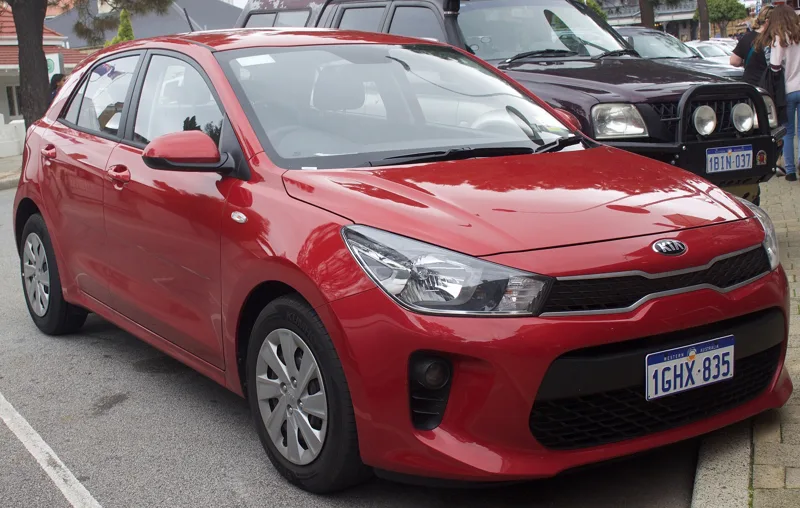
The Stonic is a B-segment subcompact crossover hatchback that Kia has built since 2017. Its name comes from the words speedy and tonic. It is the smallest car in Kia's SUV line, below the Niro, Sportage and Sorento, and it shares its platform and interior with the fourth-generation Rio.
It debuted in Frankfurt on 20 June 2017 and was shown at the 2017 International Motor Show Germany. South Korea followed on 13 July 2017, and sales began in the fourth quarter. China knows it as the Kia KX1. Engines have included a turbocharged 1.0-litre three-cylinder, a 1.2-litre four, a 1.4-litre four and a 1.6-litre CRDi diesel, which gained a 48-volt mild-hybrid system called EcoDynamics+ in 2020.
Kia discontinued the Stonic in South Korea in September 2020 because of sluggish sales. A facelifted version has been built and sold in Pakistan since November 2021 in EX and EX+ form, both with a 1.4-litre Kappa II four-cylinder and a six-speed automatic. In 2023 Kia shifted Stonic production out of Gwangmyeong, which was being retooled for electric vehicles, to the Seosan plant run by Donghee. In 2018 the Stonic collected two design prizes: an iF award in the Transportation Design category and a Red Dot for Car Design.
What changed in the second Stonic facelift?
The second facelift, unveiled on 1 September 2025, brought a redesigned front and rear, updated lights and new alloys in the Opposites United design language, plus a 12.3-inch touchscreen and a new steering wheel. The non-hybrid engine makes 74 kW (99 hp) and 172 N m (127 lb ft), and the mild hybrid makes 85 kW (114 hp).
For 2026 the mild hybrid is to rise to 88 kW (118 hp), with the same 172 N m (127 lb ft).
What is the Kia KX1?
Yueda Kia, a joint venture, builds the KX1, the Chinese-market Stonic. It looks very like the Stonic but has a modified hood, redesigned bumpers, improved daytime running lights, a circular fuel cap and a completely different dashboard. It measures 4,100 mm instead of 4,140 mm and has round fog lamps in place of boomerang-shaped LED units.
Compared with the Korean-made car it goes without AEB, blind zone monitoring and cruise control, and it has a single engine, a 1.4-litre petrol making 100 hp (75 kW) with a six-speed manual or automatic. The Chinese-made KX1 was exported to the Philippines as the Stonic in October 2020 and was replaced there by the Sonet in June 2024.
What is the Kia Sonet?
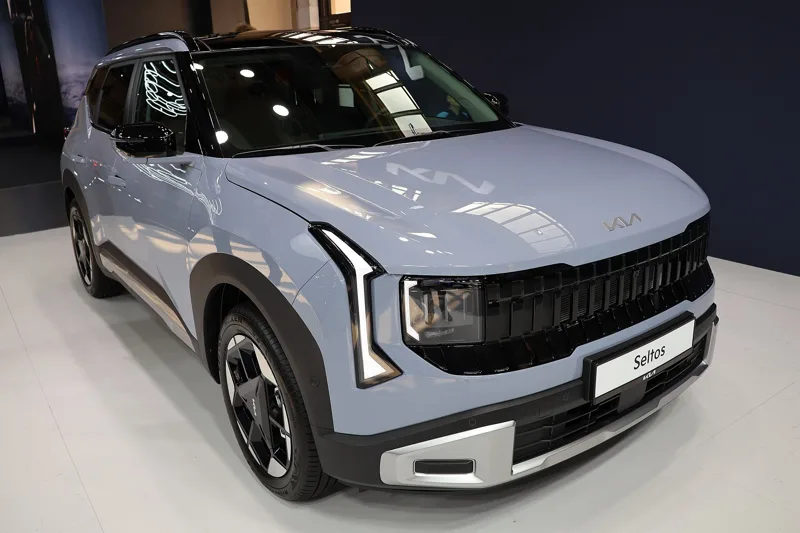
Kia has built the Sonet, a subcompact crossover SUV, since 2020. It slots under the Seltos, is a close relation of the similarly sized Hyundai Venue, and sells in emerging markets from Asia to Africa, the Middle East and Latin America. A Sonet Concept previewed it in February 2020.
The production car made its global debut on 7 August 2020 and went on sale in India on 18 September 2020, as Kia's third model there after the Seltos and the Carnival. In India it is 3,995 mm (157.3 in) long, which keeps it in the sub-four-metre category and so benefits from Indian tax breaks for shorter cars. Export cars have longer bumpers, bringing the length to 4,120 mm (162.2 in).
The facelifted Sonet was unveiled on 14 December 2023 with new front and rear fascias and a 10.25-inch touchscreen. The Yueda Kia joint venture in China began producing it in January 2024, and the first batch went to Mexico, the Dominican Republic and Colombia before Chinese sales began in April 2024.
Where is the Kia Sonet sold?
In India the Sonet comes in nine trims, from HTE to X Line, and three engines: a 1.0-litre turbo petrol (T-GDi), a 1.2-litre petrol (MPi) and a 1.5-litre turbo diesel (CRDi). The GTX+ was in high demand at launch. By September 2024 the Sonet had sold more than 450,000 units across India and its export markets.
- Indonesia: launched 11 November 2020 with a 1.5-litre MPi petrol. A three-row Sonet 7 appeared in April 2021, but fitting a third bench eliminated boot space with the seats up, and it was discontinued in 2022.
- South Africa: launched 11 May 2021 in LX and EX trims. In September 2026 a new LS+ trim arrived and the 1.0-litre T-GDi turbo was discontinued, leaving the 1.5-litre MPi as the only engine.
- Vietnam: launched 9 October 2021 alongside the fourth-generation Carnival, in Deluxe, Luxury and Premium trims.
- Mexico: launched 16 March 2024, imported from China, with 113 hp and 144 Nm from a Smartstream G1.5 MPi engine.
- Philippines: launched 6 June 2024, replacing the Stonic. A K-Style Edition limited to 150 units arrived in November 2025.
Neither Global NCAP nor Bharat NCAP has crash-tested the Sonet, so it has no published rating.
What is the Kia K4?
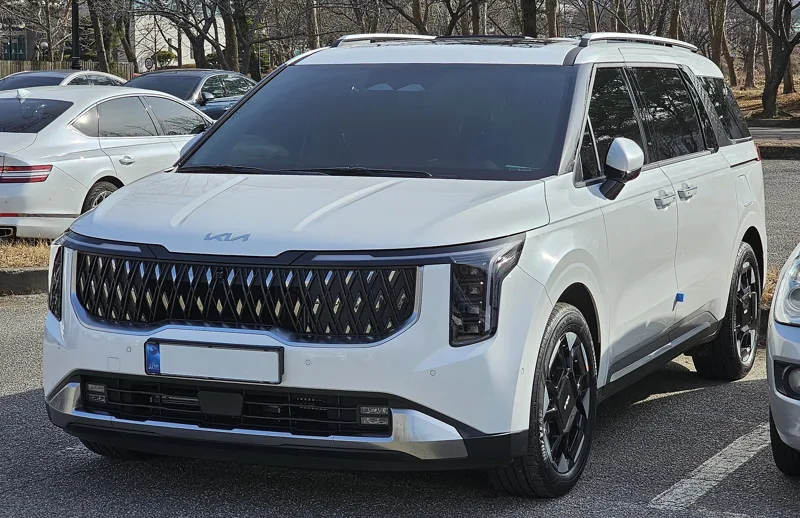
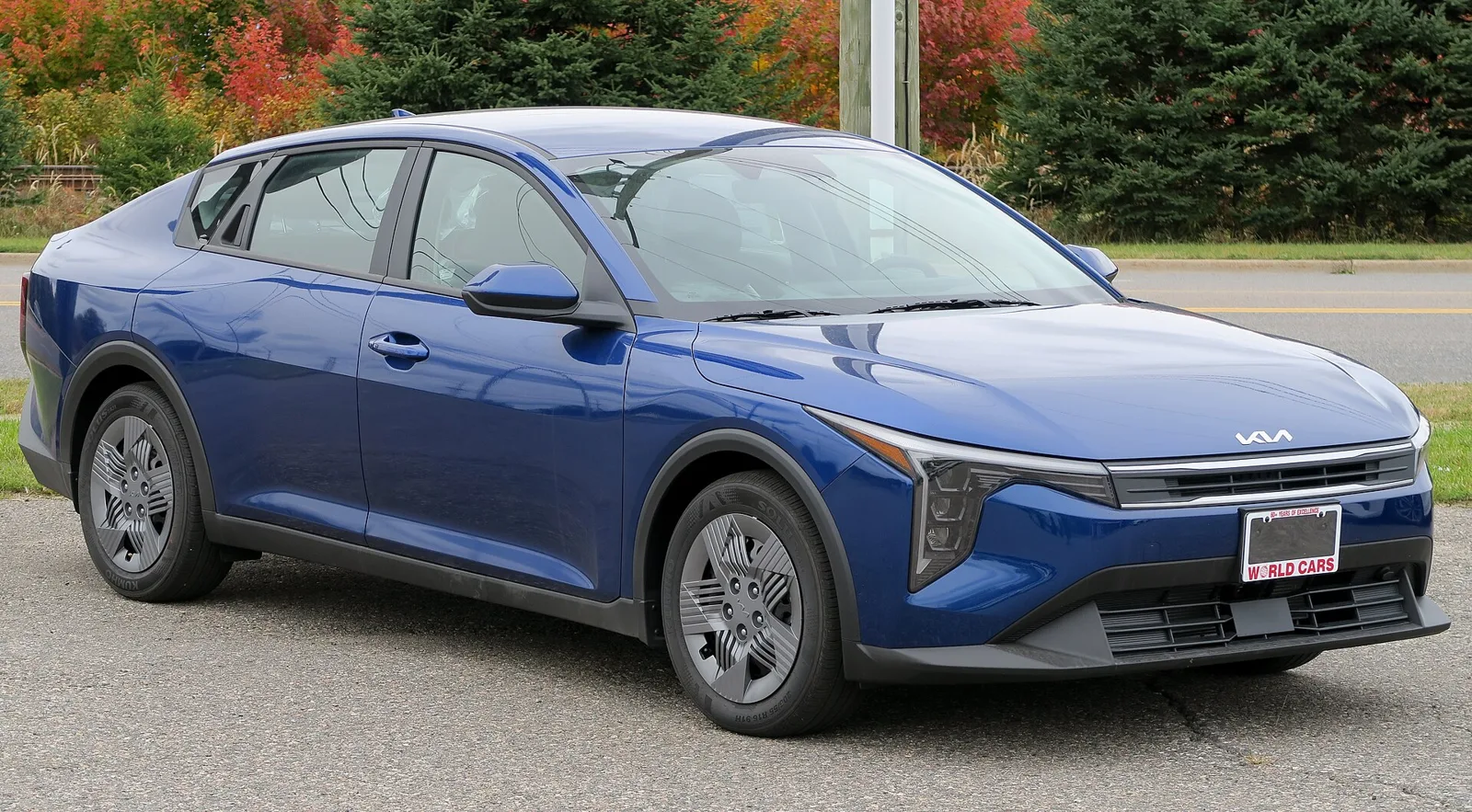
The K4 is a compact C-segment car Kia has built since 2024, replacing the Forte, K3 and Cerato. The K3 name moved to a subcompact car. Kia first introduced it on 21 March 2024 and revealed it in full on 27 March 2024, at that year's New York International Auto Show.
It started as a four-door saloon and five-door hatchback, and since 2026 there has been a five-door estate, the K4 Sportswagon, unveiled on 13 January 2026. Against the saloon it is 15 mm (0.6 inches) shorter; against the hatchback, 265 mm (10.4 in) longer. Boot space is 413 L (14.6 cu ft) in the saloon, 629 L (22.2 cu ft) in the hatchback and 604 L (21.3 cu ft) in the estate. The hatchback is 11 in (280 mm) shorter than the saloon and has an extra 1 in (25 mm) of rear headroom because of its flat roof.
What is inside the K4?
The K4 follows Kia's Opposites United design language, with vertical headlights and taillights, hidden rear door handles, a fastback saloon with a thick D-pillar, and a shooting-brake style hatchback. Inside is the Connected Car Navigation Cockpit system that debuted in the EV9, with two screens that measure nearly 30 in (760 mm) combined.
Two rows of physical controls handle the important functions, and automatic versions use a T-Bar gear lever rather than a rotary selector. Digital Key 2.0 with Ultra Wideband lets owners use compatible devices or an NFC smart card as a key, and the K4 is the first Kia with AI Assistant voice control, woken by saying Hey Kia. The 2025 K4 earned the IIHS Top Safety Pick award.
Where is the K4 sold?
North America received the K4 in August 2024 in LX, LXS (US only), EX, EX+ (Canada only) and GT Line trims, with 2.0-litre MPi or 1.6-litre T-GDi petrol engines. The hatchback followed for the 2026 model year. Mexico saw it on 1 August 2024, Australia on 16 January 2025 and the Middle East on 8 May 2025.
Argentina launched the saloon on 14 April 2026 and a GT Line Turbo hatchback on 18 August 2026. Brunei received it on 9 April 2026. Europe saw the hatchback unveiled on 17 September 2025 with a choice of 1.0-litre turbo petrol engines, with or without mild-hybrid help, and a 1.6-litre turbo, and the Sportswagon is confirmed for the European market. In Australia the hatchback arrived on 21 November 2025, when the 2.0-litre petrol switched from a six-speed automatic to an IVT.
How do the four Kias compare?
| Model | Type | Sold where | Key figure |
|---|---|---|---|
| Ray | Light car, EV option | South Korea only | Ray EV range 205 km |
| Stonic | Subcompact crossover | South Korea until 2020, Pakistan, China as KX1, Philippines | Mild hybrid up to 88 kW in 2026 |
| Sonet | Subcompact SUV | India, Africa, Latin America, Asia | 3,995 mm in India |
| K4 | Compact saloon, hatch, estate | North America, Europe, Australia and more | Boot 413 L to 629 L |
What changed for these Kias in 2026?
The K4 Sportswagon was unveiled on 13 January 2026 and is confirmed for the European market. The 2026 Stonic raises its mild-hybrid output to 88 kW (118 hp).
In South Africa the Sonet's range changed in September 2026 with the new LS+ trim and the end of the turbo petrol. The Ray EV remains South Korea only, and its sales were credited with lifting Ray volumes in 2023.