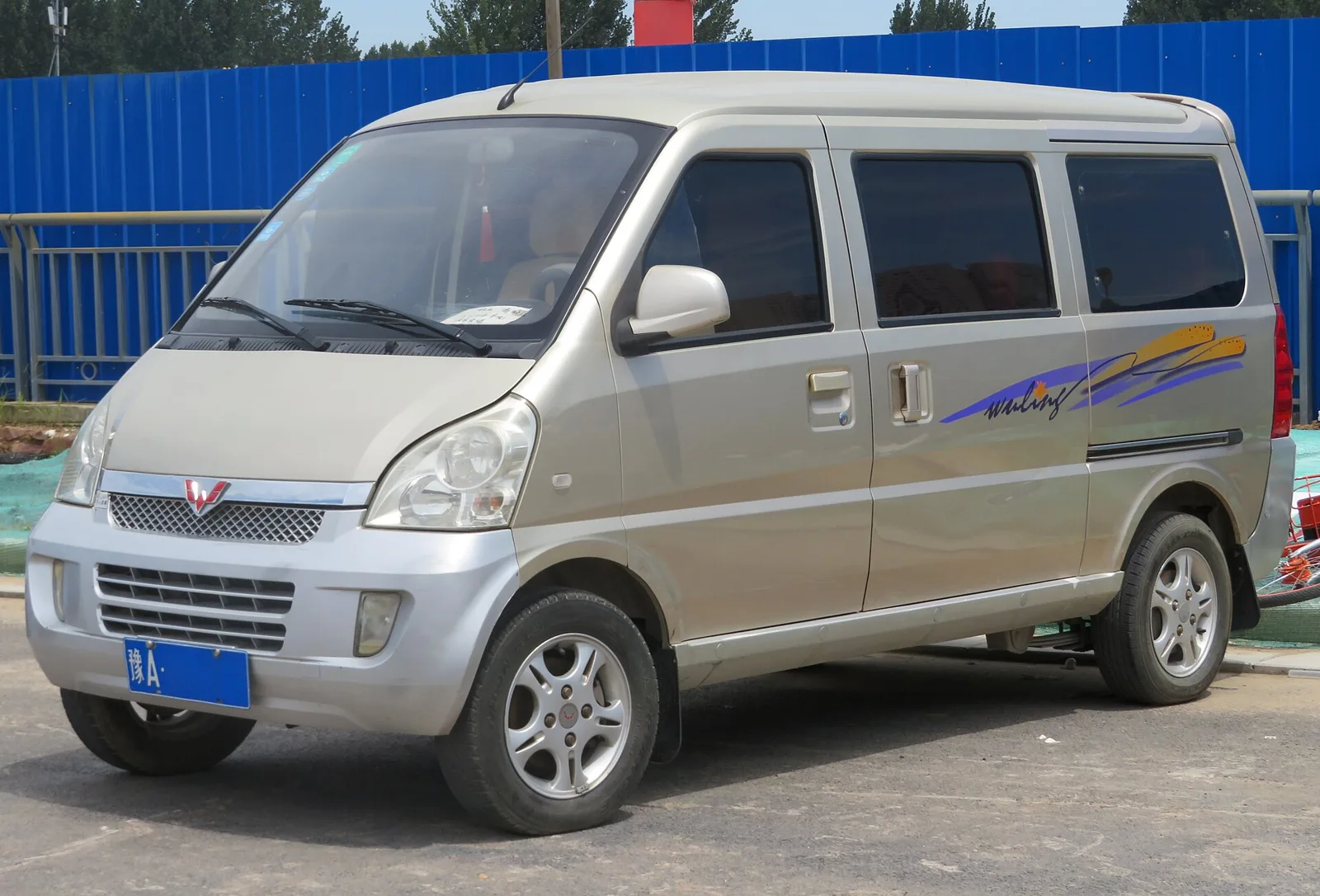
The Sunshine that was the world's third best-selling vehicle in 2011, the Rongguang that wore Chevrolet and BYD badges, and the DFSK vans that borrowed a Transit face.
Wuling Sunshine and Wuling Rongguang are small vans and pickups from the Chinese joint venture SAIC-GM-Wuling. DFSK builds the bigger C-Series vans and pickups. All three families have gone battery-electric, and Chevrolet, BYD and others have sold rebadged versions of the Wuling and DFSK vans.
In 2011 China built 943,000 Wuling Sunshines, a number that made a basic microvan with manual windows and seatbelts in only the first two rows the third best-selling vehicle on earth. Wuling's vans have since gone electric and been rebadged by Chevrolet and BYD, while the DFSK C-Series vans, from a different maker, borrowed their face from a Ford Transit.
What are the Wuling Sunshine, Wuling Rongguang and DFSK C-Series?
The Sunshine and Rongguang are microvans from SAIC-GM-Wuling, known as SGMW, a Chinese joint venture. The DFSK C-Series is a range of larger light-commercial vans and pickups from DFSK Motor. Each now exists in battery-electric form, and the Rongguang and the C-Series have been rebadged for other brands and sold in other countries.
In 2011 China built 943,000 Wuling Sunshines, a van with manual windows and seatbelts in two rows only.
What is the Wuling Sunshine?
The Wuling Sunshine is a microvan that seats five to eight people. SGMW is a joint venture between SAIC, Liuzhou Wuling Motors and the American carmaker General Motors. The first-generation van went on sale in 2002 and stayed in production until 2013.
Its sales record is the headline. SGMW made 943,000 of them in 2011, and in each of 2010, 2011, 2012 and 2013 no vehicle sold better in China. Singapore complicates things: there the Sunshine name goes on the Wuling Hongtu, a separate model, so the badge does not always mean the same van.
What was the first Sunshine like?
The van carried a range of petrol engines with outputs from 34.7 to 63 kW (50-84 SAE HP), burning between 6.8 and 7.8 L/100 km. The engine sat in the middle of the vehicle and drove the rear wheels through a five-speed manual gearbox. Brakes were discs at the front and drums at the rear, and the steering was rack and pinion.
Equipment was austere. The cheapest version had two rows of seats rather than three, air conditioning was an extra, and the windows wound by hand. Seatbelts were fitted to the first two rows only. A long-wheelbase version measured 3995 mm in length on a 2750 mm wheelbase and weighed between 1010 and 1030 kg dry.
What are the New Sunshine, Sunshine S and Sunshine V?
The new Wuling Sunshine, also called the Wuling 6390, was a slightly dearer second generation sold alongside the original in China. It was updated for the 2013 model year but kept its 1.0-litre engine, producing 61 hp (45 kW) and 85 N.m (63 lb ft) through a five-speed manual.
The Sunshine S is a redesigned base Sunshine, with an obviously different exterior and a technical upgrade that added ABS and EBD. Its 1.2-litre engine is rated at 61 kW (82 hp), with torque of 115 N.m (85 lb ft). It was dropped in 2020 because its engine did not meet China 6b emissions rules.
The Sunshine V, introduced in December 2016, is a different animal despite the shared name. The V in Wuling's naming means a body closer to a compact MPV, and its engine sits under the bonnet rather than beneath the front seats. It was discontinued in 2020 for the same emissions reason, after sales had fallen.
What is the Wuling Zhiguang EV?
The Zhiguang EV is the third-generation Sunshine, introduced in late December 2024 with sales starting in February 2025. Purely battery-electric, it uses a lengthened Hongguang Mini EV platform and keeps that car's track dimensions. Its wheelbase is 100 mm (3.9 in) longer than the previous Zhiguang, while the body is 125 mm (4.9 in) shorter overall.
The shape is boxy, like a kei car, yet it overshoots the kei limits: it is wider by 50 mm (2.0 in) and longer by 285 mm (11.2 in). The charging port is under the Wuling badge, there is almost no grille and it rides on 13-inch wheels with roof rails. The tailgate opens vertically, revealing 527 litres (18.6 cu ft) of cargo space with a loading height of 569 mm (22.4 in), which grows to 1,117 litres (39.4 cu ft) with the rear seats folded.
Inside, it is a single four-seater layout and very plain. The driver gets a small 4.2-inch digital display, a basic radio, three climate dials, a seat that adjusts four ways by hand, a rotary shift dial and a handbrake worked by hand. Twenty M6-threaded screw holes around the cabin accept accessories such as phone holders, cupholders, folding tables and racks. The rear seats and front passenger seat fold flat.
A Progressive edition was added on 23 July 2025, with a larger battery, a 7-inch instrument cluster, LED headlights and a six-way manual driver's seat.
How does the Zhiguang EV drive and charge?
A single 40 hp (30 kW; 41 PS) motor drives the rear wheels, giving a top speed of 100 km/h (62 mph). The first battery was a 17.7 kWh lithium iron phosphate pack from Gotion, with a CLTC range of 201 km (125 mi). A 30.6 kWh pack from Sunwoda, weighing 245 kg (540 lb), followed with 305 km (190 mi) of range.
Charging from 30 to 80 percent takes 35 minutes, and the van can supply 3.3 kW to outside equipment through vehicle-to-load. A version that works with CATL's Choco-SEB swappable battery network is expected, using a 42 kWh pack.
What is the Wuling Rongguang?
The Rongguang is a series of mini commercial vehicles, best known as a five-door microvan seating five to eight. It was first shown at the 2008 Beijing Auto Show. Two engines were offered, a 1.2-litre four-cylinder with 61 kW (82 hp) and a 1.5-litre with 80 kW (107 hp), both with a five-speed manual gearbox.
An extended version stretches the body to 4490mm by 1615mm by 1900mm. The Rongguang S is a more upmarket version with a fully redesigned body measuring 4135mm by 1660mm by 1870mm, and in time it took the place of the regular Rongguang. A separate Rongguang V is simply a rebadged Wuling Hongguang V, a body closer to a compact MPV.
What are the Rongguang Xiaoka and Xinka?
Pickups sit alongside the van. The Xiaoka comes in two-door and four-door forms and carries 2.0 to 2.5 tons. SGMW launched a facelift of the Rongguang pickup in July 2018, with a choice of 1.5-litre or 1.8-litre engines and prices between 45,800 yuan and 52,800 yuan.
The Xinka, whose name translates as New Truck, debuted in June 2018 to cover the 2.5 to 3.5 ton market. It is only offered as a truck, as a single or crew cab, with a standard or extended cargo bed and either a normal or dually rear axle.
Where did the Chevrolet N300 and Move come from?
Both are rebadged Rongguangs, a result of General Motors' partnership with Wuling. The Chevrolet N300 sells in emerging markets such as Ecuador, though not in Africa, and it is positioned above the N200, a rebadged Wuling Hongtu. GM's Mark Barnes, a vice president at its international operations, described the N300 as robust and well suited to demanding off-road use and the weather that buyers in emerging markets face.
GM Egypt assembles the Chevrolet Move at 6 October City, using kits shipped in by SGMW. Assembly began in the third quarter of 2012, making the Move the first Chinese vehicle put together by GM Egypt and the first SGMW model built outside China. It was the second SGMW vehicle GM sold in Egypt: the N200 passenger van arrived there and in other African countries in 2009, but it had left the Egyptian market by 2022.
How safe was the Chevrolet N300?
Latin NCAP crash-tested the entry-level N300 for Latin America in 2017. That car had no airbags, ABS or ESC, and it scored zero stars for adults and one star for toddlers.
Which electric vans came from the Rongguang?
Guangxi Automobile Group, not SGMW, produces the Wuling EV50, also called the Dianka or the Linxys EV50. The EV50 is an electric panel van based on the Extended Version of the Rongguang, built for the logistics industry. A 60 kW (80 hp) motor drives it, with a choice of two batteries. The larger pack weighs 332 kg and is good for 300 km (186 miles), while the smaller weighs 308 kg and is good for 245 km (152 miles).
Wuling claims that the lithium iron phosphate packs will last at least 2 million kilometres. The EV50 starts at 108,000 yuan (13,596 euros). A pickup or chassis-cab version, the Dianka, uses the same powertrain with 61 kW (82 hp) and 255 to 300 km of range.
Others borrowed the body. The BYD V3 keeps the EV50's exterior but has BYD's own mechanicals and blade battery layout. A 47.52kWh pack supports 330 km of range, and DC fast charging takes 1.2 hours. A permanent magnet motor makes 75 kW (101 hp) and 220 N.m (162 lb ft). The BAW Xiaohema, or Little Hippo, is another EV50 body, built in Hebei, with a top speed of 90 km/h.
What is the second-generation Rongguang?
Production of the second-generation Rongguang microvan started in October 2025. It is offered as a five- to seven-seater, and it is completely electric, with a single motor rated at 100kW and lithium iron phosphate batteries.
What is the DFSK C-Series?
DFSK Motor, a venture shared by Dongfeng Motor and Sokon Industry, builds the C-Series. It was first shown on 21 September 2009 as a set of vans, with pickups to follow. Buyers choose from a C35 cargo van, a C36 passenger van at entry level and a C37 passenger van. Pickups start with the single-cab C31 and C51 and the double-cab C32 and C52.
These models are bigger and roomier than the K-Series and V-Series and have a longer wheelbase. Prices run from RMB 46,900 to 59,800 yuan. The vans have attracted criticism for their styling, because the front end and the side window graphics bear a strong resemblance to the facelifted third-generation Ford Transit.
What do the C35, C36 and C37 offer?
The C35 cargo van was launched in the second half of 2012, with steel-sealed windows on the sides and the tailgate. It comes as a traditional two-seat panel van or a five-seat crew van. The C36 is the cheaper passenger van, with no front fog lamps, air conditioning or airbags, and steel wheels where the C37 has alloys. It seats five or seven.
The C37 sits in the middle of the range with those items fitted, and it seats 5, 7, 9 or 11 depending on the market. A facelift called the C56 has been sold since 2022, with a completely redesigned front end that has horizontal headlamps and grilles.
Which pickups does the C-Series include?
The pickups have a completely different cab, even though they are sold within the C-Series range, and their headlamps and grilles are shared with the K-Series microvans. In Taiwan the single cab was sold as the Sokon Gold Fulwin and the crew cab as the Grand Fulwin.
The C31 is a single cab for up to two, and the C32 is a four-door double cab for up to five. The C51 and C52 are larger versions with more cabin and cargo space, and the heavy-duty D-series, the D51 and D52, is based on them. The bigger and slightly more upmarket C71 and C72 arrived in 2022 with restyled cabs, with D71 and D72 heavy-duty versions.
What are the Ruichi electric vans like?
Battery-powered takes on the C31, C35 and C36 arrived as the EC31, EC35 and EC36 in 2018, and they are sometimes badged as Ruichi models. The EC35 carries a 41.4 kWh battery rated at 233 km (146 miles) on the NEDC test. That pack weighs 400 kg (882 lbs) and runs at 320 V.
All three use a single motor that drives the rear wheels through a single-speed transmission, producing 60 kilowatts (80 hp) and 200 newton-metres (150 lb ft). One review of the EC35 found it cheaper than comparable vehicles but below the standard of modern vans, not especially fast, though suitable for city driving, and prone to struggle on hills even when empty. The interior was thought a little poor for the price.
How do the electric vans compare?
| Model | Motor | Battery | Range |
|---|---|---|---|
| Wuling Zhiguang EV | 40 hp (30 kW; 41 PS) | 17.7 kWh or 30.6 kWh | 201 km (CLTC), then 305 km |
| Wuling EV50 | 60 kW (80 hp) | Two options | 245 km (152 miles) or 300 km (186 miles) |
| BYD V3 | 75 kW (101 hp) | 47.52kWh | 330 km |
| Ruichi EC35 | 60 kW (80 hp) | 41.4 kWh | 233 km (146 miles), NEDC |
| Rongguang, second generation | 100kW | Lithium iron phosphate | - |
Where is the DFSK C-Series sold?
The C31, C32, C35 and C37 reached the United Kingdom in 2017. The brand had first been launched there in 2012, but sales under the earlier distributor ended before 2016.
In Indonesia the vans are sold as the DFSK Gelora, which made its debut at a commercial vehicle expo run by Gaikindo on 5 March 2020. The panel van, based on the C35, was launched in November 2020, and the passenger van, based on the C36 and C37, in January 2021. The passenger version comes only with 11 seats. Both have a conventional 1.5-litre petrol engine and are built at DFSK's Cikande plant in Banten.
The Gelora E, an electric version, was unveiled at the same show and launched on 15 April 2021 at the 28th Indonesia International Motor Show. It comes as a passenger van built on the EC36 and a panel van built on the EC35, each driven by one electric motor. Imports from China covered 2021 to 2023, and local assembly began in February 2023. Gelora E vans also served as operational vehicles at the 2022 G20 Bali Summit.
Elsewhere, Romanian buyers can get the DFSK EC35 Cargovan from the importer New Car Trading S.R.L., in Harghita County, and the SOKON EC35 Cargovan and EC31 Pickup are sold in Thailand by Planet EV. Golden Dragon also sold a rebadged electric C-Series van with a restyled front end, the Longyun GLE570, in 2023.