Steven Spielberg's first feature, a salesman hunted across California by an unseen truck driver, and the real vehicles that made the chase.
A salesman in this 1971 Steven Spielberg thriller is pursued through the desert by a truck. The feature debut began as an ABC television movie before reaching cinemas, and it is now seen as a classic.
Duel is a 1971 road thriller directed by Steven Spielberg in his feature film debut. It follows a travelling salesman who is hunted across the California desert by a semi-truck whose driver is never fully seen. The film began as a television movie for ABC, reached cinemas in a longer version, and is now regarded as one of the greatest television films ever made.
What happens in Duel?
David Mann is a middle-aged salesman driving to a business meeting. On a desert highway he meets a dilapidated tanker truck, and the driver seems determined to pester him. Mann passes the truck, but it roars past him, then sounds its horn when he passes again. The truck follows him into a gas station, then parks beside his car.
The harassment escalates into a series of close calls. The truck tailgates Mann at high speed, and Mann crashes into a fence across from a diner. He goes inside to compose himself, and when he confronts a patron he believes is the driver, he is beaten. The truck is gone by the time he returns to his car, and the chase resumes on the road.
Later the truck pushes Mann's car onto a railroad crossing just as a freight train clears the intersection. At a roadside attraction, the truck drives into a phone booth while Mann is calling the police, and he escapes only by jumping clear. The final chase climbs a mountain range, where Mann's radiator hose breaks and the car overheats, and it ends at a canyon where Mann wedges his briefcase onto the accelerator and jumps free before the crash.
A salesman, a car and a truck that never shows its face: Spielberg's first feature proves that fear of the unseen does the heavy lifting.
Where did the story come from?
Richard Matheson wrote the screenplay from his own short story, which was published in the April 1971 issue of Playboy. The idea came from a real encounter. On November 22, 1963, a trucker tailgated Matheson on a two-lane highway in Fillmore, California, and the experience stayed with him until he turned it into fiction.
Matheson first tried to sell the concept as an episode for several television series. When those pitches failed, he decided to write it as a short story, and before writing he drove from his home to Ventura and recorded what he saw on a tape recorder. The result was a tight thriller with almost no backstory, a structure that later made the film easy to adapt.
Matheson's attempts to sell the idea as a television episode never reached the air, which is why the story stayed a short story for longer than he expected. When the film finally came together, the producers and the young director shared a sense that the material was small but potent.
Spielberg's path to the project came through his secretary, Nona Tyson, who gave him the story and suggested he apply to direct. Duel was not his first directing job, since he had made the episode L.A. 2017 for The Name of the Game, but it was his first feature-length film in the form he would later be known for.
The film's reputation also grew through word of mouth among filmmakers. George Lucas stumbled on the broadcast at a party given by Francis Ford Coppola, switched on the set, and urged his host to come and watch it at once. That moment shows how quickly the film found an audience among people who would shape the industry.
Why is the truck the real antagonist?
The truck driver is the film's antagonist, but he is hardly seen. The script keeps him offscreen, and only his arms, motioning Mann ahead, and his leather boots appear. His motives are never revealed, which makes the vehicle the real villain of the story rather than the man inside it. Mann's frustration grows with each encounter, which keeps the story focused on his nerves rather than on the mechanics of the chase.
Spielberg later explained that fear of the unknown can be the greatest fear of all, and the film plays heavily on that idea. Because the audience cannot see the driver, the truck itself becomes a character with a personality, an attitude and a hunger. That approach gave a modest television production a mythic quality that many viewers still remember.
Which vehicles were used in Duel?
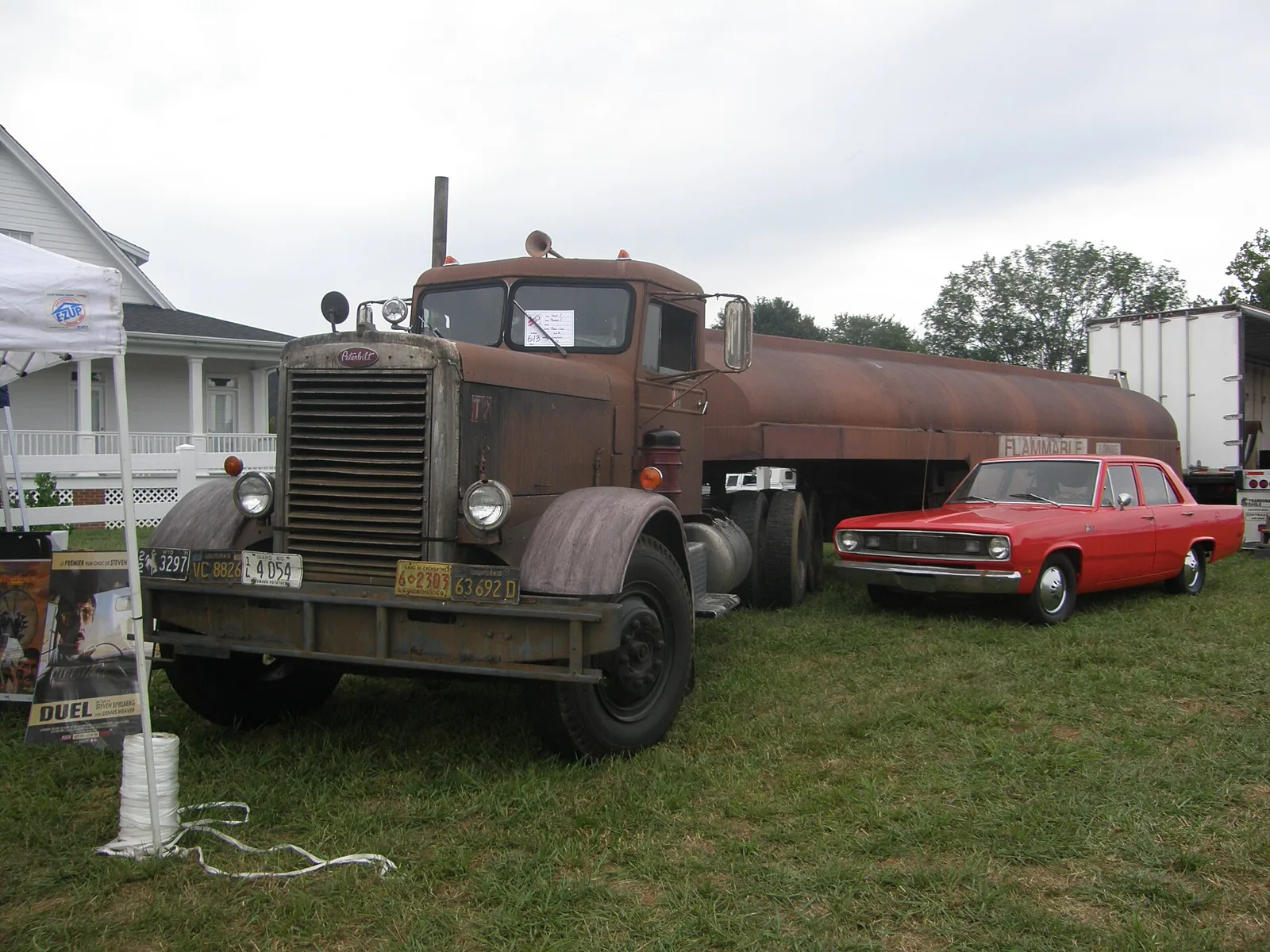
Mann's car is a red Plymouth Valiant, and four Valiants were used in production. Spielberg wanted the car to be red so it would stand out against the desert landscape in the wide shots, and the production assembled several versions to handle different stunts and scenes.
The truck was chosen with care. Spielberg held what he called an audition of trucks and picked a 1957 Peterbilt 281 over the flatter, contemporary cab-over designs. Its long hood, split windshield and round headlights gave it a face, and the crew added grease, oil and fake insects to make it look progressively uglier.
| Vehicle | Details | Use in the film |
|---|---|---|
| Plymouth Valiant (1969 stunt car) | Modified to look like a 1970 model | Stunt car used for the cliff ending |
| Plymouth Valiant (1970 and 1971) | Each fitted with a 225 cu in Slant Six | Main driving and close-up scenes |
| Plymouth Valiant (1972) | Slant Six engine | Extra scenes for the April 1972 theatrical release |
| 1957 Peterbilt 281 | 260 HP CAT 1673B turbocharged engine, 13-speed Roadranger gearbox | Main truck for the chase |
| 1960 Peterbilt 281 | Backup truck, now the only surviving truck from the film | Backup during the original shoot |
| 1962 Peterbilt 351 | Similar CAT 1673B engine | Additional scenes for the theatrical release |
The truck had a single axle with a tag-along axle behind it, and it was capable of hauling more than thirty tons. A single truck was used for the original filming, so the final plunge over the cliff had to be done in one take. The surviving backup truck, a 1960 Peterbilt 281, is the only truck from the film known to survive today.
How was Duel made?
Principal photography began on September 13, 1971, and the crew finished filming on October 4, 1971, after thirteen days. The schedule was tight, and it left ten days for editing before the television broadcast. Production was overseen by ABC's director of movies of the week, Lillian Gallo.
Spielberg insisted on shooting outdoors, despite the concerns of the unit production manager about budget and time. The compromise let him start on location for the first three days to see whether the schedule was realistic. He made an overhead map of the shots to plan each setup, and much of the film was shot in and around Canyon Country, Agua Dulce and Acton.
The landmarks from the film still exist. The tunnel, the railroad crossing and the Sierra Highway location are all recognisable, and the cliffs at the end sit off Vasquez Canyon Road. Spielberg wanted the desert to be part of the menace, and the outdoor shoot gave the film its scale.
How did sound shape the film?
Mann has little dialogue, and the truck driver has none. Spielberg wanted the vehicles and the setting to speak for themselves, so the film relies on visuals and menacing audio. The sound of the truck's engine and the roar of its horn carry much of the tension, while Mann's own car provides a contrasting whine.
Spielberg used silence as carefully as noise, an approach he attributed to the work of Alfred Hitchcock. Late in the film, Mann is woken by a sound that resembles the truck, and the audience expects a turning point. The sound turns out to be a passing train, which resets the tension for the final chase.
Spielberg believed that sound had to fit the picture like a glove, and that good sound made everything scarier. The rule shaped the whole mix, from the engine roar to the sudden silence before the next attack.
Billy Goldenberg composed the score in about a week. He wrote for strings, harp, keyboards and percussion, with Moog synthesizer effects but no brass or woodwinds. Spielberg had Goldenberg ride in the tanker truck on several occasions, an experience the composer found terrifying at first.
How did Duel perform and how was it received?
Duel first aired as part of ABC's Movie of the Week on November 13, 1971. It drew a Nielsen rating of 20.9 and a 33% audience share, and it ranked among the year's highest-rated television movies. The broadcast was an early sign that Spielberg's style could work on a wide scale.
Universal then released a longer theatrical version after the television broadcast. The television cut ran seventy-four minutes, so Universal had Spielberg film two days of new material to expand the film to ninety minutes. The new scenes included a longer opening drive, a telephone call in a laundromat and an extra confrontation at the railroad crossing, and mild expletives were added to the script.
Critics responded well. Rotten Tomatoes records 90% approval from 48 reviews, and its consensus praises the film's simple premise and rock-solid genre thrills. Stephen King called it one of the half-dozen best movies ever made for television, and he and his son Joe Hill later paid homage to it in their novella Throttle.
The theatrical edition also brought changes beyond length. Some of the television voice-over was re-recorded and rewritten, which altered the tone of certain scenes. Universal then used the footage in other places, and in 1978 stock shots of the vehicles appeared in an episode of The Incredible Hulk. The insertion displeased Spielberg, but Universal owned the footage and could use it as it saw fit.
What came after Duel?
Duel has continued to influence filmmakers and fans. Critic Scott Tobias described it as a proto-Jaws, an early statement of how to build suspense through patience and delayed payoff. Denis Villeneuve named the film among his favourite films in 2023.
The film also led to a spin-off. Throttle followed in 2005, thirty-four years later, with Tom Gillen playing David Mann in a red Plymouth Valiant that had been repaired from the wreckage. In 2015 a Kickstarter campaign tried to fund a documentary called The Devil on Wheels, the Spanish title for the film.