A single-generation three-door Volvo with a safety-concept pedigree, Polestar performance versions and an electric C30 DRIVe that found fleet buyers.
A single-generation three-door hatch from Volvo, built from 2006 to 2013 on a platform shared with the S40 and V50. Its engines ranged from fours to a straight-five, and it spawned Polestar performance versions and the C30 Electric. The car was sold in Europe, Canada and the United States.
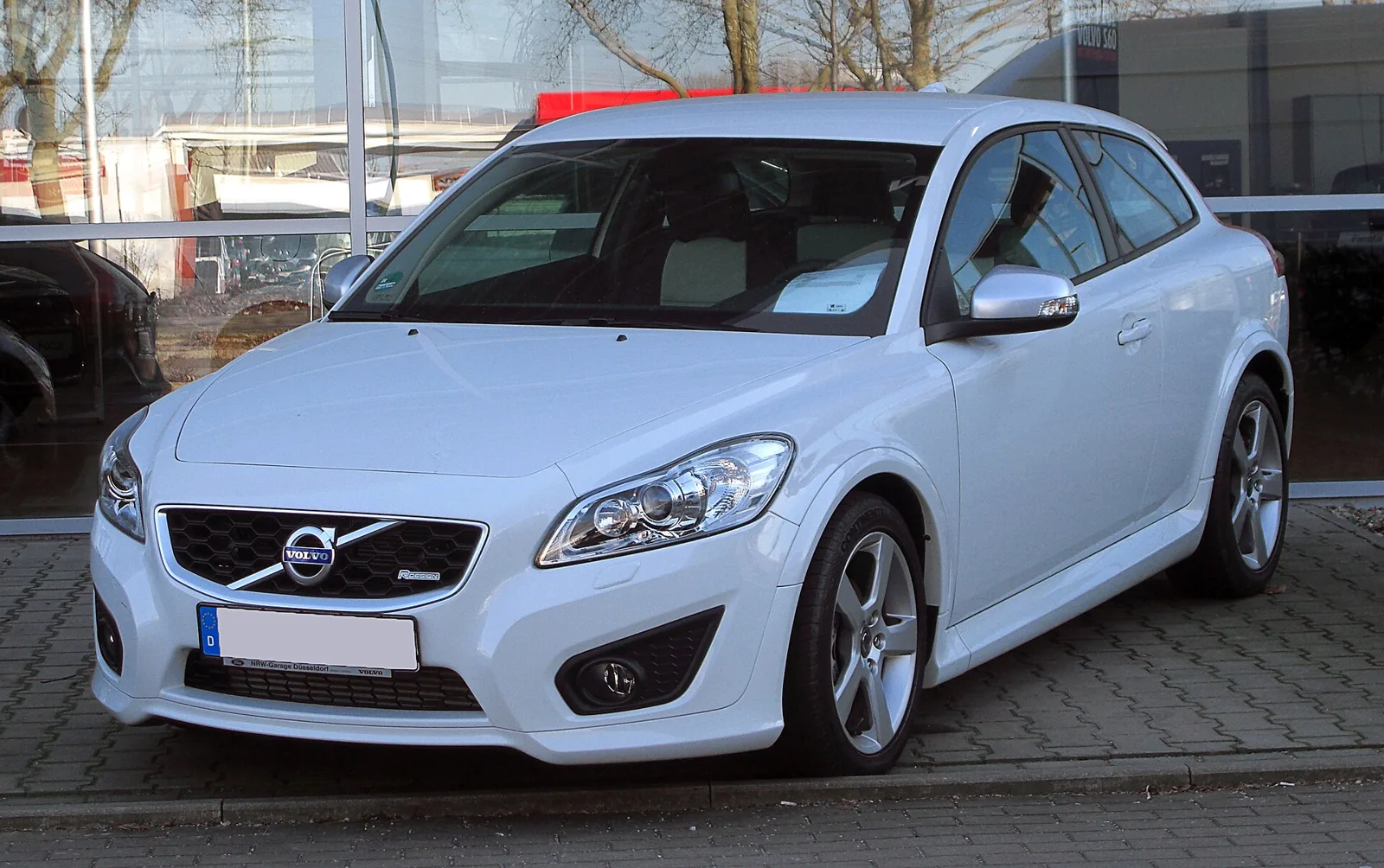
The Volvo C30 was a three-door premium compact hatchback built by Volvo Cars from 2006 to 2013 in a single generation. It sat on the platform it shared with the S40, V50 and C70, and Volvo marketed it as a premium hatchback and sports coupe. Its safety-led ideas came from a concept car that dated back to 2001.
Where did the Volvo C30 come from?
The roots of the car lie in the Volvo SCC, a safety concept car first shown at the 2001 Detroit Auto Show. Its safety ideas were tested later that year at Seville International Airport in southern Spain, and work to adapt them for production began in 2002.
Development of the production C30 started in 2003, and the car went on sale in Europe in late 2006. Its platform was the Ford C1 and Volvo P1 architecture, also used by the S40, V50 and C70 range.
Canadian buyers received the car in March 2007 as a 2007 model, and US sales began in October 2007 as a 2008 model. The car was produced in a single generation until the line was discontinued in 2013. Three-door hatchbacks carry a sporting image, because their steep rear glass and shorter doors suit a coupe-like stance.
A three-door Volvo with a safety-concept pedigree, a Polestar edge and an electric version that went to fleets.
What did the SCC concept show?
The SCC, short for Safety Concept Car, borrowed its rear hatch design from the P1800 ES and its glass hatch from the 480 ES. Its safety features included forward collision warning, a blind spot monitor and alert, lane departure warning and adaptive cruise control.
The concept also had flashing brake lights during hard braking and headlights that followed the curvature of the road as the car turned. A head-up display and communication with the car via mobile phone were part of the package as well.
Many of those features became common years later, which makes the SCC a useful reference point for the way Volvo approached safety. The C30 carried that thinking into a production hatch that buyers could actually purchase.
How was the C30 styled?
The C30's rear styling and frameless glass hatch recalled Volvo's earlier P1800 ES and 480. That heritage gave the three-door a clear identity in a crowded compact segment, and it set it apart from the saloon and estate models in the range.
Inside, the C30 shared much of its instrument panel, its floating centre stack and its steering wheel with the S40 and V50. That shared approach kept costs down and gave the car the same modern feel as its siblings.
From the 2009 model year the Volvo badge moved from the hatch handle to the glass above it, with a larger font and wider spacing between the letters. The 2010 update redesigned the front wings, introduced a larger iron mark and gave the rear a wavier, more dynamic look.
Which engines did the C30 use?
The C30 was powered by inline-four and straight-five engines. The early line-up included the T5, a 2.5-litre turbo five-cylinder, along with 2.4i, 2.0, 1.8, 1.8 Flexifuel and 1.6 petrol units, and the D5 2.4-litre diesel rated 132 kW. Each engine suited a different buyer, from economy-minded diesels to the turbo T5.
In 2009 Volvo added a 6-speed PowerShift dual-clutch automatic and a 1.8-litre E85 flex-fuel engine to the range. The Polestar option later lifted the US T5 to 250 hp (186 kW) through a software change.
Globally the C30 was offered with nine different engines, which gave buyers a wide choice of performance and efficiency. That breadth was one reason the car sold across many markets with different tax rules. Engine choice in Europe was also shaped by fuel and tax rules, which made diesel and petrol options important across the range.
How did the C30 change in the 2010 update?
The 2010 update brought a redesigned front, new wheel options and the first white wheels in the range. Those changes refreshed the car without altering its basic layout. It also introduced the C30 Contrast Colour Collection, which let buyers choose five different colours on the lower trim.
The interior received an all-new Espresso and Blond colour combination, a new luggage compartment cover and a new accessory styling kit. Optional sport chassis cars gained a lower steering ratio and a 10% faster response to steering wheel input.
From 2011, D3 and D4 engines joined the range, and Flamenco Red became a new body colour. The updated cars went on sale in early 2010 as 2011 models in North America and Australia.
What did the Polestar versions add?
The Polestar option for US T5 models raised output through a software change to the engine control computer. It was offered on several Volvo models, including 2008 to 2013 C30 T5 cars. That change left the car's US EPA fuel economy ratings untouched.
The Polestar Performance Concept went much further. Rated at 405 PS (298 kW; 399 hp) and 510 Nm (376 lb-ft), it was built to a light weight and was quoted at under four seconds to 0-60 mph, with Haldex all-wheel drive and Brembo brakes.
The concept's bodywork drew on the STCC race car, and its interior used Recaro seats trimmed in Ternsjo leather. It was a showcase of what the platform could do when tuned for track performance.
What was the C30 Electric?
The C30 Electric was a battery electric version built for limited production. Its 82 kW motor drew power from a 24 kWh lithium-ion pack that sat in the propshaft tunnel and where the fuel tank would normally be. It was built in small numbers and aimed mainly at fleets.
Volvo estimated a top speed of 130 km/h (81 mph) and acceleration from 0-50 km/h in 4 seconds. The battery gave an all-electric range of up to 150 km (93 mi) and could be recharged from a regular household socket, with a full charge taking several hours.
The car's bodies were built on the regular assembly line in Ghent, Belgium, before the glider was sent to Gothenburg for the electric components. That two-stage build reflected the car's small production run.
How many C30 Electrics were built and leased?
A total of 209 C30 Electrics were leased in Europe through October 2012, with Sweden taking the largest share. Volvo expected demand to be modest from the start. Leases were mainly offered to companies, authorities and government agencies rather than private buyers.
Production of the C30 Electric began in June 2011, and production of the wider C30 ceased in December 2012. The line was discontinued in 2013, and no cars were produced after July 2013.
Volvo planned to build about 250 cars by the end of 2012 and to allocate 100 for the US. The price of a fleet lease reflected the car's limited production, and demand was expected to be modest.
Which special editions did the C30 get?
The C30 R-Design was a North American limited version of the T5, limited to 400 units. It came in four body colours and featured a sport body kit, a sport shifter and 18-inch Atreus wheels, along with Sirius Satellite Radio.
The Boston Red Sox Edition was limited to 107 units for the US market, to mark the team's 107 victories in 2007. It came in red with Red Sox badges, floor mats and fender badges.
In Italy the C30 Black Design was limited to 600 units, with a DI-NOC carbon fibre finish on the roof and mirrors. Later, a 2013 Polestar Limited Edition for the US was limited to 250 units.
Did the C30 race?
Yes. Volvo Polestar driver Robert Dahlgren won the 2010 Scandinavian Touring Car Championship, and Volvo Polestar also won the 2010 STCC Team Championship. The team had built an STCC-Volvo race car for that season. Those results were the highlight of the car's competition record.
In the 2011 World Touring Car Championship, the Polestar Racing team used the C30 DRIVe as its race car. The C30 also won five races during the 2011 Pirelli World Challenge season, which gave the model a competitive record on track. Those results kept the model in the racing spotlight through the period.
The C30 Electric also shared first place in the Michelin Challenge Bibendum rally, a result that showed the electric model could compete on efficiency as well as performance.
How safe was the C30?
The Insurance Institute for Highway Safety gave the C30 its Top Safety Pick award. The car also received its highest rating of good in front, side, rear and roof strength tests, and electronic stability control was standard to qualify. Safety remained a central part of the car's pitch.
The C30 featured four-wheel anti-lock braking, electronic stability program, traction control and front, side and curtain airbags. Its structure used four different grades of steel to absorb and redistribute impact energy around the body.
The car was not without criticism. Its responsive handling in corners came with a downside, and the C30 was said to be less reliable on ice or snow, where the rear end could lose grip more easily than on other Volvo models. Trade-offs like these are part of tuning any car, since a sharper response often reduces grip on low-friction surfaces.
What were the Volvo C30 specifications?
The C30 used a range of engines and bodies over seven years, from the diesel and petrol fours to the turbo five-cylinder T5. Its performance peak came with the Polestar concepts, while its electric version offered a very different take on the hatchback. The table below sets out the main figures.
| Specification | Detail |
|---|---|
| Production | 2006 to 2013, one generation |
| Platform | Ford C1 / Volvo P1, shared with S40, V50 and C70 |
| T5 Polestar output | 250 hp (186 kW) after the software update |
| D5 diesel | 2.4-litre, 132 kW |
| Efficiency edition | 1.6D, 105 PS (104 hp; 77 kW) |
| Electric battery | 24 kWh lithium-ion |
| Electric range | Up to 150 km (93 mi) |
| Electric top speed | 130 km/h (81 mph) estimated |
| Polestar Performance Concept | 405 PS (298 kW; 399 hp), 510 Nm (376 lb-ft) |
What is the C30's legacy?
The C30 is remembered as a three-door Volvo with a clear design identity and a safety heritage that stretched back to the SCC. It also left a trail of performance and electric projects that show the range of Volvo's thinking.
The Twilight film placed a C30 in its 2008 movie, and Volvo reported increased US sales after the release. The car's pop-culture moment helped change how some younger buyers saw the brand.