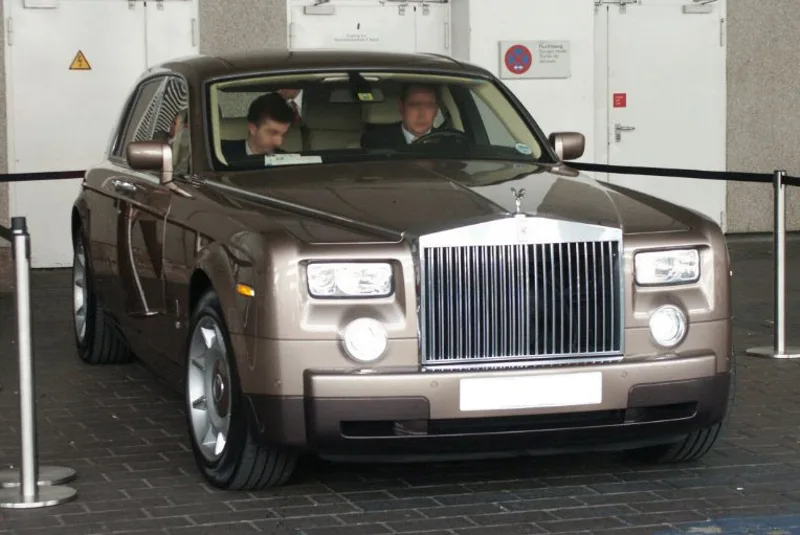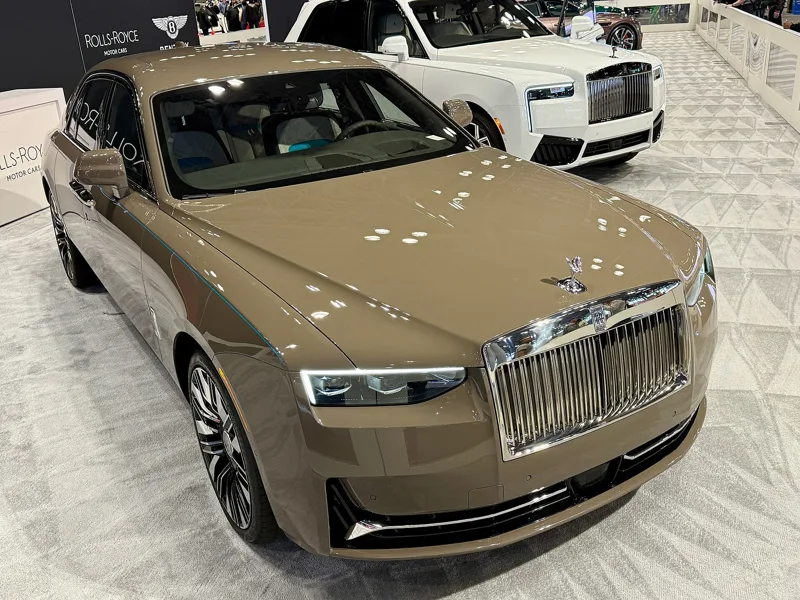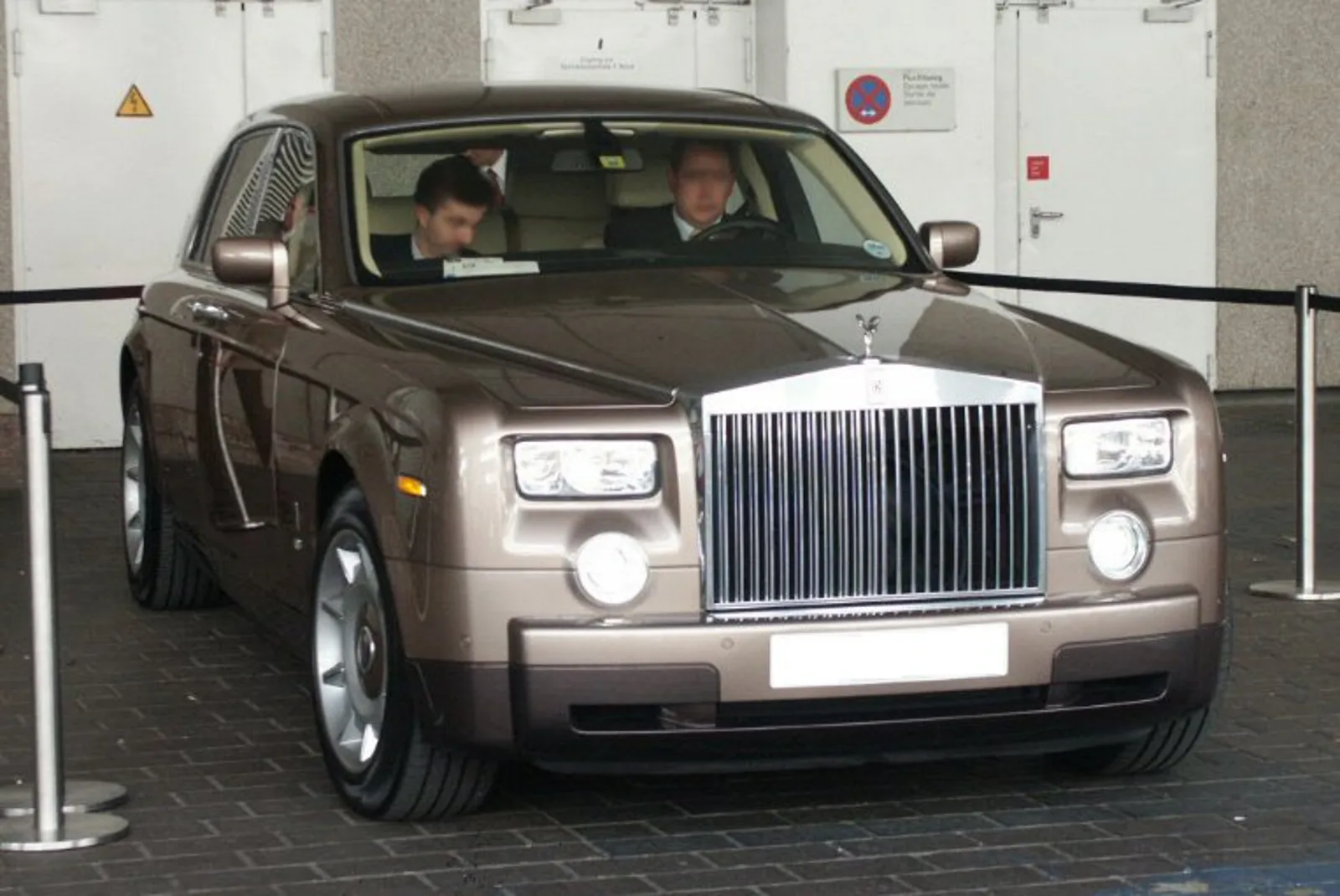
A petal-marquetry special built on the Phantom VII, the 2003 full-size saloon that revived Rolls-Royce and ran until January 2017.
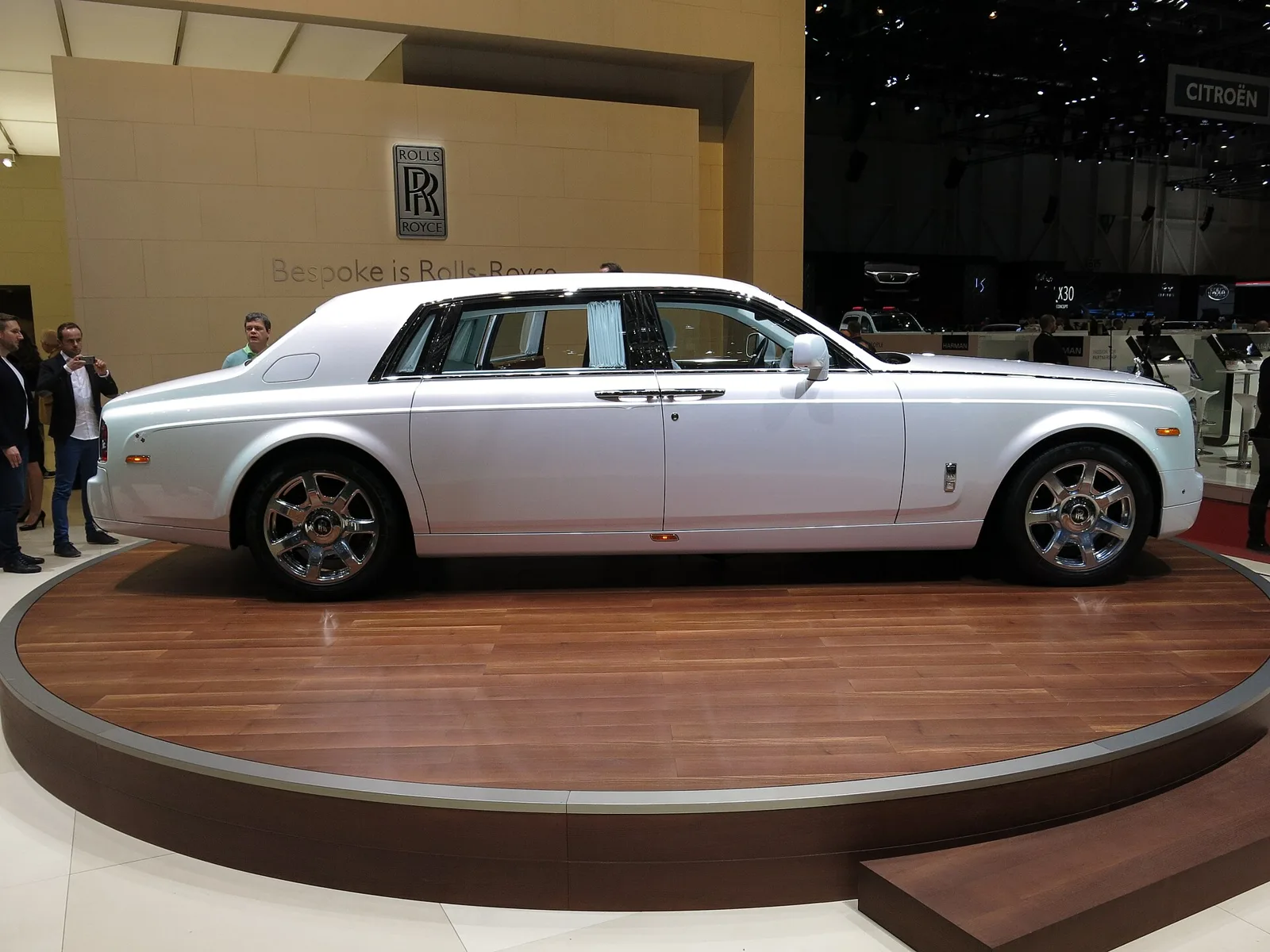
Shown at Geneva in 2015, the Serenity was a bespoke Phantom with silk upholstery, petal marquetry and a clock inlaid with hand-applied rubies. It belonged to the Phantom VII line, which launched in 2003 and ended production in January 2017.
The Rolls-Royce Phantom Serenity is a 2015 bespoke version of the Phantom, shown at the Geneva Motor Show that year. Because the edition sits inside the Phantom VII family, this article covers both the special and the full-size saloon that carried it, which launched in 2003.
When did the Phantom VII launch?
The Phantom was launched in 2003 as the seventh Rolls-Royce design to carry the Phantom name. It was the first Rolls-Royce developed and introduced after BMW bought the right to use the Rolls-Royce name and logo in 1998, and it was built as a full-sized luxury saloon.
Production ran until the end of January 2017, when the last car left the line. The Phantom VIII followed later that year, carrying the nameplate forward into a new generation.
A 2015 bespoke edition with petal marquetry, built on the Phantom VII that revived Rolls-Royce.
Why did the Phantom matter to Rolls-Royce?
The Phantom is credited with reviving the Rolls-Royce brand and restoring its reputation as a maker of luxury cars. Until the smaller Ghost arrived in 2009, the Phantom was the only car the company produced, and it served as the flagship model.
It was less exclusive than any earlier Phantom, none of which had passed 600 cars a year. Across 2003 to 2017 the family reached a total of 10,327 units.
How is a Phantom built?
Every Phantom is built on a unique chassis platform with its own body and interior, while keeping traditional Rolls-Royce design cues. The body is mostly aluminium, and final assembly takes place at the company's plant in Goodwood, West Sussex, where each car is finished to the customer's own specification.
The plant houses a paint shop, body shop, leather shop, woodworking shop and assembly line under one roof. Only three robots work in the factory, and they spray the body while the paint is polished by hand after each coat. The coach lines, exactly 3 mm (0.1 in) wide, are painted by hand as well.
The aluminium spaceframe is made from extrusions produced in Norway using hydroelectric power, then shaped and machined in Denmark and hand-welded in Germany. Customers can choose from 44,000 paint colours and specify any leather colour they want.
What makes the Phantom's doors and details distinctive?
The rear doors are hinged at the rear, a style often called suicide doors but known by Rolls-Royce as coach doors, a feature offered since the first Phantom of 1925. Buttons on both C-pillars operate hydraulic motors that close the rear doors, and an electronic lock stops them opening while the car is moving.
The car brakes to walking speed if a coach door is left open when it drives off. The Spirit of Ecstasy retracts electronically to deter theft and to protect pedestrians in an accident, and its base has a sensor that retracts the figure if it is tampered with.
The instrument panel has no tachometer. In its place is a power reserve dial that shows how much of the engine's output is unused and available to the driver. The RR logos on each wheel hub are independent bezels that stay upright as the wheel turns.
What engines and gearboxes did the Phantom use?
The Phantom used a V12 engine. BMW had first planned a 9-litre V16 but switched to a more economical V12 after the owners invited to the clinic evaluation judged the V16 far too powerful for their needs. The engine was based on the 6-litre V12 from the BMW E65 7-Series, enlarged to 6,749 cc (6.75 litres).
The enlarged displacement matched the classic L-Series V8 that Rolls-Royce had built from 1959 to 2002. Series I cars used a ZF 6-speed automatic gearbox, and Series II cars moved to a ZF 8-speed automatic.
How fast was the Phantom?
The Phantom could accelerate from rest to 100 km/h (62 mph) in 5.9 seconds. It weighed 2,485 kg (5,478 lb) and measured 5.83 m (229.5 in) in length, which gives a sense of its scale.
| Specification | Detail |
|---|---|
| Body | Full-sized luxury saloon, seventh Phantom design |
| Launch | 2003, first Rolls-Royce developed after BMW bought the name rights in 1998 |
| Height | 1.63 m (64.2 in) |
| Width | 1.99 m (78.3 in) |
| Length | 5.83 m (229.5 in) |
| Weight | 2,485 kg (5,478 lb) |
| 0-100 km/h | 5.9 seconds |
| Engine | V12, enlarged to 6,749 cc (6.75 litres) |
| Transmission | ZF 6-speed automatic (Series I); ZF 8-speed automatic (Series II) |
| Extended Wheelbase | 250 mm (9.8 in) longer, with 53.1 inches of rear legroom |
| Paint choice | 44,000 colours |
| Introductory price | GBP 250,000 in the UK; $300,000 in the US |
| Production | 10,327 units, 2003 to 2017 |
What did the Series II update change?
Rolls-Royce announced the Series II in May 2012, for sale from the 2013 model year. The exterior changes were led by Andreas Thurner, with interior updates led by Alan Sheppard, and the car received a one-piece stamped radiator grille and new single-piece wheels.
Other changes included rectangular LED lights in place of the round lower lights, a redesigned rear bumper and a simplified dashboard with an enlarged 8-inch (200 mm) LCD screen. The car also gained a new 8-speed gearbox and an improved rotary controller borrowed from the Ghost.
What is the Phantom Serenity?
The Serenity was unveiled at the 2015 Geneva Motor Show with silk upholstery in Smoke Green and painted crimson petals. Its front seats were trimmed in Arctic White leather, and the cabin used Mother of Pearl marquetry and a ruby-set clock.
The Serenity carries Smoked Cherrywood and Bamboo veneers on the door cappings, dash fascia and rear centre console. Petal marquetry in Mother of Pearl decorates the rear door cappings, while the clock face is etched with concentric circles and inlaid with hand-applied rubies.
The boot is lined in Arctic White leather with a matching carpet, and two parasols with a Serenity motif are held by bespoke leather loops on the boot lid. The body is finished in a Bespoke Mother of Pearl colour with a two-colour coachline and a three-colour blossom motif applied by Mark Court.
Which special editions came before the Serenity?
The Phantom line produced many limited editions. The Centenary Edition of 2004 was limited to 35 units to mark the company's one-hundredth anniversary.
Other editions included the 80th Anniversary Edition of 2005, limited to 25 units, and the Phantom Black of 2006, also limited to 25. The Phantom Silver of 2007 marked the 100th anniversary of the Silver Ghost, and the Spirit of Ecstasy Centenary Collection of 2011 was limited to 100 units.
The Waterspeed Collection of 2014 was limited to 35 units and celebrated Sir Malcolm Campbell's water-speed record in the Bluebird K3 boat. The Limelight, unveiled at the 2015 Shanghai Motor Show, was limited to 25 units aimed at high-profile buyers.
What did the Drophead Coupe and Coupe add?
The Phantom Drophead Coupe is a two-door convertible that was unveiled at the 2007 North American International Auto Show, with production starting in June 2007. Its design was previewed by the 100EX study shown at the 2004 Geneva Motor Show.
The Coupe followed in 2008. Its design had been previewed by the 101EX concept at the 2006 Geneva show, and production began in summer 2008 with sales starting that autumn. The first 200 Coupes sold out at announcement, and two-thirds of those orders came from customers who had never owned a Rolls-Royce before.
What was the Centenary Edition?
The Centenary Edition of 2004 celebrated the company's one-hundredth anniversary with 35 cars, all commissioned by the factory rather than built to lift sales. Each car used red RR badges, a Dark Curzon paint colour exclusive to the series and a solid sterling silver Spirit of Ecstasy bonnet mascot.
The car was revealed on 4 May 2004 at the Midland Hotel in Manchester, the place where Charles Stewart Rolls and Frederick Henry Royce first met. The leather interior was matched to the exterior in Dark Curzon, the instruments had an anodised finish, and the glove box showed the car's number out of thirty-five.
What was the Extended Wheelbase version?
The Extended Wheelbase Phantom was presented at the Geneva Motor Show in March 2005. It was 250 mm (9.8 in) longer than the standard car, and later Series II versions offered power reclining rear seats and 53.1 inches of rear legroom.
The Series II Extended Wheelbase was first unveiled at Auto China 2012, followed by Auto Expo Macau 2012. The Macau show car wore Infinity Black paint with a gold Spirit of Ecstasy, and it had a drinks cabinet, a coolbox for the individual rear seats and starlight headlining.
What did the 2009 update change?
From the 2009 model year the Phantom and Extended Wheelbase gained a shallower front grille finished in stainless steel, LED door handle lighting and 21-inch cast alloy wheels as standard. The climate, volume and window switches moved to a wood veneer panel in the door.
Other changes included a new RCA input for the 12-inch monitors in the picnic tables, new door cappings with integrated grab handles and bi-directional reading lights in the C-pillar. Production of the updated car began at Goodwood in spring 2009.
Which armoured and bespoke versions were built?
The Armoured Phantom carried a VR7 ballistic rating and went on sale first in Europe and the Middle East. One of the bespoke one-offs was the Naples Winter Wine Festival car, a burgundy Phantom that was sold at a US charity auction in 2005 for $800,000.
The armour used fibre composites and special steel, with thickened glass in the glazed areas, a polycarbonate layer and a strengthened aluminium spaceframe chassis. The Naples car had cashmere headlining, a small wine cellar under the boot floor and a cigar humidor in the glove box.
How many Phantoms were sold each year?
Rolls-Royce sold 805 Phantoms in 2006 and first met its annual target of 1,000 vehicles in 2007, when 1,010 Phantoms were sold. Production peaked at 1,212 units in 2008, with 137 Coupes and 431 Drophead Coupes among them.
The 2,000th car rolled out of the Goodwood factory in December 2005, and the 3,000th followed in March 2007. The Drophead Coupe made up 25% of 2007 sales, and its share reached 35% in 2008 before settling at 31% in 2009.
How did the Phantom production end?
On 23 February 2016 the chief executive announced that the final stage of Phantom production had begun, and that seventh-generation limousines would end that year. The Coupe and Convertible would be discontinued, and 50 Zenith models of those two bodies would be built as a final run.
Production of the Phantom Coupe and Drophead Coupe at Goodwood was set to end in November 2016 with no further renewal. The Phantom ended in late January 2017, and the company said a successor would arrive in 2018 on an all-new aluminium architecture.
Was there an electric Phantom?
The Phantom Experimental Electric, known as the 102EX, was a one-off battery electric version shown at the 2011 Geneva Motor Show. It drove through two electric motors mounted on the rear sub-frame, each rated in combination at 290 kW (394 PS; 389 hp) and 800 Nm (590 lb-ft), with a single-speed transmission.
Its battery pack was rated at 71 kWh, and the car could be charged through a plug or induction unit. The electric drive came from UQM PowerPhase, and the drivetrain integration was carried out by Lotus Engineering. The car used a leather process called Corinova.
Did the Phantom face any recalls?
In October 2010 the Phantom was included in a recall of cars with a V8 or V12 engine from BMW. The concern was the potential for a leak in the power braking system.