A lightweight two-seat electric city car from the Hotzenwald: a 1993 to 1996 pre-series run in Suhl, later test cars and a battery story.
The Hotzenblitz was a German electric car built from 1993 to 1996 by Hotzenblitz Thuringen Mobile at Suhl. It was the first passenger car in Germany developed solely as an electric vehicle, built in series and sold to customers, and the only one until the BMW i3 went on sale in November 2013.
Germany's Hotzenblitz was built to a clear brief: a light electric city car from the Hotzenwald. Its story runs from a small company founded in 1990 to a short pre-series run in Suhl, and then to a string of later experiments that used the car as a test bed. The car kept generating projects long after its production stopped.
Where did the Hotzenblitz come from?
A group of engineers from the Hotzenwald, led by the electrical master craftsman Thomas Albiez, decided in 1989 to build an electric car suited to its time. They founded Hotzenblitz Mobile in 1990, with Albiez as managing director, and the first prototype was roadworthy 19 months after work began.
The Swiss firm Schwaller Motorsport developed the frame and chassis, while MeDes Industrial Design was heavily involved in getting the car ready for production. Alfred Ritter joined the financing in July 1990. For an electric car of its size, passive safety was considered exemplary, and the magazine Auto Motor und Sport praised its details.
Production stopped with about 140 hand-built cars, but the Hotzenblitz kept working as a test bed.
How did the prototype change for series production?
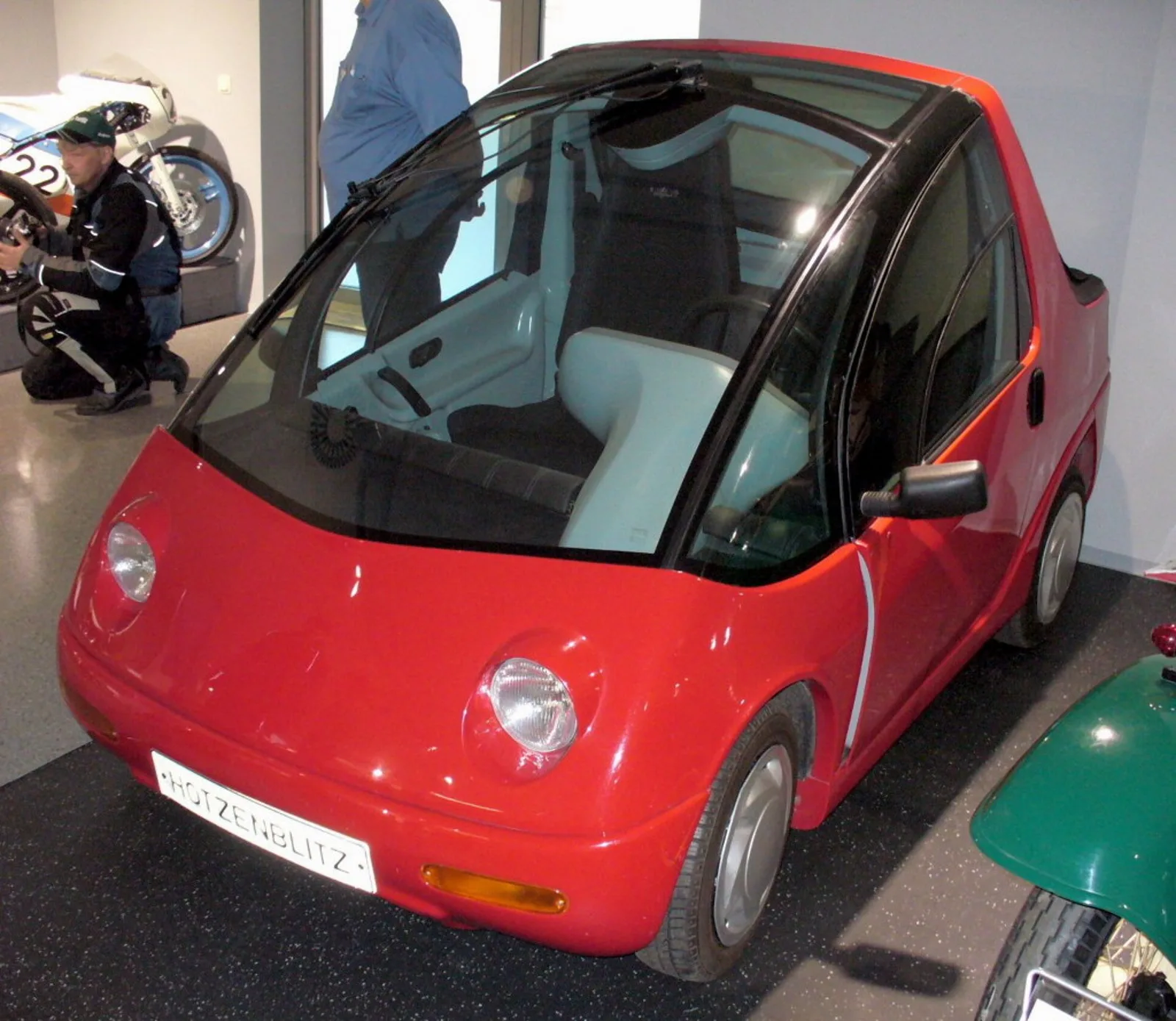
The small lens headlamps of the prototype gave way to units from Hella. The futuristic cockpit was reworked around a conventional speedometer with Ford instrument parts, and the seats became sliding, moulded units with folding backrests. A liquid crystal display, very advanced for its day, was added.
Production began at Suhl in 1993, in the halls of Suhler Fahrzeugwerk, which had been founded the year before. Trade show appearances followed: Frankfurt's IAA in September 1993 and again in 1995, plus Geneva in spring 1994 and 1995.
Why did the bodywork switch to plastic?
The first cars used hand-laminated glass-fibre reinforced plastic, which was painted in the traditional way. To cut costs in series production, Maucher Formenbau in Friedrichshafen developed a thermally formed ABS body in through-coloured plastic. Because these parts came out of a machine, the paint step was dropped.
The second, tinted windscreen above the glass was swapped for a body-coloured or black ABS part. The two versions look alike from the outside, but the GRP car gives itself away with a closed nose and a seam above the front wheel arches, which allowed the whole front to swing open for servicing. On the ABS car the bonnet is small and the nose carries two seams.
The dashboard also changed in revision, with new air vents and a rounded, deep-drawn recess for the LCD in place of the earlier attached frame.
What was the Hotzenblitz's motor like?
A three-phase asynchronous motor drove the front wheels, rated at 12 kW (16 PS; 16 hp) with a short-term peak of 16.5 kW. Top speed was roughly 100 km/h (62 mph). When braking or running downhill, the motor worked as a generator and fed up to about 11 kW back into the traction battery, which improved efficiency and range.
Key specifications
| Specification | Figure |
|---|---|
| Kerb weight | 830 kg (1,830 lb) |
| Permissible gross weight | 1,240 kg (2,734 lb) |
| Rated output | 12 kW (16 PS; 16 hp) |
| Peak output | 16.5 kW |
| Top speed | Roughly 100 km/h (62 mph) |
| Range, original battery | Up to 70 km (43 mi) at about 25 degrees Celsius |
| Consumption from the socket | 12 kWh to 15 kWh per 100 km |
| Charging time | About 5 to 6 hours on a 230 V/16 A socket |
How was the battery designed?
The original pack used 14 maintenance-free lead-gel batteries of 12 V and 60 Ah each. Together they gave a traction voltage of 168 V, a nominal energy content of 10 kWh and a weight of about 350 kg. A battery management system called BADICHEQ watched the 12 V blocks and reported range and battery condition on the dashboard display.
Inside the car, the BADICHEQ unit was housed under the floor panel ahead of the front passenger. A serial port let a PC read it during servicing and monitoring. Nothing of comparable design for lead batteries from that period is known.
With the lead-gel battery at about 25 degrees Celsius, the car could cover up to 70 km. Driving style and the outside temperature both affected range, because at high discharge currents and low temperatures a battery never yields its rated capacity. Recharging from an ordinary Schuko socket, with the onboard charger drawing 8 to 10 A, took roughly 5 to 6 hours.
What changed in the later versions?
Later versions swapped in other battery families, among them nickel-cadmium, nickel-metal hydride and two lithium types, and managed 100 to 150 km on rural routes. The dashboard display was usually replaced with one matching a revised battery management system, and kerb weight fell by 70 to 200 kg, the amount varying with battery type and size, which improved the handling.
Better battery chemistry, motor and charger electronics and more efficient recuperation all cut consumption from the socket, including losses in the charger and battery. Additional three-phase chargers could shorten charging to about one hour with modern traction batteries.
The Swiss firms Kruspan Engineering and MDW-Temperatursensorik began a further development in 2007, separately from Treffpunkt Zukunft. Kruspan fitted high-density lithium-ion cells with a nominal capacity of 39 kWh, and test runs reached 350 km. A Kruspan version with lithium-polymer cells from Kokam had a considerably higher energy content and a higher top speed.
Where did the Hotzenblitz go after production stopped?
Production halted in June 1996 because of financing problems, before a partly automated series could begin. About 140 cars had been built by hand at the Thuringian vehicle plant in Suhl, mainly the Buggy (EL-Sport) type, and they carried the character of a pre-series.
Treffpunkt Zukunft acquired the project and a stock of components from the insolvency estate around the end of 1997, funding itself through new private investors. A 1998 plan for a revised series, built on the experience of those 140 cars and backed by North Rhine-Westphalia and Euroimpuls BeteiligungsAG, left no documented record of a single new car made from fresh parts. The best-documented later build was frame 148, reassembled in 2010 by kraftvollleicht out of spare and surplus components.
A revised model, working title E-Mo or E-Mobil, was announced as a two-seater with room for two emergency seats and a weight below 800 kg. Its promised modern batteries and portable range extender never appeared, and no series production followed after 1996.
Why was the Hotzenblitz used as a test car?
Its lightweight build and electric drive made the car a handy test bed. The German Aerospace Center (DLR) built a fuel-cell hybrid test car, named the Hylite. Cooling and combustion air both have to reach the fuel cell, so the nose of that vehicle needed reshaping with cooling openings. It was also present at the first Hotzenblitz gathering, held at Dogern in August 2004.
At eCarTec 2009 one car was shown with a solar roof that could be pulled out, and in 2011 Kendrion tested a drive with two electric motors and an electronic differential on the car.
In 2011 a car bearing frame 126 entered Wave2011, a tour whose full name is World Advanced Vehicle Expedition. The team called itself Team 9 Faraday USA, and Roger Miauton, Mark Fuller and Mike Collier were among its members. The tour covered 3,000 km across eight countries, and this was the most advanced documented stage of the car's development up to that date.
What was it like to use?
The car seated two, with a padded bench of two emergency seats above the boot drawer. Its low centre of gravity gave it excellent road holding, and it was intended for city traffic. A diesel heater kept the cabin warm enough in winter, although the ventilation was not especially strong and the large windscreen could mist up.
The buggy version came with zip-on doors and a level cloth top. The City model came with fixed doors, a higher cloth top on folding struts, and a pair of rear seats whose backs fold down. A hardtop whose rear window swings out could replace the fabric roof.
In winter a 100 W electric heater mat in the battery tray switched on automatically below 15 degrees Celsius, which raised energy use by 1 to 2 kWh per 100 km, depending on the driving profile.