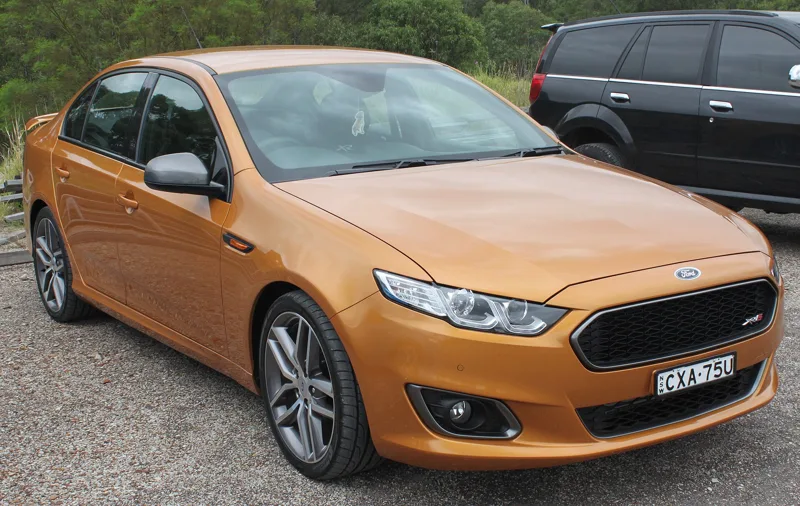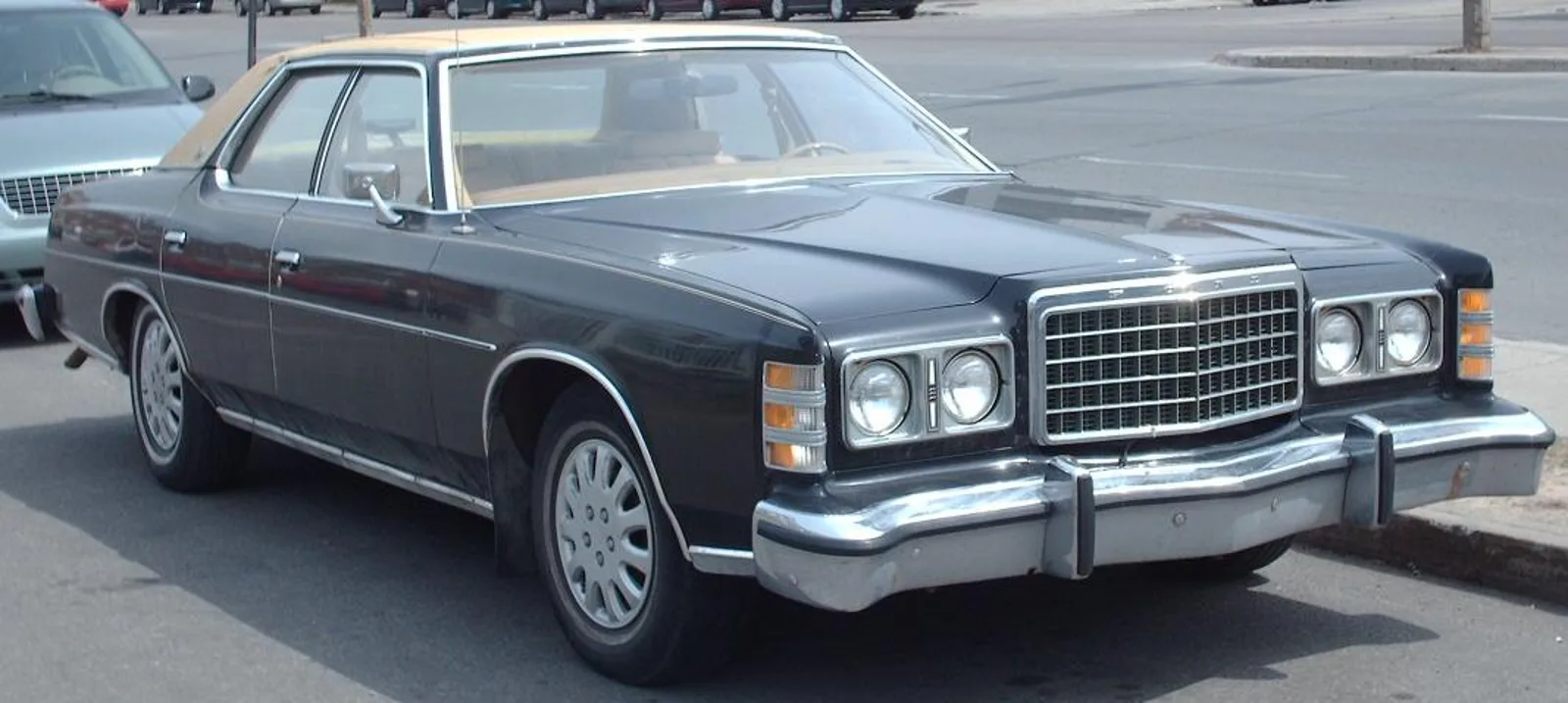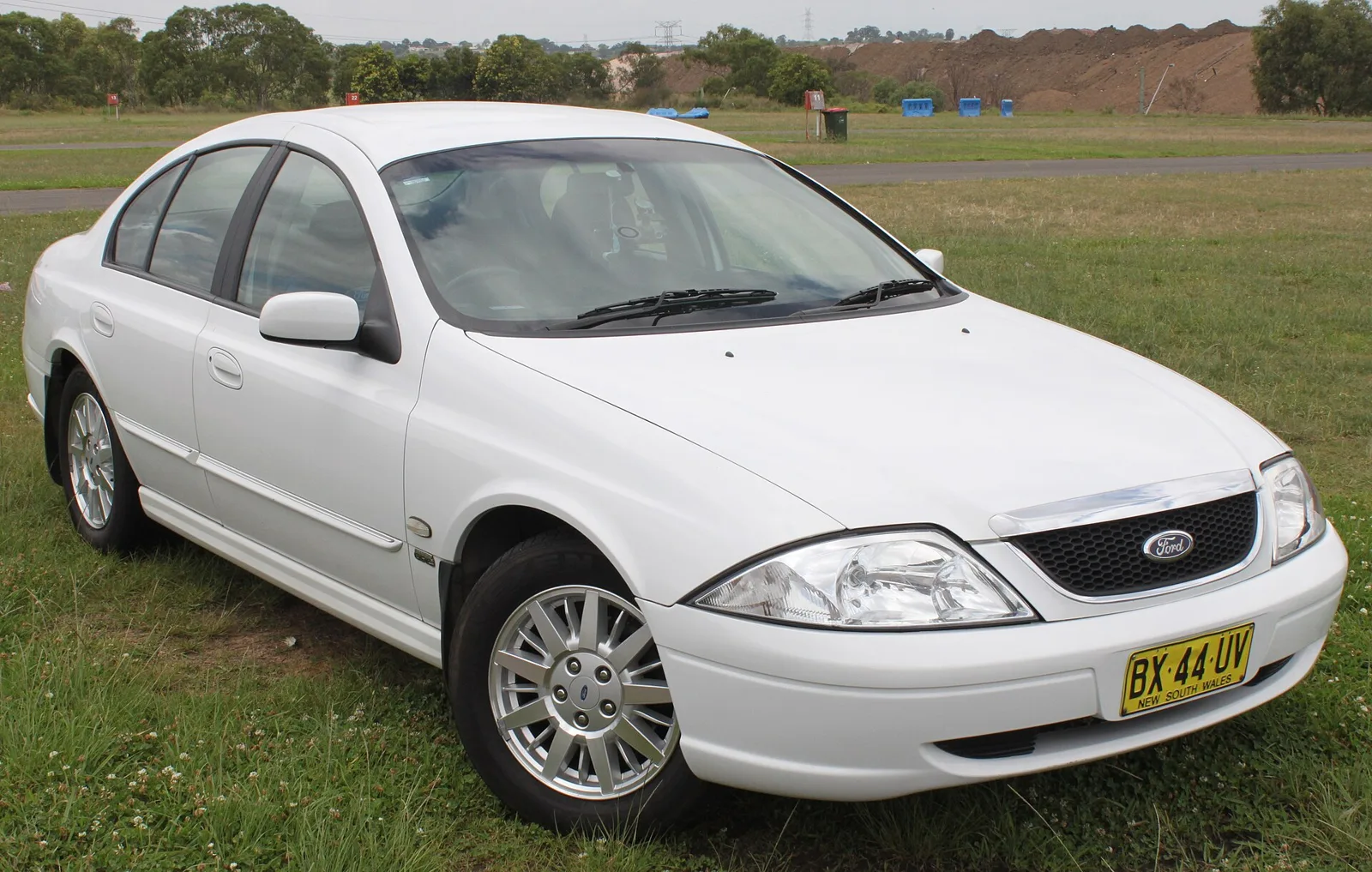
Ford Australia's first sixth-generation Falcon, built on the EA169 platform, with the Series II upgrade, the T series V8s and a racing record that fell short.
Built on the EA169 platform from 1998 to 2002, the AU was Ford Australia's first sixth-generation Falcon. It came with Intech sixes, a Windsor V8 and, in the T series, the Synergy 5000 V8, and it was sold in several guises.
The Ford AU Falcon was a full-size car that Ford Australia built from 1998 to 2002. It was the first sixth-generation Falcon, and it replaced the EL series in several forms, including the Fairmont luxury variant and the TE50 and TS50 sports models.
Rather than importing a replacement, Ford rebuilt its own platform. The result brought new engines and a bold styling direction that divided opinion, and its sales never matched those of the car it succeeded.
What was the AU Falcon?
The AU began life in a programme called Project Eagle, which started in February 1993 and received the codename EA169 in 1994. The programme cost A$700 million before launch, and the finished car sat on the EA169 platform developed for it.
Ford Australia weighed a heavily revised fifth-generation Falcon against imported options such as the Taurus, the Crown Victoria, the Scorpio and the Mazda 929. It settled on a thorough redesign of its own platform.
The long-wheelbase Fairlane and LTD followed in 1999, extending the family across the range.
A New Edge Falcon styled to win younger buyers, which polarised the public it was meant to win.
Why did Ford redesign the Falcon instead of importing one?
Australian buyers placed a premium on towing capacity, interior room and the local jobs that production supported. The imports came only as sedans or sedan and wagon bodies, and none could take a V8, so they did not suit the market.
Keeping the car local preserved the Falcon's identity. Towing, cabin space and V8 power all stayed at the heart of the design.
How did the AU's styling and aerodynamics work?
The AU carried Ford's New Edge styling, which was meant to appeal to younger buyers with avant-garde looks. In Australia the look split opinion, and it played into the hands of the more rounded Holden Commodore VT. Its shape was a clear break from the EL.
The sedan's drag coefficient of 0.295 was roughly 11% better than the EL's, and the wagon managed 0.34. The base car lost 35 kg (77 lb), its bodyshell was 17.5 per cent stiffer, and fuel consumption improved by eight per cent.
Independent rear suspension came as standard on some models and as an option on others. It used double wishbones on an isolated subframe. The Falcon and Futura badges reused lettering from the 1950s, a deliberate link to the car's heritage.
What engines did the AU offer?
The revised six-cylinder engines used variable valve timing on some models. A temperature sensor in the cylinder head could detect coolant loss and let the car limp home by shutting down cylinders. Each engine was tuned for its own role in the range.
The base Intech six made 157 kW (211 hp). The HP version for the XR6 delivered 164 kW (220 hp) from a unique cylinder head, reshaped ports and recalibrated engine management. The VCT engine in the XR6 VCT made 172 kW (231 hp), and the Windsor V8 carried over from the EL with 185 kW (248 hp).
The automatics were four-speed BTR units, and the manual was a five-speed T5. The XR automatic offered an adaptive shift with five strategies to match the driving conditions.
What were the Series I models?
The first series hit showrooms in September 1998 and was refreshed in April 2000, when the car gained a larger update. Its launch slogan was I've come a long way, baby, and the range was built to appeal to fleet buyers at the bottom and performance buyers at the top.
The Forte took over from the GLi name and targeted fleet buyers and younger drivers. Its price of A$30,690 included an automatic and air conditioning, which mattered because rival Australian cars charged extra for air conditioning.
The Futura was the family-minded step up at A$34,990. It added a body-coloured grille, ABS as standard, cruise control, alloy wheels and a centre-console digital clock. The Falcon S was an entry-level sports sedan built on the Forte, with a body-coloured grille, alloys, S decals and a high-level spoiler.
The XR series was the performance end of the range: the XR6 HP, the XR6 VCT and the XR8. All three shared a quad-lamp front bumper bar and a bonnet without the high profile. The Series I XR cars could also be fitted with a full Tickford bodykit and a bi-plane rear spoiler.
The Fairmont aimed at the Holden Berlina. It carried the Futura's fittings along with a honeycomb grille, an 80-second headlamp delay, wood-grain dash inserts, 15-inch wheels and an analogue clock. Above it sat the Fairmont Ghia, a sedan-only range topper with 16-inch wheels, 11 speakers and a 250-watt audio system.
Which special versions joined the AU range?
The Falcon Classic was the only limited edition of the first series. It went on sale in June 1999, was marketed until October that year, and came with an eggcrate grille, dual airbags, ABS, cruise control, a warm charcoal interior and 15-inch alloys. It cost A$30,690.
The utility range arrived in June 1999 with XL, XLS, XR6 and XR8 style side utilities, plus a cab-chassis and a factory drop-side tray. The tray was the first Ford Australia had built in several years.
On the utility the load bed stood apart from the cab, unlike the integrated bed of the Holden. That made it easy to fit tray decks, service bodies and camper shells, and tradespeople and private owners alike took to it.
What changed in the Series II AU?
The Series II arrived in April 2000 and tackled many of the first series' shortcomings. It took the raised bonnet from the Fairmont, adopted a more conventional grille for the Forte and Futura, and gained a stronger rear bumper and a laminated firewall.
Other changes included 16-inch wheels to suit larger twin-piston calipers, a lower stance with new dampers and joints, and cloth in place of vinyl. A transponder in the key improved security, and a front airbag became standard across the range. White turn signal lenses replaced the amber ones.
Structural work improved the car's crash rating. Independent ANCAP testing gave it three stars for adult occupants, with a score of 24.2, and it showed a low risk of injury in the offset test. Airbag and seatbelt pretensioners and load limiters went into the front seats, and wagons received a three-point rear centre belt.
The brakes gained thicker discs, aluminium twin-piston front calipers, bigger pads and a larger master cylinder. An optional Tickford Premium Brake package on the XR6 VCT and XR8 brought 329 mm grooved front discs.
Owners received three years or 60,000 km of routine service at no extra cost. The entry Forte gained automatic transmission, air conditioning and front power windows as standard, shaking off the budget image of the first series.
Did the Series II add LPG and limited editions?
From July 2000 the Intech E-Gas LPG engine joined the line-up. Its fuel system was a single-point, carburettor-style unit rather than sequential injection, and it had its own plugs, leads and engine management. Sedans carried a 92-litre LPG tank, while wagons had 115 litres.
Several limited editions followed. The X-Pack upgraded the Forte with accessory alloys and an XR-style rear wing. The SR succeeded the S with ABS, while the Futura Classic and the 75th Anniversary sedans marked the company's 1925 founding. The XR8 Rebel had a Ford Racing bodykit, 18-inch wheels, MOMO controls and a PlayStation 2 with Grand Turismo III.
Stillwell Ford, a dealer group in South Australia, offered a Sportryder from late 2000, priced at A$29,990 with Pedders suspension and local alloys.
What did the Series III bring?
The last AU-based Falcon appeared at the Sydney Motorshow in November 2001, almost without warning. Its range mirrored the Series II, with three exceptions: the Falcon S was dropped, a limited XR6 VCT ST appeared with the XR8 Rebel's Ford Racing bodykit, and a Pursuit 250 utility arrived through TVE.
Outside, the car gained body-coloured mirrors and side strips, standard side skirts and new wheels on some models, along with a dot-matrix windscreen band to cut sun glare. ABS became standard across the range, but the XR cars gave something up: the limited-slip differential became optional on the XR6, and every XR received a simpler stereo.
A Havoc bodykit, with stainless mesh bumper inserts, fog lights and side skirts, became optional on all Falcons. The Fairmont and XR could also take the REX package, which let rear passengers watch DVDs or plug in game consoles.
Series II and III output to September 2002 came to 237,701 cars.
How did the FTE T series work?
Ford Tickford Experience was a partnership of Ford Australia and Tickford. Its T series had the TE50 and TS50 on the short wheelbase, and the TL50 on the long one, which was based on the Fairlane. Buyers got stronger specifications and a premium service package.
The T series ran in three stages from 1999 to 2002, using the T1 on the AU, the T2 on the Series II and the T3 on the Series III. Its engine was a modified Windsor V8 called the Synergy 5000, hand-built and fitted with a plaque bearing the builder's name.
As the Windsor production wound down, the final batch was known as the Windsor Stroker, with its displacement raised to 5.6 litres. Those engines went into the XR8 sedan and the Pursuit 250, and they were among the most powerful naturally aspirated fuel-injected Windsors ever built.
The TE50 could be ordered with a five-speed manual or a four-speed automatic. The TS50 and TL50 were automatic only, with Electronic Sport Shift, the first locally built system to put manual shift buttons on the steering wheel. The T models also carried MOMO steering wheels, optional Brembo brakes and 17-inch or 18-inch alloys.
Did the AU spawn other versions?
British importer Verte Automotive, a one-time AC Cars subsidiary, sold AU utes as the Verte Tempest from March 2002. It came in XL and XLS trim, and its fuel was LPG alone, drawn from a 4.0-litre inline-six. Plans for coupes, utes and sedans followed, but none of them made it to market.
In 2000 the Hillier Brothers built a two-door AU coupe from a Forte-spec former police car, which appeared at the Summernats festival that year. A later version, the 300+ concept, was shown at the 2001 Melbourne Motor Show. Only three coupes were made in the end, the 300+, the Autotek Arrow and a red XR8.
What concept cars did Ford and its partners show?
Several concepts were built to improve the Falcon's standing. The R5 utility was unveiled at the 2000 Sydney Motor Show as a V8 crew-cab with rear suicide doors, and it previewed the BA Falcon's dashboard and its standard-cab utility range.
The Falcon XR8 Xplod sedan, shown in 2001, was never built. It wore a gold paint called Firestorm, a full Tickford bodykit, 18-inch alloys and a Sony Xplod audio and DVD system that gave the car its name.
The Falcon 300+ coupe was revealed at the 2001 Melbourne Motor Show. Made by Advanced Engine Components and Miller Design for A$1 million, it used a supercharged 4.6-litre Mustang-sourced engine producing 350 kW (470 hp), and it could reach 100 km/h in 4.6 seconds. Although at least 100 units were intended, it never reached full production.
The Arrow coupe, unveiled at the 2002 Melbourne Motor Show, was an extreme take on the Falcon from the aftermarket firm Autotek and the coachbuilder Hillier Conversions. It had an aggressive restyled nose and was built in small numbers at prices from A$100,000 to A$140,000.
How did the AU perform in racing?
The AU was expected to return Ford to competitiveness in V8 Supercar racing, but its aerodynamics held it back. Over four years it won 8 of 52 rounds, although it took 22 pole positions in those rounds, three of them at Mount Panorama.
Across 125 races the car claimed 46 fastest laps and won 23 races, about 19% of the total. It did not take a championship or the Bathurst 1000, but its best-known victories came at the Queensland 500, where Paul Radisich and Steven Johnson won in 2001 and David Besnard and Simon Wills in 2002.
Poor results for Ford at the end of the 1990s led the series to Project Blueprint, meant to balance the field. Privateers raced the AU too: Trevor Haines brought a TE50 home 13th in the Australian GT Production Car Championship of 2002, and Warren Luff won V8 Brute Ute titles in 2002 and 2003 in an AU XR8 ute.
Why did the AU struggle with buyers?
The AU was competitively priced and generously equipped, especially the entry-level Forte, yet sales failed to match those of the EL. Many customers found the New Edge styling too dramatic, and in 1998 the Commodore VT beat the Falcon by about 25,000 sales.
Critics objected to the many oval shapes and the cheap plastics, and some labelled the car a laughing stock. Headroom was tight at the front and rear, which made getting in and out awkward.
Some reviewers also found the ride compliance poor and the cabin insufficiently insulated for sound. Two years after production ended, Ford recalled more than 230,000 of the cars over a potential steering fault.
What were the AU Falcon's engine figures?
| Engine | Models | Output at launch |
|---|---|---|
| Intech I6, base | Forte, Futura, S, Fairmont | 357 N-m (263 lb-ft); 157 kW (211 hp) |
| Intech HP I6 | XR6 | 366 N-m (270 lb-ft); 164 kW (220 hp) |
| Intech VCT I6 | XR6 VCT and Fairmont Ghia | 172 kW (231 hp) in the XR6 VCT; 168 kW (225 hp) in the Ghia |
| Windsor V8, XR8 | XR8 | 412 N-m (304 lb-ft); 185 kW (248 hp) |
| Synergy 5000 V8 | TE50 and TS50 | 200 kW (270 hp) in the TE50; 220 kW (300 hp) in the TS50 |
| Windsor Stroker, 5.6 L | T3 models | 500 N-m (370 lb-ft); 249.8 kW (335.0 hp) |