From the x-Activity show car to xDrive all-wheel drive, with a 480-litre boot and a production run that ended in 2010.
The BMW X3 E83 was the first generation of BMW's premium SUV, produced from 2003 to 2010. It began as the x-Activity concept shown in Detroit in January 2003, went on sale in January 2004, and introduced the xDrive all-wheel-drive system.
The first BMW X3 started life as a roofless concept called the x-Activity, shown in Detroit in January 2003. The production E83 that followed went on sale a year later, and it brought the xDrive all-wheel-drive system to the X3 range. Its main production line was set up in Graz, at Magna Steyr, and the first-series X3 ran until 2010.
What was the x-Activity concept?
The x-Activity was the first official appearance of the car that became the E83. It was a concept at the Detroit Motor Show in January 2003, and at that stage it had no side pillars and no roof from the top of the windscreen to the rear window. The only element in that area was a transverse bar at the height of the rear bench.
The concept carried roof bars, and its missing roof gave it a cabriolet-like look. The show car nonetheless drew the reaction its makers had hoped for, and the project moved forward to a production car.
A roofless concept in Detroit, a 480-litre boot and the first X3 with xDrive all-wheel drive.
How was the production X3 E83 designed?
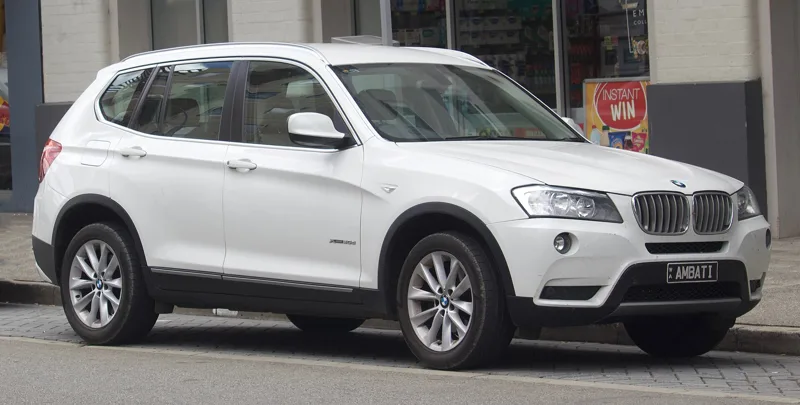
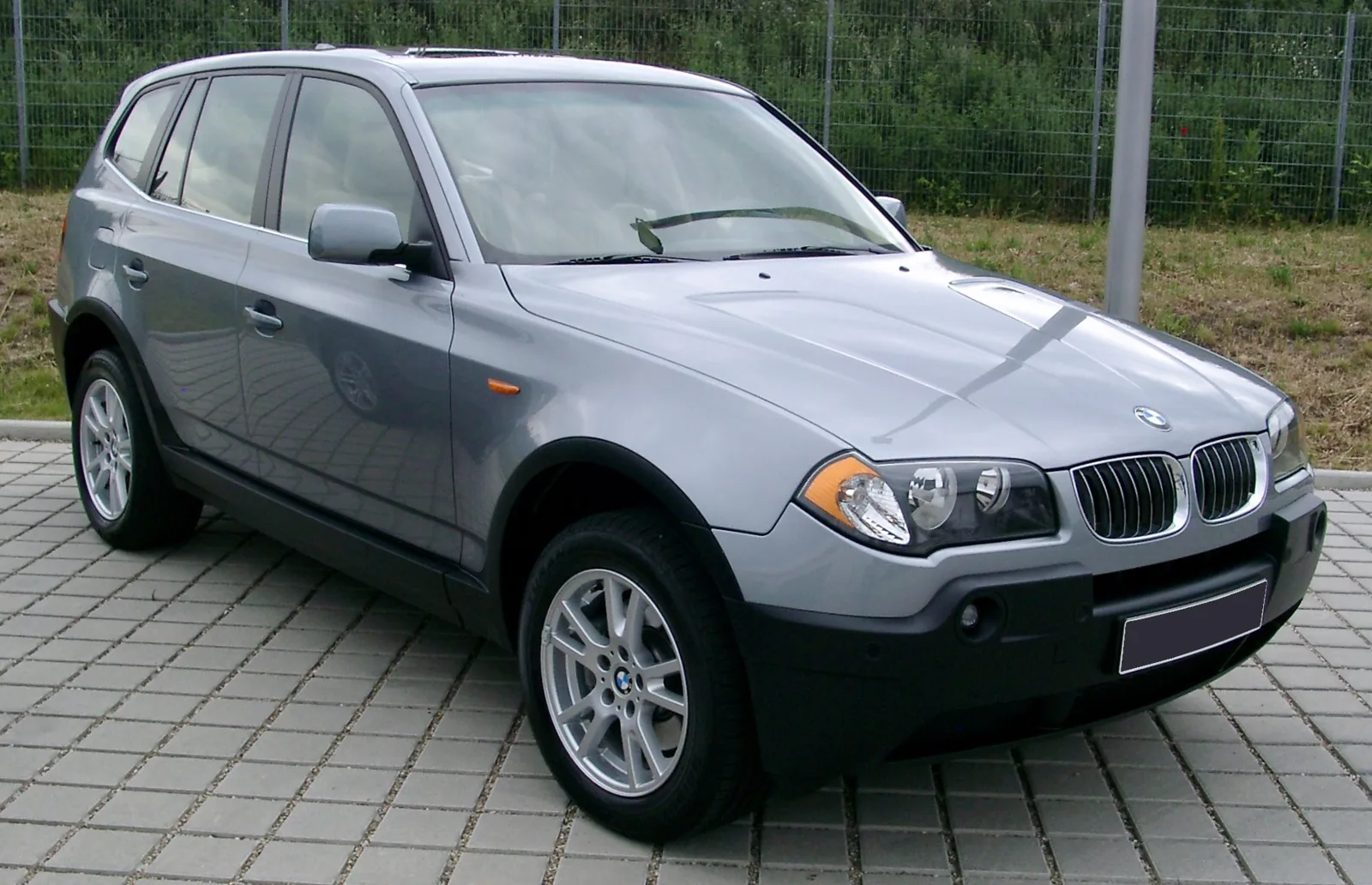
The E83 was styled by a team led by Chris Bangle, and its line drew on the latest motifs of several concepts of the period, such as the x-Activity and the X-Coupe. The front carried the usual BMW identity, with split projector headlights and the classic twin-kidney grille. The production bumper differed from the one shown a year earlier, and it was made of unpainted plastic in a different design.
From the side the car looked balanced and proportionate. The roof was now present, though without roof bars. The flanks carried the edges and curves typical of Bangle's approach, seen in full clarity on the first BMW Z4, but on the X3 they were more subdued and less extreme. Raw plastic sill panels framed the body and the two bumpers.
At the back, the light clusters were stepped and cut by the tailgate line, and the bumper was left unpainted. The number plate sat in a trapezoidal recess, and a small spoiler gave the rear view some attitude.
How much luggage could the E83 carry?
The E83 offered a boot of 480 litres, which was larger than that of its bigger sibling, the X5, at the time of the X3's debut. The X5 was still in its first series, coded E53. With the rear bench folded, the maximum load capacity rose to 1,560 litres.
The interior was sober and ergonomic. Some elements recalled the 3 Series E46, others echoed the first-generation Z4, and details such as the air conditioning came from the 5 Series E39 and the contemporary X5.
What engines did the X3 E83 launch with?
At launch the E83 came with two petrol engines and one diesel, all matched to a 6-speed manual gearbox. The 2.5i produced 192 PS (189 hp), the 3.0i produced 231 PS (228 hp), and the 3.0d common rail turbodiesel produced 204 PS (201 hp).
- X3 2.5i: petrol unit of 2,494 cc (152.2 cu in), 192 PS (189 hp)
- X3 3.0i: 231 PS (228 hp) from 2,979 cc (181.8 cu in) petrol
- X3 3.0d: 2,993 cc (182.6 cu in) common rail turbodiesel, 204 PS (201 hp)
Key specifications of the first X3
| Specification | Detail |
|---|---|
| Generation | First BMW X3, premium SUV, produced 2003 to 2010 |
| Sales start | January 2004 |
| Launch petrol engines | 2,494 cc (152.2 cu in), 192 PS (189 hp); 2,979 cc (181.8 cu in), 231 PS (228 hp) |
| Launch diesel engine | 2,993 cc (182.6 cu in), 204 PS (201 hp) |
| Gearbox at launch | 6-speed manual on all three engines |
| Brakes | Discs on all four wheels, 332 mm front and 320 mm rear |
| Boot | 480 litres, up to 1,560 litres with the rear bench folded |
| Drivetrain | xDrive all-wheel drive |
How did xDrive work on the X3?
The X3 debuted the xDrive system, an all-wheel-drive setup described as intelligent. It distributed drive torque automatically to one axle or the other as conditions required. The mechanical base was derived from the all-wheel-drive 3 Series E46, with a unitary body like that of the larger X5.
The front axle used a MacPherson layout with a telescopic oleo-pneumatic strut and an anti-roll bar. The rear was a multi-link design with double-acting dampers. Disc brakes sat on all four wheels, measuring 332 mm at the front and 320 mm at the rear, and ABS, DSC stability control and traction control completed the package.
Which trim levels were on offer?
The E83 launched in four trim levels, all available with all three engines. The base car came with dual front airbags, front side airbags, front and rear curtain airbags, air conditioning, central locking, electric mirrors and windows, power steering and alloy wheels.
- Eletta: base equipment plus rear head restraints, a car radio and fog lamps
- Attiva: Eletta equipment plus xenon headlights
- Futura: the top trim, Attiva equipment plus satellite navigation
Options common to every trim included an alarm, a 5-speed automatic gearbox, a leather interior, electric adjustment on all seats, parking sensors, metallic paint and a sunroof.
What changed in the first years?
The X3 was eagerly awaited by SUV enthusiasts when it went on sale in January 2004. During that year the range was first updated. The base trim disappeared, and the lineup gained the X3 2.0d, a 2-litre (122.0 cu in) turbodiesel rated at 150 PS (148 hp). Buyers could not get an automatic for it, even for a fee.
The 2.0i followed during 2005, with a naturally aspirated 2-litre (122.0 cu in) petrol engine also rated at 150 PS (148 hp). It was not offered with an automatic either, although the automatic gearbox had moved from 5 to 6 speeds in September 2005. At the end of that year the 3.0d's output rose from 204 PS (201 hp) to 218 PS (215 hp).
Was there a hybrid X3 E83?
Yes, but it never left the prototype stage. A hybrid X3 E83 appeared in 2005, pairing a 3-litre (183.1 cu in) petrol engine of 231 PS (228 hp) with a 30 kW (40 hp) electric motor. The motor could supply up to 400 Nm (295 lb ft) of maximum torque.
What did the 2006 restyling bring?
The restyling was presented at the Paris Motor Show in autumn 2006. New bumpers were fitted, the front one resembling the x-Activity's design but only partly painted in body colour. New alloy wheels arrived too. The front light clusters received clear glass, while the rear ones switched to LED technology.
Inside, new upholstery and seat padding were fitted, and the dashboard and centre console were lightly revised. The engine range gained a 3-litre (183.1 cu in) petrol unit producing 272 PS (268 hp), which replaced the earlier 3-litre rated at 231 PS (228 hp) and powered the new X3 3.0si. The 2.5si's power rose from 192 PS (189 hp) to 218 PS (215 hp), and the 3.0sd became the diesel flagship with a 3-litre (183.1 cu in) bi-turbodiesel producing 286 PS (282 hp), with a 6-speed automatic as standard.
How did the range change from 2007 to 2009?
In 2007 the biggest change came under the bonnet of the X3 2.0d, whose output went up from 150 PS (148 hp) to 177 PS (175 hp). The base trim was reintroduced to the range that year.
For 2008 the models were renamed with the xDrive prefix to emphasise the system. The X3 2.0i became the X3 xDrive20i, the 3.0d became the xDrive30d, and the 3.0sd became the xDrive35d. Some models also gained improvements in fuel consumption and emissions.
In 2009 the X3 xDrive18d joined the range, powered by a 2-litre (122.0 cu in) turbodiesel detuned to 143 PS (141 hp).
Where was the X3 built?
From 2003 to 2007 Magna Steyr assembled the X3 at its Graz plant in Austria, using German components. The company was long known for building all-wheel-drive and niche vehicles. Production was also due to move to Spartanburg, South Carolina, to the plant that already built the Z4 and X5.
Rayong, in Thailand, has turned out the X3 since 2005. The factory opened in May 2000 on a 25 million dollar investment, and it also builds 5 Series and 7 Series models. In 2006 production began in Egypt at October City, through Bavarian Auto, which builds and distributes BMW cars in emerging markets.
When did the first-generation X3 end?
The first-series X3 was taken out of production in autumn 2010, making way for the second generation, coded F25. By then the range had gone through the xDrive renaming and several engine updates.