A public road circuit of 60.721 km that has carried motorcycle racing since 1911, with records, named corners and a long safety history.
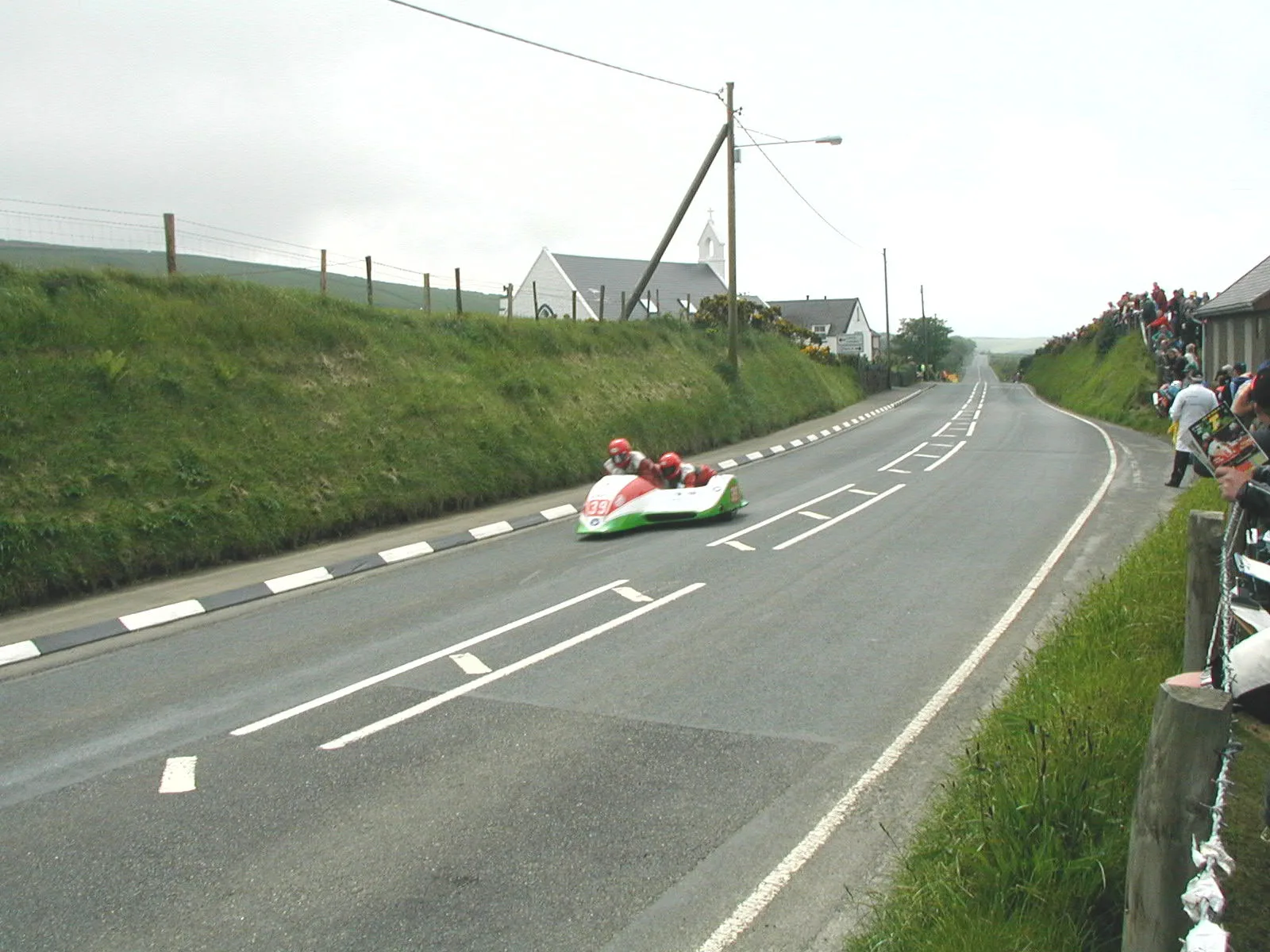
Starting in Douglas, the course spans 60.721 km (37.730 mi) of public roads on the Isle of Man. Motorcycle racing began on the island in 1904, the outright lap record stands at 16 min 36.115 sec, and the course has 219 corners, many of them named after riders.
The circuit that hosts the Isle of Man TT is a public road course that runs through towns, villages and open countryside. The TT and the Manx Grand Prix are both held there each September, and the circuit is one of the best-known motorcycle venues anywhere.
Where does the TT Mountain Course run and how long is it?
The clockwise course is 60.721 km (37.730 mi) long and starts on Glencrutchery Road in Douglas, the island's main town. The route combines urban streets, rural roads and the high mountain section of the A18 before returning to the town.
From the grandstand, riders turn right at Quarter Bridge and head out of Douglas on the A1 towards Peel. They pass Union Mills, Glen Vine, Crosby and Greeba before turning onto the A3 at Ballacraine for Ramsey, then climb past Kirk Michael, Ballaugh and Sulby.
The highest point sits near the 31st Milestone, where the spot height reaches 1,385 ft (422 m). Hailwood's Height marks the summit, and the descent from there runs through open countryside and into the suburbs of Douglas, bringing riders back to the finish.
A road circuit of more than 60 km that has carried motorcycle racing for over a century has had its safety rules reshaped many times.
How did motor racing begin on the island?
Racing on the island began in 1904 with the Gordon Bennett Trial, run over an 83.93 km (52.15 mi) route. British law then limited cars to 20 mph (32 km/h), so the island authorities were asked to allow racing on public roads.
Tynwald passed the Highways (Light Locomotives) Act 1904 to allow the use of local roads. In 1905 a motorcycle trial was run the day after the car event, because the bikes could not climb the steep Snaefell section of the course.
The course was cut back in stages. It shrank to 40.38 mi (64.99 km) in 1906, St. John's Short Course, at 24 km (15 mi), served the 1907 TT, and the 1908 layout of 37.50 mi (60.35 km) lost two loops to become the Four Inch Course.
The name came from 1908 regulations that capped engine cylinder diameter at 4 inches (100 mm). The Auto-Cycle Club adopted the Four-Inch Course in 1911. Once motorcycles raced on it, the route was known by the name Isle of Man TT Mountain Course.
How has the course changed since 1919?
For the 1919 TT the course turned left at Cronk-ny-Mona onto the primary A18 Mountain Road and was lengthened to 60.75 km (37.75 mi). Further alterations in 1922 brought the distance to 60.735 km (37.739 mi), and in 1938 the official length was amended to 60.72 km (37.73 mi).
Major alterations for the 1934 races included removing a sheep-gate on East Snaefell and a hump-backed bridge at Ballig. The Cutting received a memorial to Jimmie Guthrie in 1939 at a cost of 1,500 pounds, and the road at the 33rd Milestone was widened before the 1947 races.
Windy Corner was widened in the winter of 2004 to 2005, and Brandish Corner followed in 2005 to 2006, gaining a gentle bank and a curve of uniform radius as safety measures.
The A18 Mountain Road was closed in the winters of 1991 and 1992 for repair work to its foundations from the 26th Milestone up to the Mountain Box, and the Bungalow tram-crossing hotel was taken down during the winter of 1957/58 as part of the changes of that period.
Bedstead Corner was widened for the 1953 races, and the Quarterbridge junction gained a roundabout in 1963. It was re-profiled again in 1986, with two mini-roundabouts and a new traffic system that changed the approach to the town.
What changed in the twenty-first century?
Road repairs and widening continued from 2003 to 2006, including work on the A3 from Barregarrow to Cronk-y-Voddy. From 2007 the Department of Transport widened the road at Braddan Bridge and proposed a new road linking Signpost Corner with Governor's Bridge.
The new link road ran alongside the older A18 Bemahague Road, which kept carrying the TT and Manx Grand Prix. Its construction began in 2008 and cleared trees from the Bemahague Estate, which contained the Lieutenant Governor's official home.
In July 2008 the transport department unveiled a 4 million pound road safety scheme for the Quarterbridge junction, including a fresh roundabout and the removal of the Quarterbridge Hotel. In 2009 a grass bank was removed at Keppel Gate to give a run-off area.
Lap records and speed milestones
| Category | Time or speed | Holder and year |
|---|---|---|
| Outright lap record | 16 min 36.115 sec, 136.358 mph (219.447 km/h) | Peter Hickman, BMW M1000RR, 2023 |
| Senior TT lap record | 16 min 42.778 sec, 135.452 mph (217.989 km/h) | Peter Hickman, 2018 |
| Sidecar TT lap record | 18 min 42.350 sec, 121.021 mph (194.764 km/h) | Ryan Crowe and Callum Crowe, 2025 |
| Unofficial top speed | 206 mph (332 km/h) | Bruce Anstey, practice, 2006 |
| Cycling absolute lap record | 1 hour, 23 minutes and 48 seconds | Peter Kennaugh, 2015 |
Peter Hickman also holds the Senior race record, averaging 131.700 mph (211.951 km/h) in 2018. The sidecar race record is held by Ben and Tom Birchall, set in 2023 over three laps covering 113 miles at 119.784 mph (192.774 km/h).
What are the fastest car laps on the course?
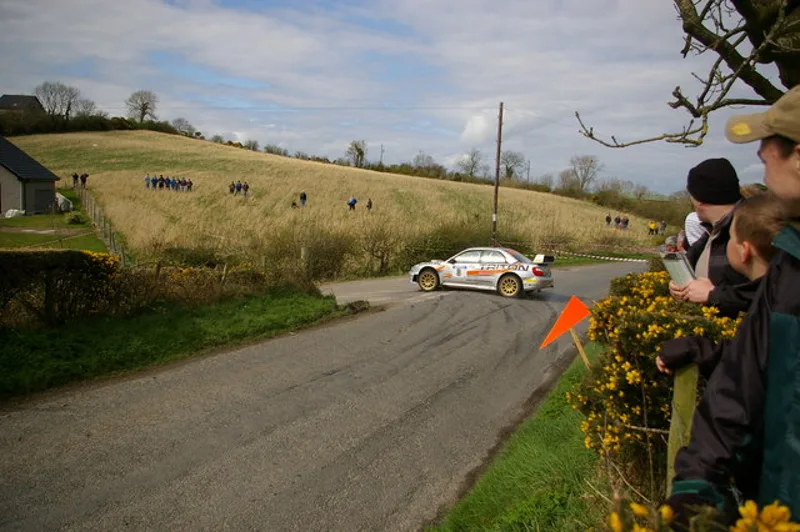
Mark Higgins holds the quickest car lap listed for the course, a run of 17 minutes 35 seconds in a Subaru WRX STI in 2016. Earlier, Tony Pond had become the first driver to average 100 mph (160 km/h) for a lap, in a Rover 827 Vitesse in 1990.
Pond's lap took 22 minutes and 9.1 seconds. Higgins chipped away at the figure in steps: 19 minutes 56.67 seconds in 2011, 19 minutes 15.88 seconds in 2014 and 17 minutes 49.75 seconds on 4 June 2016 before his final run.
The final run averaged 128.73 mph (207.17 km/h) in a 2016 model of the same Subaru WRX STI. Earlier runs used a car prepared to USAC Rally America specification, so the rally-based machine was adapted for the road course.
The first Manx International race was run on 18 June 1936, and it was a single lap of the Mountain Course. Organisers said in May 2017 that the 2017 British National Road Race Championships would take place on the circuit, two weeks after the TT.
Cycling has used the same roads. Charles Holland, from the Midland Cycle and Athletics Club, won that first massed-start race in a time of 1 hour, 42 minutes and 57 seconds, and in 2015 Peter Kennaugh took the absolute cycling record in 2015 at 1 hour, 23 minutes and 48 seconds, undercutting Chris Boardman's 1993 time by 6 seconds.
Why are so many corners named after riders?
The course has 219 corners, and about 60 of them carry names, many honouring riders who died or who set records on the course. Edges Corner, named in 1920, was the first corner to honour a competitor, and the practice has continued ever since.
The S-bend on the A18 was renamed Guthrie's Memorial once the 1939 memorial was built at The Cutting.
Brandish Corner honours Walter Brandish, who broke a leg after a crash in the right-hand gutter during practice for the 1923 races. Birkin's Bend is named for Archie Birkin, who was killed there in 1927 when he swerved to avoid a fish van.
Handley's Corner was named after Wal Handley, who crashed during the 1932 Senior race. Guthrie's Memorial, built in 1939, honours Jimmie Guthrie, and Doran's Bend recalls Bill Doran's crash during the 1950 evening practice.
The Les Graham Memorial, a stone shelter built in 1955, honours the first 500 cc world champion. Hailwood's Rise was named in 1981 for Mike Hailwood, and Duke's and Joey's were named in 2003 for Geoff Duke and Joey Dunlop, who tallied 26 race wins.
In 2013 the Isle of Man Government named corners after active competitors, including John McGuinness, with 23 TT wins, and Dave Molyneux, with 17. Recent names honour non-riders such as Ray Caley and Harold Leece.
How has safety on the course developed?
Since 1911 the course has recorded 270 rider competitor fatalities in practice and races up to 2025, including Manx Grand Prix and Clubman deaths. Many of the safety changes followed those deaths, from helmets to GPS tracking of course cars.
The first fatality came in 1911 practice, when Victor Surridge, who rode for the Rudge-Whitworth works team, died after a crash near Glen Helen. It may also have been the island's first death involving a motorcycle or another road vehicle.
In 1934 Syd Crabtree died in heavy hill fog on the first lap of the Lightweight TT. For the 1935 races, two travelling marshals on motorcycles were hired to look for riders who had gone missing, particularly in bad weather.
Crash helmets became compulsory for the 1914 TT after Frank Bateman died in the 1913 Senior race. A flag to signal the end of a race was first used after Fred Walker was killed near the finish in the 1914 Junior TT.
Practice moved to closed public roads from 1928, and evening practice sessions began in 1937. Seeding of competitors was introduced for the 1959 TT on safety grounds. After a series of fatal accidents at the 1978 sidecar races, paired starts were abandoned for the TT in 1979.
In 1970 six competitors died during the TT, making it the deadliest year in the event's history. From 1973 races were delayed or postponed whenever weather stopped a rescue helicopter from flying, and air fencing was added to corners in later years.
Newcomers have had to complete a Speed Control Lap since 2004, and a mandatory TT Mountain Course licence followed in 2006. A serious accident at the 26th Milestone in 2007 killed a competitor and two spectators during the Centenary races.
In 2013 a rider lost control on the descent of Bray Hill and hit a wall and a spectator safety area, injuring 11 spectators. After a red flag incident and a fatal accident in 2018, competitors were required to wait on the course and travel only in the course direction, and course inspection cars were fitted with GPS tracking.