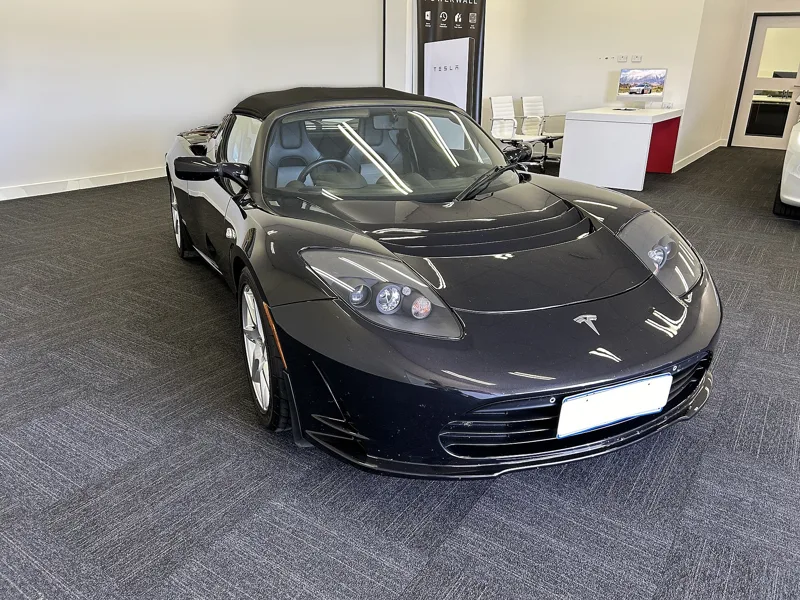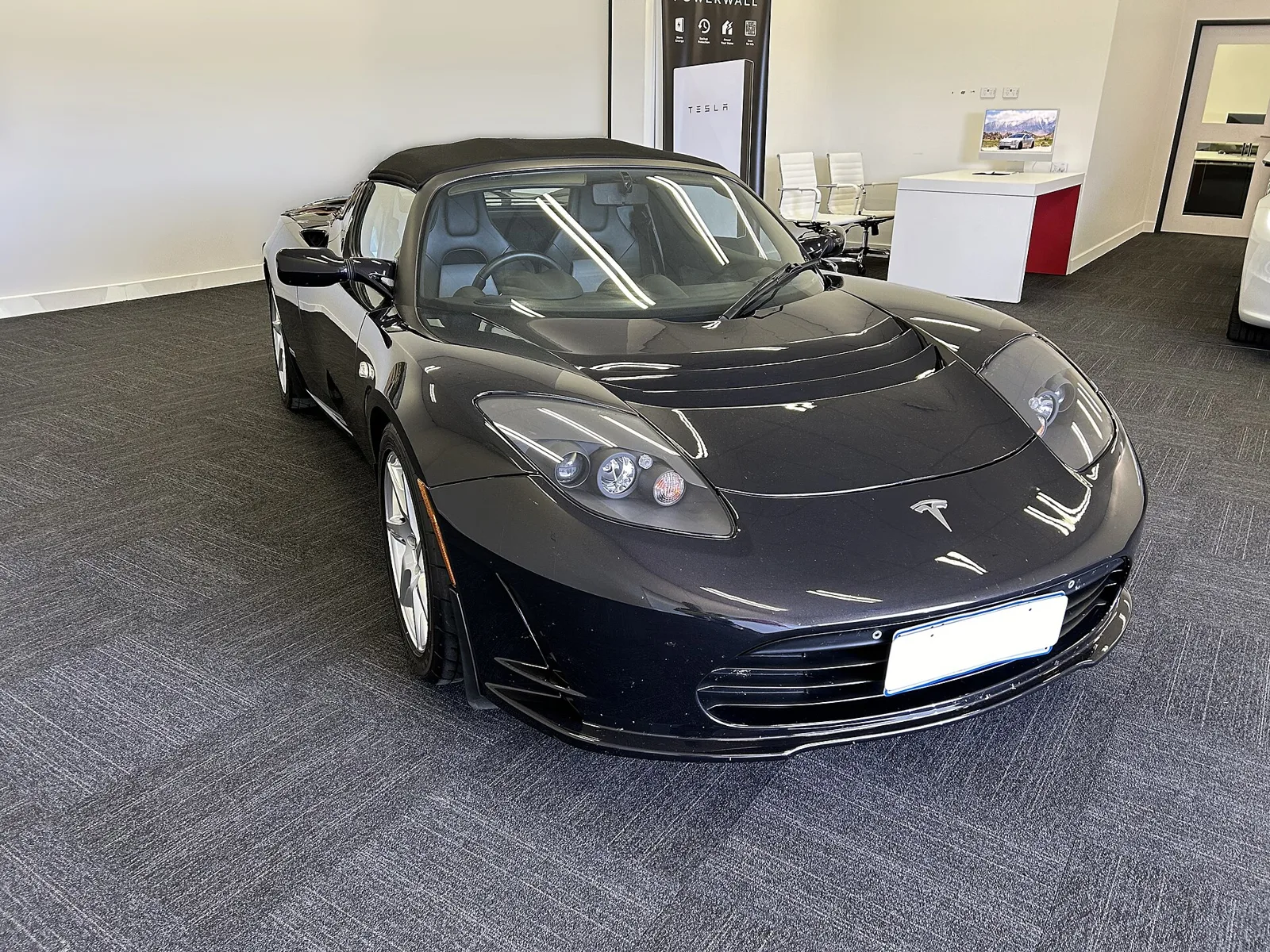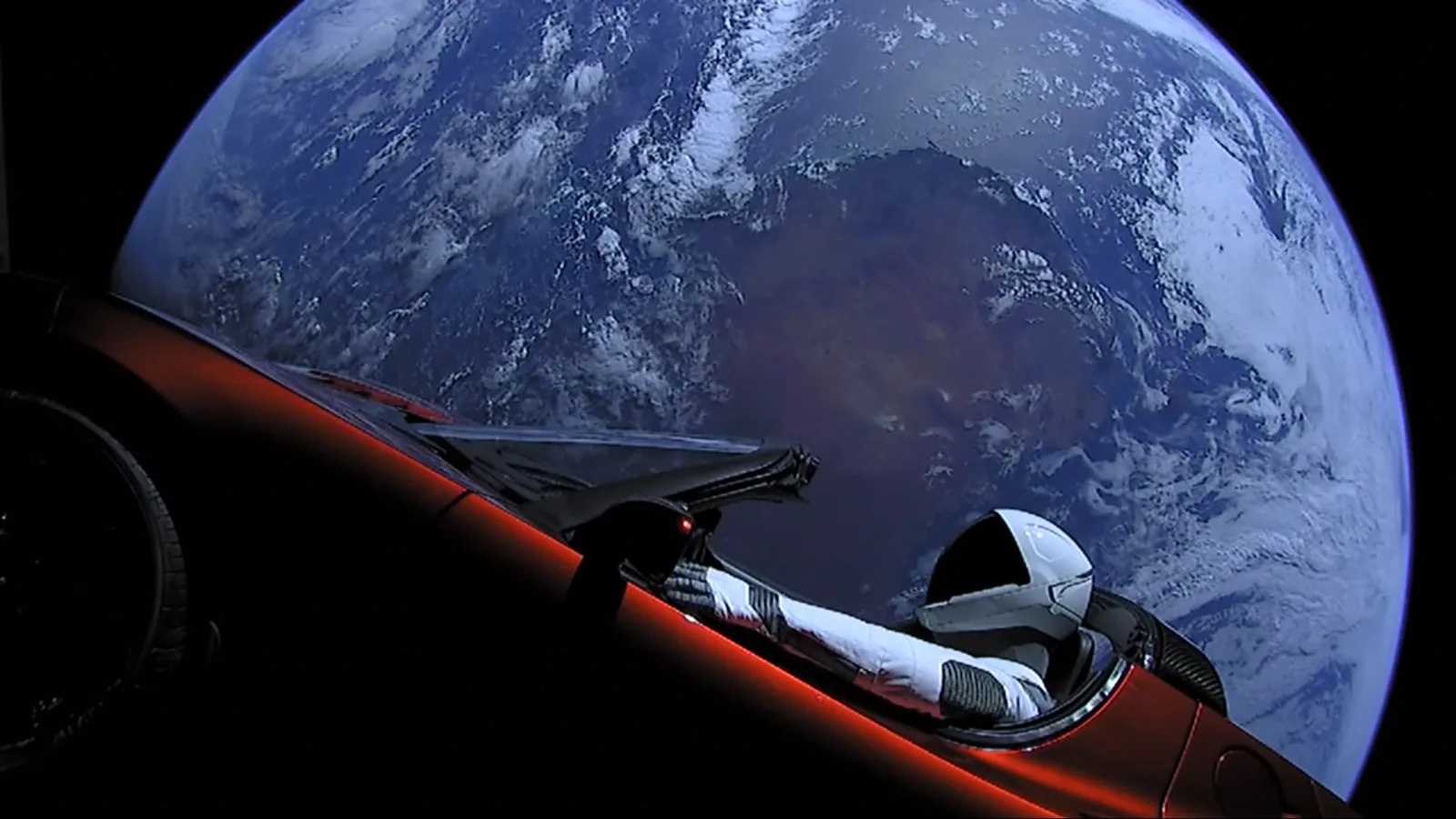
A 2010 Roadster used as the dummy payload on the 2018 Falcon Heavy test flight, now circling the Sun with a spacesuited mannequin at the wheel.
A 2010 electric sports car once used by Elon Musk for commuting, the Roadster entered a heliocentric orbit in 2018 as a Falcon Heavy payload. A spacesuited mannequin called Starman sits at the wheel, and the car's path crosses the orbit of Mars.
Elon Musk's Tesla Roadster was launched on 6 February 2018 as the dummy payload of a Falcon Heavy test flight, and it is still travelling through the Solar System. A mannequin in a spacesuit sits at the wheel. The car is the first production vehicle ever launched into space, and it had once been Musk's own commuting car.
Why did Musk put a car on a rocket?
Musk promised a payload he called the silliest thing imaginable, then chose his own car to fill that role. The load was a meaningful test of realistic size and weight, and the publicity it generated was substantial. Musk saw the launch as a way to excite people about possibilities beyond Earth.
Musk said the launch was meant to spark interest in space, which he linked to a long-term aim of taking people to other worlds. Critics were not all convinced. Lori Garver, a former NASA deputy administrator, first described the choice as a gimmick and a missed scientific opportunity. She later passed on a SpaceX executive's account that the company had offered free launches to NASA and the Air Force, and nobody had accepted.
The first production car in space now circles the Sun, with a mannequin still at the wheel.
How did the Roadster become the payload?
The choice grew out of online exchanges. A March 2017 remark about the test payload was followed in June by a follower's suggestion of a Tesla Model S, and in December 2017 Musk named his personal midnight cherry Roadster as the load. Each step was public, which helped the idea spread.
The flight also had a practical objective. Engineers needed to show that Falcon Heavy could push a load out to Mars's orbit, and a road car made a convenient heavy stand-in. The Roadster is also the first standard road-legal vehicle to go into space, coming after a line of special-purpose lunar and Mars rovers.
What was inside the car?
Engineers fixed the Roadster at an angle above the payload adapter, adding tubular mounts for front and side cameras. A full-scale mannequin in a SpaceX pressure suit took the driver's seat, and the cabin carried a run of pop-culture references, from a novel to a miniature toy.
The mannequin, Starman, rested his right hand on the steering wheel and his left elbow on the open window. He takes his name from a David Bowie song, and before launch the sound system was programmed to repeat another Bowie track, Space Oddity.
A copy of Douglas Adams' The Hitchhiker's Guide to the Galaxy lay in the glove box, accompanied by a towel and a dashboard sign that said DON'T PANIC. A Hot Wheels Roadster with a miniature Starman sat on the dashboard, and a plaque under the car listed the staff who had worked on the project.
A circuit board carried the words Made on Earth by humans. The car also held Isaac Asimov's Foundation novels on a 5D optical disc, a demonstration of compact data storage meant to last. The Arch Mission Foundation supplied the disc to Musk.
What were the mission figures?
The figures below cover the launch, the catalogue entries and the car's orbit. Distances appear in astronomical units (au) and kilometres, with imperial equivalents in brackets where they were published. Most values come from records compiled after the flight, so they describe the path as it has been tracked.
| Item | Figure |
|---|---|
| Launch licence | Issued 2 February 2018 |
| Launch | 6 February 2018, 15:45 EST (20:45 UTC) |
| Launch site | Launch Complex 39A, Kennedy Space Center |
| Catalogue entry | SATCAT 43205, COSPAR 2018-017A |
| Aphelion | 1.66 au (248,892,559 km), 9 November 2018 |
| Peak speed | About 121,000 km/h (75,000 mph) near perihelion |
| Orbital inclination | About 1 degree, against 1.85 degrees for Mars |
| Rotation period | 4.7589 minutes (4 minutes, 46 seconds) |
An astronomical unit is the average distance between the Earth and the Sun. Measured that way, the car's farthest point from the Sun lies beyond the orbit of Mars, which makes the scale easier to picture than a raw kilometre total.
How did the launch unfold?
The rocket left Kennedy Space Center's Launch Complex 39A on 6 February 2018, at 15:45 EST (20:45 UTC). The upper stage carrying the car first entered an Earth parking orbit, then fired a second time to reach an escape path.
Before that second firing, the stage coasted for six hours through the Van Allen radiation belts. The manoeuvre showed a capability the US Air Force had asked for, namely placing heavy intelligence satellites straight into geostationary orbit.
Cameras inside the car and on booms fixed to the custom adaptor fed a live broadcast, which showed the Roadster with the Earth behind it. Musk had suggested the battery could run for more than 12 hours, yet the stream lasted just over four hours and cut out just ahead of the last burn. SpaceX later placed the images in the public domain on its Flickr account.
Where is the Roadster now?
The car follows a heliocentric path, meaning it orbits the Sun rather than the Earth. Its route crosses the orbit of Mars, reaching a farthest point of about 1.66 au from the Sun, but it is designed not to intercept the planet.
Some nine months after liftoff the car had moved beyond Mars's orbit, and it reached its farthest point on 9 November 2018 at 12:48 UTC, some 248,892,559 km (1.664 au) out from the Sun. Its inclination is roughly 1 degree to the ecliptic, while Mars sits at 1.85 degrees, a difference that keeps the two paths apart.
Near perihelion, the closest approach to the Sun, the car should be moving at roughly 121,000 km/h (75,000 mph). Only one earlier SpaceX payload had left Earth orbit, and that was DSCOVR, which went to the Earth-Sun L1 point. Even a true Mars transfer would not have worked, because the upper stage carried no propellant, manoeuvring or communications equipment suited to inserting a car into Mars orbit. The flight did show that Falcon Heavy could send large loads towards Mars in future.
How has the car been tracked?
Observers began following the car within days of launch. The Virtual Telescope Project spotted it two days after liftoff at an apparent magnitude of 15.5, and its spin period was later measured at 4.7589 minutes, or 4 minutes and 46 seconds.
Peter Starr, an Australian astronomer, observed the car with a 0.43 m Planewave telescope at Dubbo, NSW. The ATLAS telescope, operated by the University of Hawaii, logged it automatically, and the Deimos Sky Survey picked it up from 720,000 km (450,000 mi) away, and a flicker hinted that it was spinning.
By 11 February 2018, 241 independent astrometry observations had been pooled by SeeSat-L, a mailing list for amateur satellite spotters. That work pinned the car's position to within one-tenth of an arcsecond, a precision that beat most objects in space.
The orbit was not always identified correctly. In 2025 a citizen astronomer searching archival Catalina Sky Survey data took the car for a new asteroid, and the Minor Planet Center gave it the designation 2018 CN41. The mistake was corrected eighteen hours later, and the entry was removed from the archives.
How did people react?
Reaction was quick and mostly amused, though some observers were uneasy. Commentators saw a shrewd marketer at work, while others raised concerns about contaminating otherwise sterile bodies or about adding to space debris. Many people treated the car as a viral joke.
Advertising specialists called the launch the greatest car advert ever made without spending a penny on media, and a Guardian technology writer described it as a blend of real progress and a publicity stunt. Scientific American argued that a car was not wholly pointless, since a test needed a load of that size and weight.
Internet culture moved fast. Western Australia Police shared a photo of a radar gun aimed at the car as it passed above Australia. Skoda made a parody clip of a Skoda Superb driving to Mars, a village in central France. Donut Media tried to send a Hot Wheels Tesla Model X toward the stratosphere on a weather balloon. A Russian company called ToSky flew a small-scale replica of a Soviet-era Lada to 20 km (12 miles), with a mannequin of Roscosmos chief Dmitry Rogozin on board, to collect data for stratospheric balloon design.
Some reports linked the images to the opening of the 1981 animated film Heavy Metal, in which a traveller arrives on Earth in an old convertible. The live feed reached over 2.3 million viewers at once on YouTube, which put it second only to Felix Baumgartner's 2012 leap from the stratosphere.
What did the car mean to critics and artists?
Critics treated the Roadster as more than a publicity gimmick. The Verge likened it to a ready-made, in the manner of Marcel Duchamp's Fountain (1917), while Flinders University's Alice Gorman read it as a symbol of mortality and masculinity.
Alice Gorman, who teaches archaeology and space studies, argued that the car's chief purpose was symbolic. In her reading the red sports car stood for power, wealth and speed, along with a fragile masculinity. She also suggested the car worked as a charm against the fear of death, and that the mannequin, never alive, now seemed to haunt space.
Could the car hit Earth or Mars?
Simulations spanning 3 million years put the chance of a collision with Earth at about 6%, and about 2.5% for Venus. Those risks compare well with the figures for other near-Earth objects, and the half-life of the tested orbits is about 20 million years.
Trajectories can shift sharply after a close pass by the Earth-Moon system in 2091. The refined orbit has already ruled out a close return to Earth that had originally been predicted for 2073. In October 2020 the car came within about 8 million kilometres (5 million miles) of Mars, too far away for the planet's gravity to alter it noticeably. Its next approach to Earth is set for 2047, at about 5 million kilometres, roughly 13 times the distance from Earth to the Moon.
How long will the car last?
Radiation and micrometeoroid strikes will degrade the car steadily. Musk once speculated that it might drift for a billion years, but the chemist William Carroll expects decay on a much shorter timescale, with plastics and paint lasting only about a year.
Carroll explained that radiation breaks down any material built on carbon-carbon bonds, which includes carbon fibre. Glass and metal that survive the impacts would outlast the rest, leaving the aluminium frame, inert metals and some glass as the last parts of the car.
Will there be a follow-up mission?
No follow-up has been confirmed. Musk has, however, floated the idea. In August 2019, as the car completed its first orbit around the Sun, he floated the idea of sending a small spacecraft, or a Starship, to draw alongside it and take pictures.
He even raised the possibility of returning the car to Earth to study how the Sun had eroded it. The comparison he drew was with Apollo 12, which recovered parts of the Surveyor 3 lander for study, and the car's quiet orbit still carries its story around the Sun.