From mill machinery in Budapest to the Phonix, Magomobil and Magosix, the company that shaped Hungarian motoring between 1901 and 1933.
MAG, short for Magyar Altalanos Gepgyar, was a Budapest manufacturer that began as a mill engineering works in 1884 and built cars from 1901. Its own 25 hp car arrived in 1913, and the company stopped work in 1933 after the 1929 economic crisis.
MAG, formally the Magyar Altalanos Gepgyar, was the best-known car maker in Hungary before the Second World War. The business began in 1884 as a mechanical engineering firm in Budapest, took up cars in 1901 and produced its own passenger car by 1913. All work stopped in 1933, and the company was dissolved in 1941.
Where did MAG come from?
MAG grew out of a small engineering partnership founded by Daniel Podvinecz and Vilmos Heisler, who opened their business in Budapest on 15 September 1884. Their first customers were millers who needed grinders, threshing machine parts, drive belts and gears. By 1900 it had bought a larger site on Vaci street.
Both founders were in their twenties when they moved into motor cars. In 1901 they began assembling Austrian Leesdorfer cars, which were themselves French Amedee Bollee designs built under licence. Their later Phonix model was a German Cudell design, also built under licence, and it became the firm's most successful early product.
Production stayed craft-based for a long time. Each part was made individually by hand, because the firm never moved to mass production. A wide range of products kept the business afloat through the difficult economic years before the car trade took over.
From mill machinery in Budapest to a taxi-focused car range, MAG shaped Hungarian motoring before 1933.
How did the car business begin?
The turning point came in 1904, when the firm acquired all the machinery of the Leesfeld car works near Baden and transferred it to Budapest. Salvaged stock from the German Cudell factory near Leesdorfer, which had burnt down, also reached the Vaci street plant. The Phonix was shown at the 2nd Budapest International Motor Show in the spring of 1905.
The Phonix was a four-seater with a reclining engine, electric ignition and a friction switch. It won a gold medal at the Bucharest International Fair, but buyers were slow to come. At the end of 1907 only eight of them were on Hungarian roads. The range ran from a two-cylinder model rated at 10 hp to four-cylinder engines in 16/20, 20/24 and 35/40 hp versions.
When supplies of Cudell parts dried up in 1906, the company bought stock from the Alba car factory in Trieste. Alba had been set up in 1906 and was liquidated in 1908. The smaller 24 hp model, rated 18-24 hp, went on sale as a passenger car, while the 45 hp model, rated 35-40 hp and fitted with an Aster engine, became a bus and truck under the Phonix name.
Podvinecz died in 1908. Heisler then led the firm on his own for a while and, from 1911, alongside Geza Jalsoviczky, a former head of the Budapest State Higher Industrial School who had retired.
Why is the MAG name used?
The MAG name came from a state subsidy scheme. In 1911 the Hungarian Ministry of War launched a subsidy truck programme that repaid part of the price of trucks meeting military requirements, in return for lending them to the army. Heisler accepted its terms, which required a separate automobile plant finished by the end of November 1912.
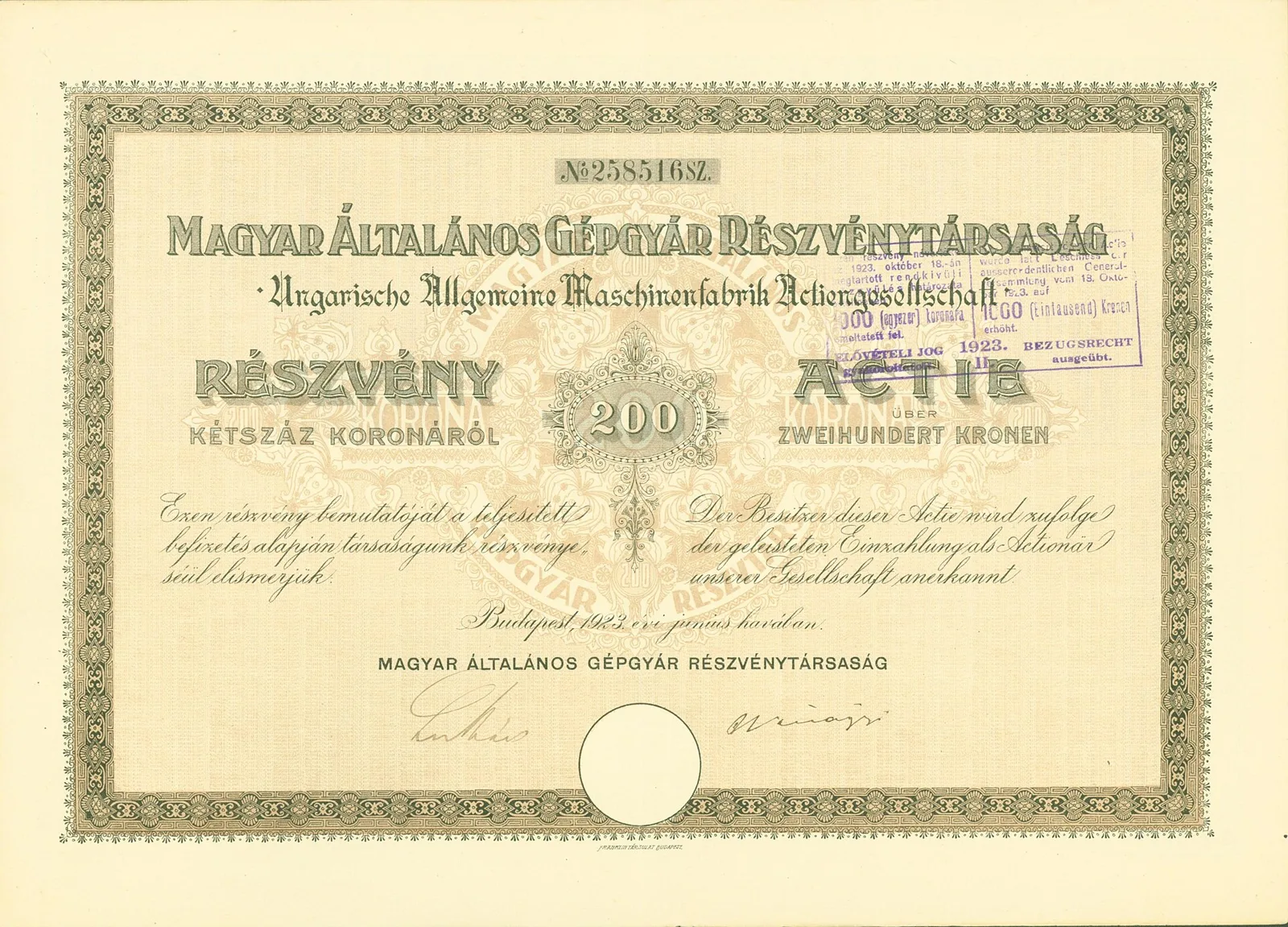
The subsidy also required a trademark registered in Hungary only, and that clause produced the brand name MAG. The works also had to be equipped for 80 workers. On 4 July 1912 the company was renamed Magyar Altalanos Gepgyar Reszvenytarsasag. The old Vaci street factory carried on with mill machinery, engines and steam plant, while the new automobile works opened as a separate production plant.
What was the first MAG car like?
The first passenger car of the company's own design was ready by 1913. It had a 25 hp engine of three litres, with a 90/120 mm bore and stroke. The crankshaft ran in bearings at three points, and the car used a Bosch high-voltage ignition magneto, a single-disc dry clutch and semi-elliptic springs at both ends.
The chassis measured 4,085 mm overall, with a 3,000 mm wheelbase. Nearly 50 examples were built, but only as chassis, because the bodywork came from other firms. Two-tonne lorries were also produced, complete with their engines, to meet the subsidy conditions.
Which MAG models were built?
| Model | Period | Notes |
|---|---|---|
| Phonix (Cudell licence) | From 1905 | Two-cylinder 10 hp; four-cylinder 16/20, 20/24 and 35/40 hp |
| Leesdorfer (assembled) | From 1901 | Austrian cars built from French Amedee Bollee designs under licence |
| Own design passenger car | 1913 | 25 hp, three-litre; nearly 50 built as chassis |
| Subsidy lorry | 1913 | Two-tonne, built with its engine to meet army subsidy terms |
| Mail collection van | 1914 | Series of 50 for the post office; plans by Janos Csonka |
| Post-war chassis | 1923-1924 | Based on a pre-war postal carriage; 60/100 mm bore and stroke, 10 hp |
| Magomobil | 1924-1925 | Four-cylinder touring car, sold in small numbers |
| Magotax | From 1925 | Taxi-focused version of the Magomobil |
| Magosix | 1920s | Six-cylinder, built at Matyasfold partly with American parts |
How did the First World War change MAG?
Car production ended once the war began. Parts and engines already built were turned into generators and other machines for the army. A run of 50 mail collection vans for the post office had only just started when war broke out.
In 1914 the War Ministry ordered the works to build aircraft engines, and the firm went on to build complete aeroplanes under an Austro-Daimler licence. Skoda joined the joint-stock company in 1915. By the end of 1916 the company ranked second among industrial employers in the Monarchy.
In January 1916 the company bought a plot at Cinkota, on the outskirts of Matyasfold. The entire outlay came to 5 million Austro-Hungarian crowns, with 1.6 million for buildings and 2.4 million for machinery. Cinkota granted a 15-year tax exemption.
The siding that linked the aircraft factory to the Cinkotai HEV line was finished in April 1916. The works covered 10 hectares and had a 39 m water tower and a 30 m factory chimney.
In October 1917 Archduke Joseph Ferdinand, who led the imperial and royal air arm, toured the works. In the same year the engine, automobile and aircraft plants moved to Matyasfold, leaving the Vaci street works to carry on with steam engines and mill equipment.
What happened to MAG cars between the wars?
After the war the company, owned by Camillo Castiglioni, the owner of Austro-Daimler, returned to cars because the peace treaty ruled out aircraft production. It reused a pre-war postal carriage chassis and fitted 10 hp engines, but the country had barely recovered from the war and fuel was short. From summer 1923 to summer 1924, only 150 cars were built.
A 1925 report made the problem plain. A MAG touring car cost $850 in America, against a domestic price of $1,050. In 1923 the firm had begun developing a model aimed at taxi operators, and the Magomobil and Magotax went into production in 1925. Jeno Boszormenyi, technical director from 1924 until 1931, was responsible for bringing the Magomobil and Magosix into series production.
The Magomobil never became competitive. In 1927, 2,602 cars were sold in Hungary, and only 148 of them were made by MAG. The company was constantly losing money. The six-cylinder Magosix, based on an American model and partly built from American parts, was made at Matyasfold to compete with locally sold American cars, but it did not change the balance.
Why did MAG stop making cars?
The 1929 economic crisis proved decisive. The Credit Bank, which had financed the company, began to liquidate MAG. The sale of the stock was transferred to the Meray Motorcycle Works, which was owned by the Hungarian General Credit Bank, and a number of the surviving Magosix chassis were completed there during the wind-up.
All work at MAG ceased on 10 January 1933, and the decision was taken to sell the plant, tools and other movable assets. On 18 April 1941 the closing general meeting dissolved the Hungarian Machine Works Limited Company. The firm's output over its life included 2,000 passenger cars, 150 trucks and buses, and 1,000 automobile engines.
Where were the MAG factories?
The first works stood on Vaci street, where a 3,810 square metre plot was split into two halves and registered in 1900. The machine shop held about 100 machine tools and an assembly section. A carpenter's shop, a warehouse, an upholsterer, a painter and a blacksmith completed the site, which was already cramped when automobile work began.
A factory-built compound condensation steam engine powered the whole plant. In 1910 a private locomotive, fitted with a 20 hp petrol engine built by the firm, towed goods around the yard. By 1920 the company had completely abandoned the old Vaci street site for Matyasfold.
Matyasfold was run under Cinkota's administration until 1950, yet the factory and airport are still referred to by that name. Both sat on the southern side of the Old Matyasland housing estate, and the works covered 10 hectares.
The old Vaci street works continued with steam engines and mill equipment as a limited partnership. Sandor Heisler became a shareholder in that partnership, and the Hungarian General Engineering Works Ltd took an outside stake.
Why does MAG still matter?
Before the Second World War it was the most common Hungarian vehicle maker. It outperformed other local makers, including Rock, Raba and MARTA, at a time when the government was trying to build up domestic industry. Contracts from the postal service, the military and other bodies boosted production during the years of expansion.
Its engineers also left a mark. Janos Csonka and Jeno Fejes designed the early range, and Jeno Boszormenyi led the company's technical work through the 1920s. Taxi drivers relied on these simple four-cylinder tourers for decades, and once the war ended Budapest's taxi trade was launched on Magotaxes.
The company's story falls into three phases. It began as a mill engineering works that found an early market in automobiles, then grew through the war years on aircraft and army work. In the interwar period it became a car maker that struggled against locally available American models until the crisis of 1929 ended the effort.