The 1978 pledge that lets a badge cross borders, the differences between plates, placards and clocks, and how misuse is policed in the United States and Britain.
Disabled parking permits give reserved bays and sometimes free or longer parking. International Transport Forum members have recognised each other's badges since 1978, the EU uses a standard Blue Badge, and rules on eligibility, display and enforcement differ widely between countries.
Few documents travel as freely as a disabled parking permit. Since 1978, members of the International Transport Forum have agreed to give people with disabilities the same parking concessions they give their own citizens, which means a badge issued at home can be honoured in another country. The details of who qualifies, how the badge is displayed and what it unlocks depend on the country, and in some places on the town. The privilege is valuable enough that misuse is described as a major problem on both sides of the Atlantic.
What is a disabled parking permit?
A disabled parking permit, also called a disabled badge, placard or tag, a handicapped permit or placard, and a "Blue Badge" in the European Union, is displayed when a vehicle is parked and gives its operator special parking privileges. These include using a space reserved for people with disabilities, staying longer in a time-limited space, or parking at a meter without paying.
The value of the permit is the reason it is worth cheating.
Where are disabled parking permits recognised abroad?
The international rule starts in 1978, when member countries of the International Transport Forum, an intergovernmental body within the OECD, agreed to give disabled visitors the same concessions as their own nationals. A resolution numbered 97/4 updated and extended the pledge in 1997, and it now covers member states and associated countries. The condition is simple: the badge must show the international wheelchair symbol. Until 2007 the Forum operated under the name European Conference of Ministers of Transport, which it had held since 1953.
European Union
In the EU a permit can give partial or total exemption from parking charges and penalties, and shows entitlement to dedicated bays and off-street parking where they exist. In some places the concession reaches tolls or restrictions on where a vehicle may be driven. Council recommendation 98/376/EC urged member states to issue permits in a standard Community model and to recognise those from other states; Council Recommendation 2008/205/EC amended it, and the European Economic Area incorporated it through its own agreement. Since 2000, all general permits in the EU have shared a common style and blue colour, which is where the name "Blue Badge" comes from. A badge from one member state is generally recognised in the others, with exceptions. The privileges themselves vary: parking in no-parking zones, extended time limits, waived fees, or using pedestrian areas in urgent situations.
North America
Canada's Mutual Recognition of Parking Badges Agreement, run by Transport Canada, ensures that valid permits are recognised in every province, in the United States and in participating international territories. Canadian provinces honour a US state's plate or placard, since US states honour Canadian ones. The United States is less uniform: states differ on foreign permits, with some honouring them and others requiring visitors to apply.
New York City has been a flashpoint. A disabled elderly man from New Jersey was ticketed in Brooklyn in 1991 despite showing his New Jersey placard, and in 1997 a woman with multiple sclerosis who used a wheelchair was ticketed for showing a placard not issued by the city. Both argued that failing to recognise out-of-city placards violated their civil rights. The city recognises valid placards from elsewhere for marked disabled spaces, which are all in off-street lots.
United Kingdom
Britain's scheme began with Orange Badges under the Chronically Sick and Disabled Persons Act 1970. Badges are a right for anyone meeting statutory requirements, mostly tied to receiving certain disability benefits, and a local authority can issue badges to people with a permanent disability that seriously limits their mobility but falls outside the rigid rules. The Great Britain scheme stops short of private land: it covers public roads and council car parks, and ports, airports and railway stations often decline to honour its concessions unless their operators choose to offer parking privileges. Badge holders from the EU need a UK parking clock from their issuing office, or the vehicle is treated as if no badge were shown.
How do disabled parking schemes differ by country?
| Country | How it is issued | What is displayed |
|---|---|---|
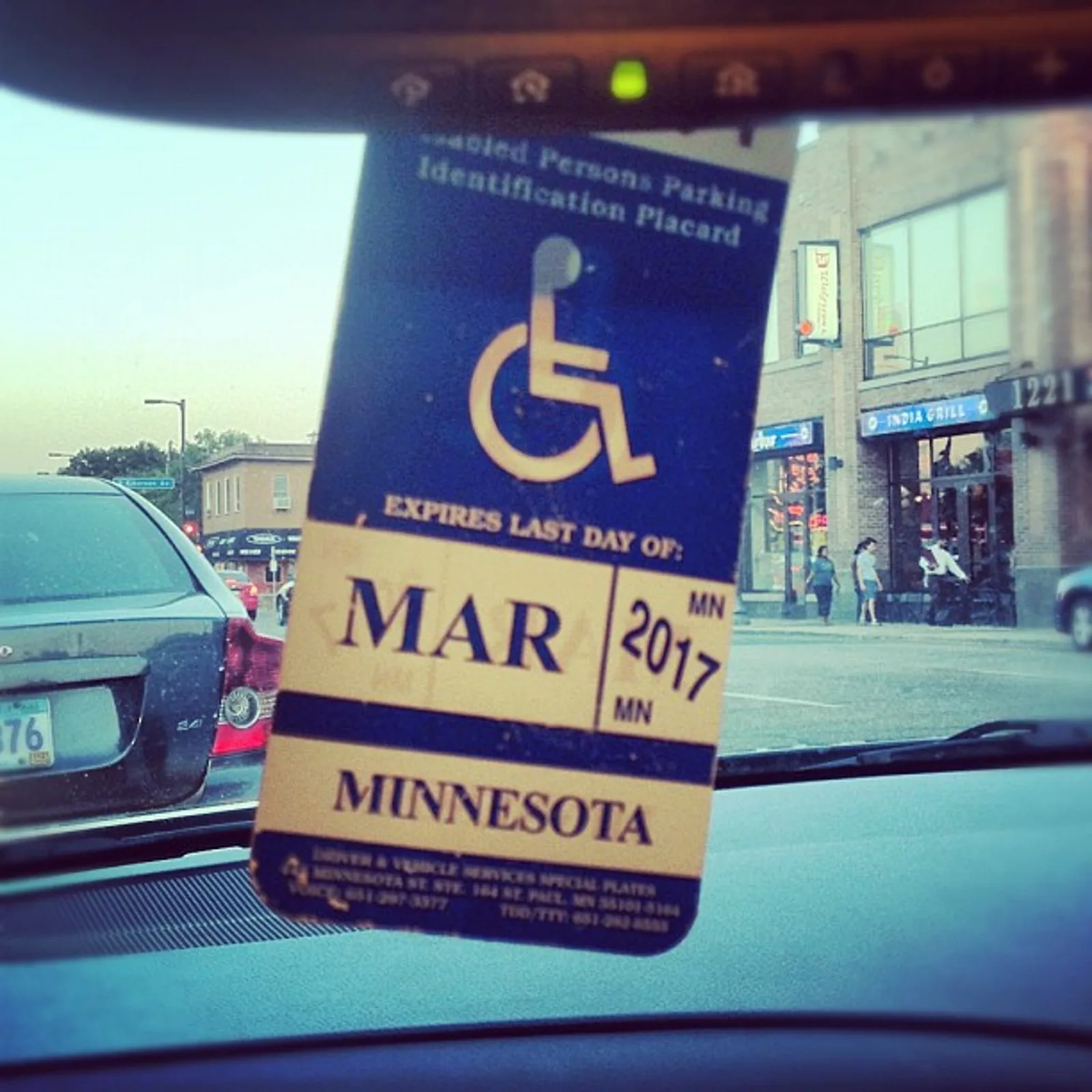
| United States | By state agencies; medical rules vary by state | Special plates, or placards hung from the rear-view mirror |
| Canada | By provincial and territorial ministries; certification by a healthcare practitioner | Portable placards on the dashboard or sun visor, tied to the person |
| United Kingdom | By local authorities, as of right or by concession | Blue Badge with a parking disc in England and Wales |
| European Union | By member states to a standard model | A common blue badge |
| Australia | By state and territory organisations under a national scheme from September 2010 | A permit; eligibility rules differ among jurisdictions |
Who qualifies
In the United States the medical requirements are set by each state but usually limited to specific disabilities. As a general rule they cover people who depend on a wheelchair, crutches or a cane, or who are missing a leg or foot, and some states add cardiovascular, pain or respiratory conditions. About half the states (26) accept blindness, which lets a person obtain a permit to use as a passenger, 14 accept a disabled hand, four accept deafness (Georgia, Kentucky, Virginia and Wyoming), and only Virginia and New York recognise mental illness or developmental disabilities.
Canada leaves the detail to the provinces. The baseline targets severe mobility impairment, often meaning a person cannot walk a set distance, from 50 to 200 metres, without risk to health or without aids. British Columbia, through the non-profit SPARC BC, focuses on physical mobility impairments or severe respiratory conditions needing portable oxygen. Ontario, through ServiceOntario, covers severe physical restrictions and legal blindness but explicitly excludes deafness or cognitive conditions unless they directly impede walking. Quebec, through its automobile insurance society, is distinctive in assessing intellectual, psychological and psychiatric disabilities where they create severe safety risks. Permanent placards typically last three to five years and renew without recertification, and temporary ones last up to six months.
Australia's national scheme dates from September 2010, and applicants usually submit a medical assessment, proof of identity and forms, with processing times and fees varying by state or territory.
How are disabled parking permits displayed and used?
In the US, plates generally go on a disabled driver's own vehicle, while the portable placard can move from car to car with the person, whether they are driving or riding with someone else. Colours vary by state, but red for temporary and blue for permanent placards are the most common. In Canada the permit is tied to the individual rather than the car, so it can be moved between personal, commercial and ride-share vehicles, provided the holder is travelling in it.
American reserved spaces follow the Americans with Disabilities Act guidelines, which say accessible spaces should be at least 2440 mm (96 in) wide and linked to an accessible route to the entrance. There is generally at least one at any public parking location, with more according to lot size and the type of site. The International Symbol of Access normally marks them, though the design of the symbol varies widely, and blue outlines often replace the white or yellow lines used elsewhere. A car in one must show its plate or placard or risk a ticket.
What the badge allows beyond the space is local. In some big US cities holders park free at meters and are exempt from time limits; eight states waive meter fees for holders (California, Illinois, Maryland, Massachusetts, South Carolina, Texas, Utah and Virginia), although Illinois limits the benefit to drivers meeting specific criteria. Virginia also has accessible meters that holders must pay at the usual rate unless exempt. In Canada, municipal bylaws decide whether holders get free meters or extended time limits, even though the International Symbol of Access guarantees designated stalls nationwide.
In England and Wales a holder must show a parking clock unless signs say otherwise, set to the quarter-hour of arrival and visible through the windscreen from the dashboard or facia. On yellow lines, a maximum of three hours is allowed. London adds local colours, using different colours borough by borough, green for Camden, white for Westminster, purple for Kensington and Chelsea and red for the City, to confine standard concessions to local residents, and Norwich runs a green badge scheme. In Northern Ireland the standard scheme generally applies only on-street, and a "White Badge" is needed for pedestrian zones. In Scotland a council parking attendant may inspect a badge, and refusing is an offence. Local councils there can make it an offence not to display a blue badge in a disabled bay, and police and councils can seize misused badges.
Electric vehicle charging
Charging adds a wrinkle. California had more than 27,000 plug-in electric vehicles, with about 2,000 more arriving each month, and 6,218 public charging stations by July 2013. Guidelines call for 1 in 25 charging stations to comply with the Americans with Disabilities Act. A charging station is a service rather than a parking space, so even an ADA-compliant one is shared by any electric vehicle that needs to charge, and no vehicle without a plug-in, placard or not, may use a charging space.
How are disabled parking permits abused?
The privilege is substantial and the temptation to use or obtain one illegally is correspondingly large. Abuse is identified as a major problem in the US, where some estimates suggest that most permits seen on the street are being used or obtained fraudulently, and medical privacy law often makes it hard to tell genuinely disabled people from abusers. The common patterns are using the vehicle, plate or placard of a disabled person without carrying them, often by family members; using an illegally bought placard; forging a physician's signature on the application; and feigning or exaggerating symptoms to persuade a doctor to sign.
A subtler problem is physician approval for conditions that do not actually qualify. It is often a simple error, caused by not fully understanding the law. A cognitive, psychiatric or developmental condition such as autism qualifies in only two states, yet permits issued for them remain legal and valid, and most holders sincerely believe they qualify. The result is far more permits than spaces, which can leave more severely disabled people with nowhere to park. People with invisible disabilities can be hard to distinguish from fraudulent users, and suspicion has sometimes turned into hostility toward legitimate holders.
Penalties and enforcement
Penalties vary. Canadian fines for illegal use, alteration or fraud start at $300 and reach $5,000 in some jurisdictions, and parking authorities can demand identification to confirm the holder is present. In the United Kingdom, misuse can bring fines of up to GBP 1,000. In England in the year ending March 2021 there were 698 reported prosecutions, a fall of 49% that may reflect the pandemic's effect on behaviour, enforcement and resources. Between 1 April 2020 and 31 March 2021, 74% of English local authorities (110 of them) had policies supporting prosecution, and half of those without one planned to adopt one.
London has seen rising numbers. In 2023, 6,415 Penalty Charge Notices were issued for Blue Badge offences, a 25% rise from 5,132 in 2022. The National Agency for Blue Badge Fraud Investigations works with councils to detect misuse and prosecute offenders, has campaigned about badge theft and now publishes the statistics once compiled by the Department for Transport. The Disabled Persons' Parking Badges Act 2013 gave councils and police extra powers against fraud.