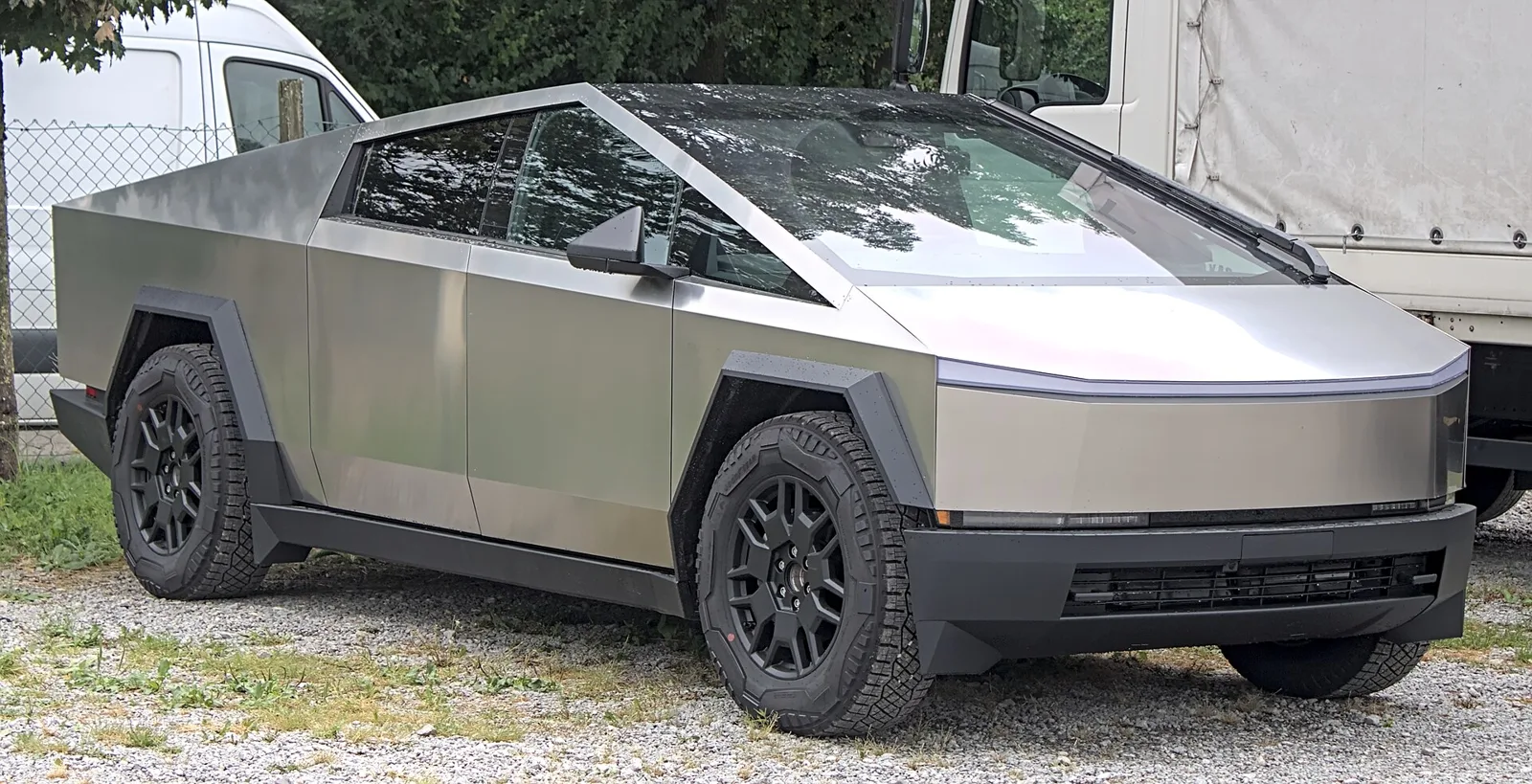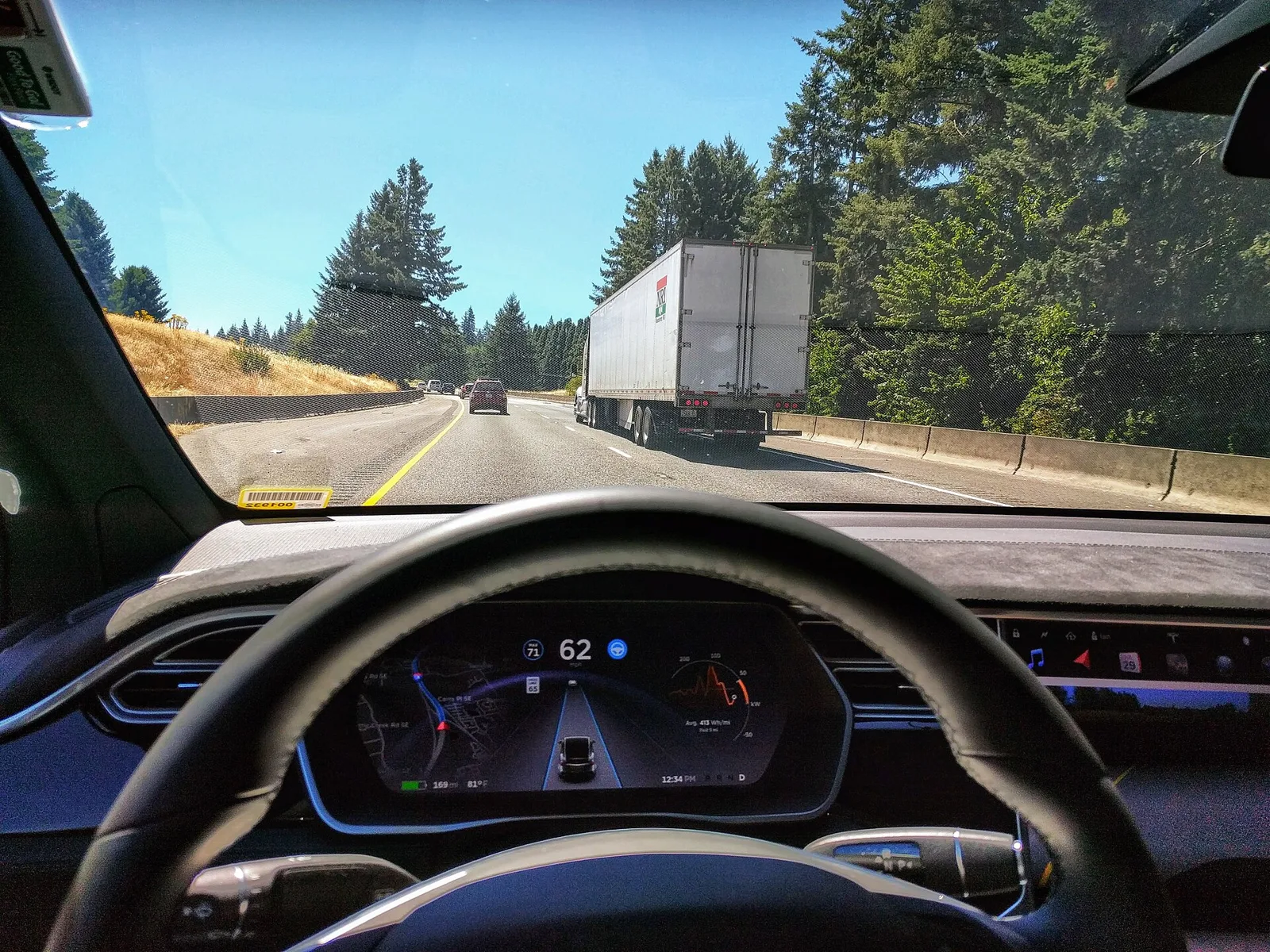
Five hardware generations in twelve years, three different computer suppliers and one bold decision to drop radar, with the upgrade disputes that followed.
Tesla Autopilot hardware is the sensor and computer set behind the company's driver-assistance system. It has moved from Mobileye cameras and radar to Nvidia and custom Tesla chips, and by 2023 it had become a camera-only design.
Tesla Autopilot is the driver-assistance system Tesla fits to its cars, built on a suite of sensors and an onboard computer. Its hardware has been revised several times since 2014, and it moved to an all-camera design by 2023, unlike rival systems that generally include radar or lidar. The sequence of hardware versions explains much of the system's history and most of its controversies.
What is Tesla Autopilot hardware?
Tesla Autopilot hardware is the set of cameras, radar, ultrasonic sensors and onboard computer that power the company's advanced driver-assistance system. Each generation has changed some part of that set, from the sensors to the processor. Each generation also carried a different computer, starting with a Mobileye chip and later moving to Nvidia hardware and Tesla's own chips.
Rivals usually combine cameras with radar or lidar, so Tesla's approach has been a point of contention from the start. Its choices reflect a long argument about whether vision alone can match what a driver sees, and about how much of the hardware a car needs at launch.
Five hardware generations, three computer suppliers and one decision to drop radar, which turned a driver-assistance feature into a long-running debate.
How did Hardware 1 work?
Hardware 1 appeared on vehicles built after late September 2014. It combined a single camera at the top of the windshield, a forward-looking radar in the lower grille and twelve ultrasonic sensors around the bumpers. The Mobileye EyeQ3 computer, built on a 40 nm process, handled the vision work using a neural network.
The system enabled Autosteer, Auto lane change, Autopark and side-collision warning. Auto lane change could be started by the driver's signal once it was safe, because the ultrasonic sensors had a limited range of 5-metre. The system then completed the manoeuvre by itself.
The early limitations were significant. In 2016 the system did not detect pedestrians or cyclists, and two Hardware 1 cars rear-ended motorcycles. In September 2016 Tesla gave the radar an equal role in object detection, where it had previously only confirmed what the cameras saw. Tesla said that change might have prevented a fatal May 2016 crash in Williston, Florida, in which a white trailer against the sky went undetected.
Mobileye ended its partnership with Tesla in 2016. Tesla said Mobileye backed away after learning that Tesla was developing its own vision-based sensor system. Hardware 1 cars were never offered an upgrade to Hardware 2, because the work and cost would have been substantial.
What changed with Hardware 2 and 2.5?
Hardware 2 arrived on vehicles built after October 2016 with an Nvidia Drive PX 2 computer and eight cameras covering 360 degrees. Tesla claimed the computer could process 200 frames per second, and Elon Musk called it basically a supercomputer in a car, with 12 trillion floating point operations per second. The system kept twelve ultrasonic sensors and a forward radar able to see through heavy rain, fog or dust. The Autopilot computer sat just above the glovebox and could be replaced to allow for future upgrades.
The camera layout put three forward-facing cameras beside the central rear-view mirror, two side cameras in the B-pillars, two rear-side cameras in the front fender turn-signal repeaters and one rear camera above the licence plate. Each camera fed the computer a black-and-white image, which may have helped processing speed.
Enhanced Autopilot was initially limited to one camera when it was enabled in February 2017 through a software update. A later update, a month afterwards, added the narrow-angle forward camera. Hardware 2.5 followed in August 2017 with a secondary processor node for redundancy, and it enabled dashcam and sentry mode. Its radar supplier changed from Bosch to Continental, which supplied the ARS4-B unit.
The Model 3 and Model Y added an in-cabin camera. It was disabled at launch and was activated in May 2021 to monitor driver attentiveness in vehicles without radar, while Autopilot was in use.
Why was Hardware 3 needed?
Tesla said its large neural networks, trained by the third quarter of 2018, could not run on the vehicles already built because those cars lacked the computing power. Hardware 3 was designed to run them, with 2.5 times the performance of Hardware 2.5, first available in April 2019.
The FSD Chip was fabricated by Samsung on a 14 nm process, and Jim Keller and Pete Bannon led the project from February 2016. It has twelve ARM Cortex-A72 CPUs at 2.6 GHz, two systolic arrays and a Mali GPU. Tesla claimed 2,300 frames per second, 21 times the 110 frames per second of Hardware 2.5. Two chips were fitted for redundancy. The HW3 board is the same physical size as the HW2.5 board, so upgrades from HW2 and HW2.5 became possible, which had not been true for the move from HW1.
| Generation | Shipping from | Computer | Cameras and sensors |
|---|---|---|---|
| Hardware 1 | Late September 2014 | Mobileye EyeQ3 | One windshield camera, forward radar, 12 ultrasonic sensors |
| Hardware 2 | October 2016 | Nvidia Drive PX 2 | Eight cameras, forward radar, 12 ultrasonic sensors |
| Hardware 3 | April 2019 | Tesla FSD Chip, two units | Eight cameras in the HW2 positions |
| Hardware 4 | January 2023 | FSD Computer 2 | Higher-resolution cameras with a sealed front housing |
Tesla said Hardware 3 was necessary for full self-driving but not for enhanced Autopilot functions. Owners who had bought the FSD package were promised a free upgrade. When the FSD Beta arrived in 2021, subscribers with Hardware 2 or 2.5 were asked to pay US$1500, and within days the price was cut to US$1000. A 2022 default judgment in Washington state ordered a free upgrade for one owner, and the judge pointed to Tesla's earlier assurances that every car sold since 2016 carried the necessary hardware for full self-driving.
What happened with Tesla Vision?
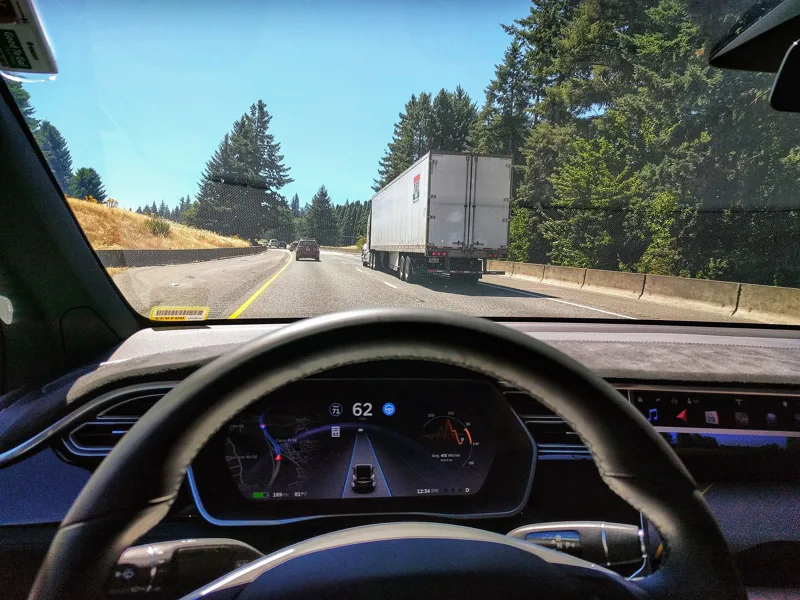
Musk announced the pure vision approach in late May 2021, and forward radar was removed from Model 3 and Model Y built for the North American market. Tesla imposed temporary limits on features such as Autosteer and promised they would return within weeks through over-the-air updates. The Washington Post reported in March 2023 that the immediate result was an uptick in crashes, near misses and other mistakes by vehicles that had lost the sensor.
Safety bodies reacted. Consumer Reports removed the Model 3 from its Top Picks list in 2021, and the Insurance Institute for Highway Safety (IIHS) said it would withdraw the Top Safety Pick+ award. Both later restored their ratings. NHTSA rescinded its check marks for several driver-assistance features on affected vehicles, and those marks were restored by October 2022.
The New York Times reported in December 2021 that Musk had taken the camera-only decision himself, and former employees said engineers had warned that cameras could be obscured. The company uses an Autopilot labelling team of hundreds of staff, who watch clips captured by the cameras and tag visible signs and objects, and that tagged material trains the vision system.
Tesla announced in October 2022 that ultrasonic sensors would go by 2023, and vehicles without them initially shipped without Autopark, Park Assist and Summon. Park Assist in 2023 relied on the cameras to judge distance, and High Fidelity Park Assist arrived for AMD-equipped cars in late 2023. Through 2024, Summon was renamed Dumb Summon, and the revamped Autopark and Smart Summon, the latter named Actually Smart Summon, were rolled out.
What is Hardware 4 and what comes next?
Hardware 4 began shipping in January 2023 in refreshed Model S and Model Y vehicles. Samsung manufactures its processor in Hwasung, South Korea, on a 7 nm process, and the custom SoC is called FSD Computer 2. Musk said Hardware 4 is three to eight times more powerful than Hardware 3, and a teardown found 16 GB of RAM and 256 GB of storage.
The first Hardware 4 cars ran FSD software by emulating Hardware 3, which meant downsizing the camera images. FSD v13.2.1 was the first version to use the native resolution of all cameras. Tesla added front bumper cameras across the line in October 2025, although retrofits to older Hardware 4 vehicles were not offered.
Naming has added confusion. Some Fremont-built Model Ys shipped in late December 2025 with parts labelled hardware 4.5, and Tesla called the label a mistake in January 2026. At the April 22, 2026 earnings call, Musk announced AI4.1, with 32GB of memory per chip and a 10% increase in computing power and memory bandwidth, scheduled for production in 2027.
Hardware 5, named AI5, was announced at the June 13, 2024 annual meeting as ten times more powerful than Hardware 4. It was designed to use up to 800 watts, against up to 100 watts for Hardware 3 and 160 watts for Hardware 4. Its date slipped repeatedly, and in April 2026 Musk said it would not be used for cars. Tesla had also signed a deal with Samsung for AI6 chips in July 2025, but in January 2026 AI6 was no longer planned for vehicles.
The company stopped installing radar in new vehicles from 2021 and announced in 2022 that it would drop ultrasonic support as well. In June 2022 Tesla filed with the US Federal Communications Commission for a new radar module. A later filing suggested the module would not be high-resolution, unlike the radar used by some other manufacturers.
What are the advantages and drawbacks of a camera-first approach?
A camera-first design removes radar from the picture, which avoids combining two different sensor streams. Its supporters point out that humans drive with two eyes, a comparison Musk has made publicly.
Critics raise specific concerns. Tesla itself argued that its radar could have prevented the 2016 Williston crash, which the system did not catch. Critics also note that a sensor which sees a large object, even without identifying it, will not fail to register that object, whereas a vision system depends on training to recognise it.
The debate has not been settled. The hardware history shows Tesla changing course several times, and each change has raised questions about what the car can see when its cameras are obscured.