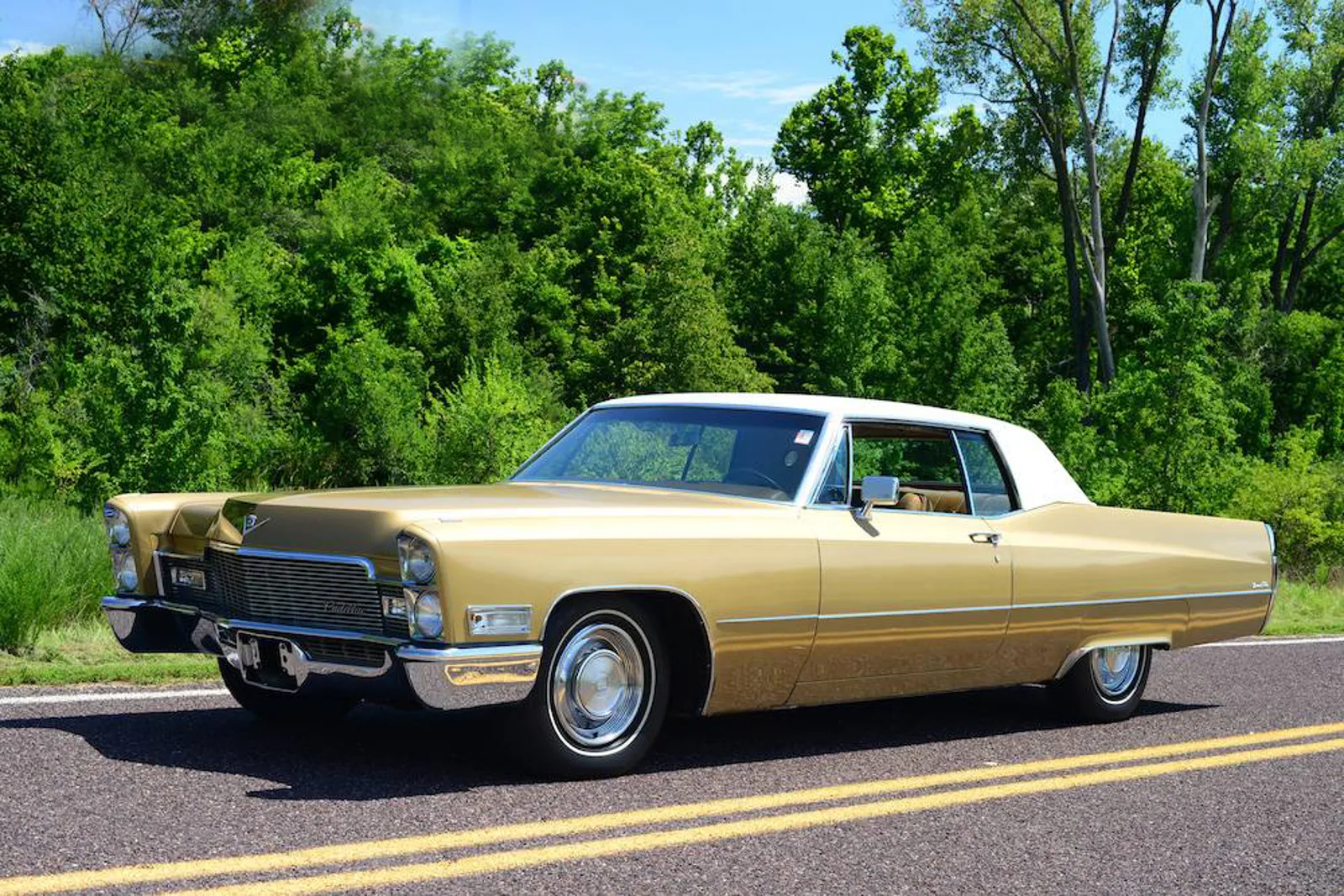
From a 1949 hardtop coupe to the 2005 sedan, the DeVille name carried Cadillac's mainstream model through eight generations, record sales and the Night Vision era.
The DeVille was Cadillac's mainstream model name for eight generations, starting as a 1949 Series 62 trim level and ending as a standalone model in 2005. Its 1977 model year set an all-time record of 234,171 units sold. The name was retired for 2006, when the line became the DTS.
The Cadillac DeVille was a model name used over eight generations, first as a trim level of the 1949 Series 62 and later as a standalone model in the brand range. The last model sold as a DeVille was the 2005 full-size sedan. For 2006 the nameplate was retired, and the line continued as the DTS.
What does the DeVille name mean?
DeVille comes from the French de la ville, meaning of the town. The coupe de ville was a compact closed carriage from French coachbuilding, with room for two inside and a driver's seat outside, intended for town use. Cadillac first applied the name as a trim level on the 1949 Series 62.
Cadillac first showed the Coupe de Ville at the 1949 Motorama. The prototype sat on a Sixty Special chassis, with a decorative air-scoop, chrome around the front wheel openings and a single-piece windshield and rear glass. Its interior was black, trimmed in grey leather to match the roof.
GM President Charles E. Wilson used the prototype until 1957, when he gave it to his secretary. The car was found and restored in the 2010s, and it was in a private collection in Ontario as of 2017.
From a 1949 hardtop coupe to the 2005 sedan, the DeVille carried Cadillac's mainstream name through eight generations.
How did the 1949 Coupe de Ville launch?
The Series 62 Coupe de Ville arrived late in the 1949 model year and was among the first pillarless hardtop coupes ever produced. It cost US$3,496, which was only a dollar less than the Series 62 convertible. Its price equalled about $47,306 in 2025 dollars.
Sales grew quickly after the launch. The first year brought 2,150 units, 1950 reached 4,507, and 1951 more than doubled again to 10,241. In 1956 the Sedan de Ville joined the range, and it sold 41,732 in its first year.
The Coupe de Ville and Sedan de Ville moved to their own series in 1959. Over 53,000 DeVilles sold in that first year as a separate series, roughly 37% of all Cadillacs sold.
What did the early DeVille styling look like?
The 1959 Cadillac is remembered for its huge tailfins and dual bullet taillights. Engine output was 325 hp from a 390 cu in (6.4 L) V8, and the DeVille carried script nameplates on the rear fenders. The 1961 redesign slanted the grille back between dual headlamps and added skeg fins with a three-quarter-length spear moulding along the lower body.
The 1963 car had a bolder, longer look, and it offered 143 interior options, a record for the brand. The 1964 facelift brought a bi-angular grille that formed a V-shape in both planes. The same year Comfort Control, an automatic heating and air conditioning system, was introduced as an industry first. The engine grew to 429 cu in (7 L) with 340 hp available, and the Turbo-Hydramatic transmission arrived with it.
What changed with the 1965 redesign?
The 1965 DeVille moved to a 129.5-inch (3,290 mm) wheelbase on a new perimeter frame. Its redesign used vertical headlight pairs. The 429 cu in engine remained the power source until the 472 cu in V8 arrived in 1968. The 1967 DeVille carried an eggcrate grille and stacked dual headlights.
In 1968 the hood grew by 8.5 inches (220 mm), and the new 472 cu in (7,730 cc) V8 was rated at 375 hp. Front disc brakes became available that year. The 1969 DeVille took on the Eldorado look, with dual horizontal headlamps set into the outer step-downs of the grille. The hood was lengthened again, which added to the impression of length.
How did emissions rules change the DeVille?
In 1971 the compression ratio fell from 10:1 to 8.5:1 so the engine could run on unleaded fuel, and output dropped from 375 to 345 SAE gross hp. The 1971 full-size bodies also set a record for interior width in the GM range.
In 1975 the 500 V8 replaced the 472 as the standard engine. The 1977 cars were a major downsizing, and they were over 9 inches (230 mm) shorter than the previous year's model. They used a 180-horsepower 425 cu in V8 and sat on a lighter body built to improve fuel economy.
A showroom-stock 1971 Coupe de Ville placed third in the Cannonball Run and posted the highest average speed in the event, 84.6 mph (136.2 km/h) excluding stops. It averaged 8.9 mpg-US while doing so.
The 1980 model year brought a major facelift, with a more aerodynamic nose, a nearly vertical rear window and higher, straighter rear fenders. The grille took on a formal look with thick vertical bars, and the cars appeared heavier and more upright, even though they were slightly shorter than the 1977 to 1979 models.
The Phaeton option was discontinued that year, but the d'Elegance package remained. The coupe also took on full, bright side window surround mouldings, which gave it a sharper finish than the sedan.
Which engines powered the DeVille in the 1980s?
In 1980 an earlier V8 gave way to a 368 cu in (6.0 L) V8 with 150 hp. The 1981 model introduced the modulated-displacement V8-6-4 engine, which was developed by the Eaton Corporation and could run on eight, six or four cylinders depending on load.
In 1982 the car gained a new 249 cu in (4.1 L) aluminium-block V8 with closed-loop digital fuel injection. In 1985 the DeVille moved to front-wheel drive on the C platform, which used the first transversely mounted V8 in series production.
The 1988 car had a 155 hp 4.5 L V8, and the 1991 model offered a 200 hp 4.9-litre V8 from the HT series.
How well did the DeVille sell?
The DeVille sold strongly in the 1970s. In 1972 sales reached a record 194,811, and in 1973 they set a new record at 216,243. The 1977 total of 234,171 De Villes was an all-time record for the nameplate. The DeVille's weight within the brand grew steadily.
By 1962 the separate series had sold 71,883 units, about 45% of Cadillac's total sales, and by 1970 the 181,719 DeVilles sold made up 76% of all Cadillacs. Sales fell sharply once the 1980s began. The Coupe de Ville sold 55,490 that year, a drop from the much higher figures of the decade before.
What did the sixth generation bring?
The sixth generation was introduced for 1985. It was a front-drive car on the C platform, and the DeVille and Fleetwood models sold nearly 200,000 units in their first year. The model was downsized and fitted with a transverse V8.
The 1989 facelift lengthened the sedan wheelbase to 113.8 in (2,890 mm) and revised the rear roof and backlight. The Touring Sedan and Touring Coupe trims were introduced in 1986 with a $2,880 package, and the Touring Sedan returned in 1991 as a limited run of 1,500.
Approximately 5,300 Touring Sedans were built in 1992. The coupe was discontinued in July 1993, after the 1993 model year, because the two-door body style had been declining in sales for several years.
How the DeVille's ride and engine evolved
The sixth-generation car kept front-wheel drive, and later DeVille model years used larger variants of the same V8. The layout gave the car a flatter passenger compartment floor than its rear-drive predecessors had offered.
The continuously variable road sensing suspension, later sold as MagneRide, was an adaptive system that showed how far the DeVille's chassis had moved from the simple designs of the 1950s. It added a new level of control to the car's ride.
What was the seventh generation?
The seventh generation arrived in 1994 as a four-door Sedan DeVille on a 113.8-inch (2,890 mm) wheelbase. Its passenger space measured 117.5 cubic feet (3.33 m3), and the trunk held 20 cubic feet (570 L). Production moved to Hamtramck, Michigan.
The seventh generation moved the Sedan DeVille onto a lengthened version of GM's front-drive K platform, which was shared with the Seville. The earlier generation had used the C body that the Oldsmobile Ninety Eight and Buick Park Avenue also shared.
The Northstar V8 was offered in the Concours, producing 270 hp in 1994 and 300 hp (220 kW) in the L37 version from 1996. The Concours also used MagneRide adaptive suspension from 1994, which made it the most performance-oriented model in the line.
A later facelift shortened the name to DeVille, and it refreshed the front fascia, interior and rear fenders. The Fleetwood Limited was a stretched version built by Superior Coachbuilders for 1998 and 1999, and only 781 examples were made across the two years.
Production of the seventh generation ceased in July 1999.
Which packages changed the DeVille's look?
The DeVille was often sold with option packages that altered its styling and interior. The Cabriolet roof package was priced at $348 on the 1977 Coupe de Ville, and it was one of the most popular options on the car.
The Phaeton package, offered from 1978, gave the car a simulated convertible top, special pinstriping and wire wheel discs. It cost $1,929 in its first year and $2,029 in 1979, when the d'Elegance package added Venetian velour upholstery at $725.
The Touring package was priced at $2,880 when it was introduced in 1986. It set the DeVille apart from the regular models, and the Touring Sedan later became a limited edition with its own special features.
What did the eighth generation change?
The eighth generation came in 2000 on the revised G platform, and it reached a drag coefficient of 0.30. The new platform brought new door panels and seats, along with standard seat-mounted front side airbags. The performance Concours was renamed the DTS, and the DHS replaced the d'Elegance trim as the luxury option.
Night Vision was a worldwide first for series production, and it was built with Raytheon. It relied on a passive infrared sensor behind the grille. It was discontinued in 2004, after its run on the eighth-generation car.
Tim Allen designed a high-performance variant in late 2000, the TAD DeVille DTSi. It had stiffer suspension, 18-inch Konig wheels, and Brembo calipers. Its Northstar V8 was tuned to 398 hp at 6400 rpm.
The last DeVille was assembled at Detroit/Hamtramck Assembly in June 2005, and the DeVille nameplate was replaced for 2006 by the DTS.
Why does the DeVille still matter?
The DeVille's story is one of steady change, from tailfin styling and large V8s to downsizing, front-wheel drive and a final four-door line. Its sales rose and fell with the market, but it remained the brand's core car for most of its life.
Few nameplates from the period carried so many generations under one name. The DeVille's name was used for more than half a century, and the later DTS carried its heritage into the next decade.
Key DeVille figures at a glance
The table below collects the main figures from across the eight generations. The launch price, sales records and wheelbase changes are the most useful reference points for a buyer or enthusiast.
| Item | Detail |
|---|---|
| First model | 1949 Series 62 Coupe de Ville, launch price US$3,496 |
| Generations | Eight, from 1949 to 2005 |
| 1959 wheelbase | 130 in (3,302 mm) |
| 1965 wheelbase | 129.5 in (3,290 mm) |
| 1977 downsizing | Over 9 in (230 mm) shorter |
| 1994 wheelbase | 113.8 in (2,890 mm) |
| 1994 passenger volume | 117.5 cu ft (3.33 m3) |
| 2000 drag coefficient | 0.30 |
| Record year | 1977, 234,171 De Villes |
| Last DeVille built | June 2005, Detroit/Hamtramck Assembly |