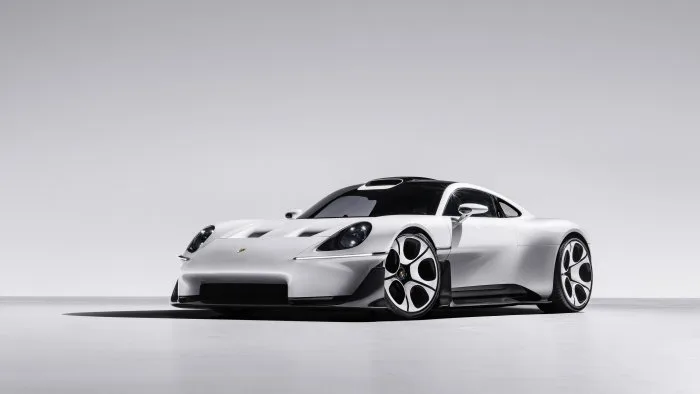
The vision model, shown on a pier in New York, previews Porsche's next design language and a new platform.
Porsche revealed the Mission S vision model on 15 October 2026 on a pier in Queens, New York. The company says the car previews its next design language and a new mid-engined super sports car platform, to be offered permanently above the 911.
Porsche is building a mid-engined super sports car to sit above the 911, and it is not planning a single hypercar run. The company made the announcement on 15 October with the world premiere of the Mission S, a vision model shown on a pier in Queens, New York, as a first look at where its design is heading.
The venue was chosen deliberately. Photographs of the mid-engined 550 Spyder taken on that same pier in 1953 travelled around the world, and Porsche regards that car as its first super sports car and a base for its popularity in the United States.
Dr Michael Leiters, Chairman of the Executive Board of Porsche AG, said a Porsche has to be recognisable at first glance and that the Mission S previews ideas that will shape the brand in the coming years. He described the platform behind it as a permanent, versatile addition to the customer offering rather than a one-off. Tobias Suhlmann, Vice President Style Porsche, said the direction will soon reach the future product range. All of it sits under the company's 'Sportwagenschmiede '35' realignment.
Exterior
Porsche says the Mission S carries familiar shapes forward: torpedo fenders, the roofline and a pronounced width-to-height ratio. The surfaces are designed to look as if they float. A wraparound line ties the front and rear light signatures together, with muscular surfaces above it and exposed technical areas below, which the company links to its lightweight philosophy.
Earlier cars are quoted throughout. The round headlights and prominent fenders recall the 911, the shut lines running into the lights nod to the G model, the flat nose follows the GT1 and the roofline under the rear wing is reminiscent of the 959. At the back, a car-in-car arrangement is taken from the GT1.
With the engine placed centrally, the car keeps Porsche's flyline profile. Porsche points to a cooling solution reminiscent of the 917's radiator fan and an integrated active rear wing. The wheels take their cue from the dial design of the 928 and are intended to be light.
Interior and controls
Inside, the layout draws on the 550 Spyder and the 356. Two lines run across the dashboard and into the doors to give the feeling of sitting deep within the car. Classic switches and buttons share space with modern displays, and the seats gain a centre-panel belt buckle and repositioned electric adjustment controls.
Behind the steering wheel sit five round instruments, with an analogue rev counter at the centre and a display positioned behind it. Depending on the drive mode, the rev counter moves closer to the driver, and the instruments sit either side by side or one behind another. The key holder stays left of the wheel, and push-pull dashboard controls give direct access to comfort and driving functions.
There is no permanent centre screen and no fixed passenger display. A retractable holder compatible with MagSafe lets the driver use a personal smartphone for navigation or information, and the My Porsche App can show digitally rendered, historically inspired designs for the dials.
The show car is finished in Firn White Metallic and Light Red Metallic outside, with Black Chrome and Special Black inside. Porsche says the colours reinterpret classic motorsport schemes in white, grey and red.
A new tier above the 911
Porsche has not published specifications, a powertrain, performance figures, pricing or a production date for the platform. What it has committed to is the principle: for the first time, a super sports car offer that stays available permanently, positioned above the 911 and built on the company's motorsport experience.